
Author: Vigor Forty Editorial Team
Medically Reviewed By: Editorial Review Board
Disclaimer: This article is for informational purposes only and is not a substitute for professional medical advice. Read our full Medical Disclaimer.
📌 Key Takeaways
- The Omega-3 Prescription: EPA and DHA from cold-water fish are not just heart-healthy; they are clinically proven to reduce the systemic inflammation that degrades joint cartilage and tendon tissue.
- Collagen & Vitamin C Synergy: Consuming collagen peptides alongside vitamin C is a biological requirement for your body to synthesize and repair the connective tissue matrix damaged by exercise and aging.
- The “Protein+ Movement” Connection: Spacing high-quality protein across 3-4 meals provides the essential amino acid bricks necessary to rebuild the micro-tears functional workouts create in muscle and tendon.
- Sleep as a Performance Drug: 7-8 hours of quality sleep is when growth hormone pulses drive tissue repair. Sleep deprivation directly elevates cortisol, which is catabolic to muscle and bone.
- GLP-1 Nutrient Density Imperative: During rapid weight loss, every calorie must work harder. Nutrient-dense, anti-inflammatory foods protect lean mass and bone density when total food volume is dramatically reduced.
Read Related Articles
- The Non-Negotiable Blueprint: How to Build an Age-Defying Body After 4
- Knee Longevity: 5 Non-Surgical Strengthening Protocols Your Orthopedic Surgeon Agrees With
- The Deep Core Canister: Building a Natural Back Brace from the Inside Out
- Hip Integrity: Unlocking Mobility to Extend Your Movement Age
- Fast-Twitch After 50: Why Power (Not Just Strength) Prevents Falls
- The Essential Recovery Toolkit: Anti-Inflammatory Nutrition for Joint Preservation
Introduction: The Work You Do After the Workout
You have just completed a focused functional training session. Perhaps you worked through the deep core canister protocols, feeling the satisfying burn of your transverse abdominis locking your spine into rigid stability. Maybe you loaded your hips through a full range of motion, prying open a joint capsule that has been stiff for years. Or you threw a medicine ball into the ground with maximum violence, awakening dormant fast-twitch fibers that your nervous system had almost forgotten existed.
You have sent a powerful signal to your body: adapt, rebuild, become more resilient.
But a signal without raw materials is just noise. The biological construction project you have initiated—repairing micro-tears in muscle fibers, remodeling tendon collagen, replenishing synovial fluid, strengthening bone matrix—requires specific, deliberate nutritional inputs. Without them, you are not building an age-defying body. You are simply breaking one down faster.
Recovery is not passive rest. Recovery is an active, nutritionally-driven construction phase where the real gains occur. For the man over 40, the margin for recovery error is razor-thin. The same inflammatory cascade that younger bodies silence overnight can linger for days in aging tissue, contributing to chronic joint stiffness and delayed healing. This toolkit gives you the precise nutritional levers to accelerate recovery, quench inflammation, and ensure that every drop of sweat in the gym translates into a stronger, more resilient structure.
Section 1: The Omega-3 Prescription — Systemic Inflammation Control
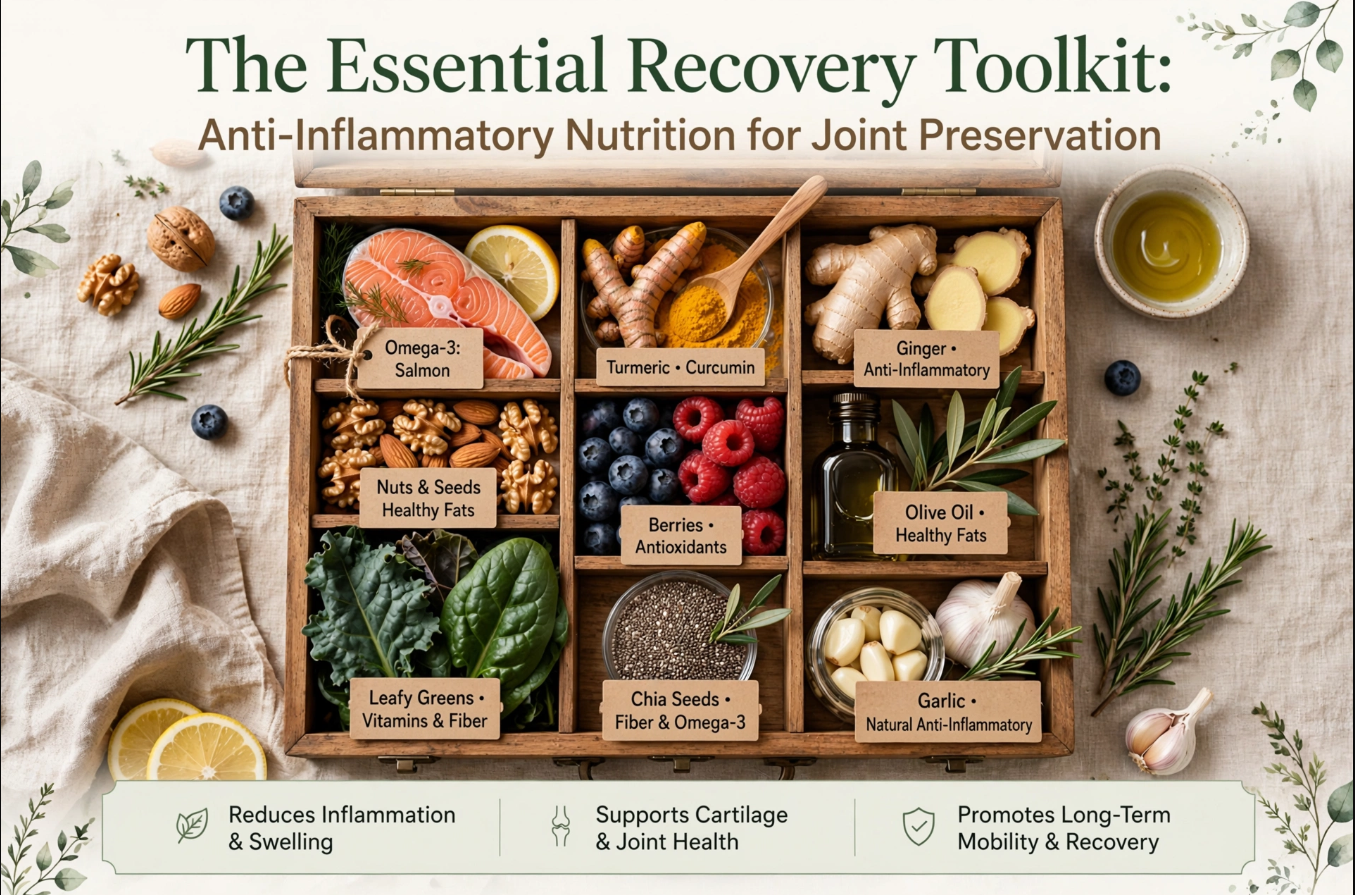
Chronic, low-grade systemic inflammation is the silent enemy of joint longevity. Unlike the acute inflammation that follows a sprained ankle—visible swelling, redness, heat—systemic inflammation simmers quietly throughout the body. It is fueled by processed foods, excess visceral fat, chronic stress, poor sleep, and the accumulated wear-and-tear of decades of living. This inflammatory background continuously degrades the cartilage matrix within your joints, weakens tendon insertions, and accelerates the breakdown of the very tissues you are working so hard to strengthen.
Omega-3 fatty acids, specifically eicosapentaenoic acid (EPA) and docosahexaenoic acid (DHA), are the most clinically validated nutritional tools for dampening this inflammatory fire. These long-chain fatty acids are precursors to specialized pro-resolving mediators (SPMs)—signaling molecules that actively turn off inflammation once its job is done. Without adequate EPA and DHA, the inflammatory response can become a chronic, smoldering burn that never fully resolves.
The Prescription:
- Source: Wild-caught cold-water fatty fish are the gold standard. Prioritize salmon, mackerel, sardines, herring, and anchovies. These fish consume algae rich in EPA/DHA and accumulate the fatty acids in their tissues without the heavy metal concerns of larger predatory fish like tuna.
- Dosage: Aim for a minimum of 2-3 servings per week. For those with diagnosed joint pain or inflammatory conditions, consider a high-quality fish oil or algae oil supplement providing a combined 2-3 grams of EPA/DHA daily, under medical supervision.
- Plant-Based Note: Flaxseeds, chia seeds, and walnuts provide alpha-linolenic acid (ALA), a precursor to EPA. However, the conversion rate of ALA to EPA in the human body is extremely inefficient (typically less than 5-10%). Plant sources are beneficial but should not be relied upon as the sole source of these anti-inflammatory fats.
The Direct Joint Benefit:
Multiple randomized controlled trials have demonstrated that consistent EPA/DHA supplementation reduces morning joint stiffness, decreases the production of cartilage-degrading enzymes, and lowers the need for non-steroidal anti-inflammatory drugs (NSAIDs) in individuals with osteoarthritis. This is not a marginal effect. This is a foundational recovery strategy.
Section 2: Collagen and Vitamin C — The Connective Tissue Repair Duo
Your tendons, ligaments, joint capsules, and the organic matrix of your bones are all built primarily from collagen—specifically Type I, Type II, and Type III collagen. As discussed in the Blueprint, collagen synthesis slows with age. But it does not stop. You can actively stimulate new collagen production by providing the specific amino acid building blocks and the essential enzymatic co-factors required for the process.
Collagen is uniquely rich in three amino acids: glycine, proline, and hydroxyproline. These are not abundant in typical muscle meats like chicken breast or steak, which are dominated by different amino acids. Consuming collagen peptides (hydrolyzed collagen) provides a concentrated source of these specific building blocks, flooding the bloodstream with the raw materials that fibroblasts need to weave new connective tissue.
However, collagen synthesis has a non-negotiable co-factor requirement: vitamin C. The enzymes that cross-link collagen fibers—prolyl hydroxylase and lysyl hydroxylase—require vitamin C as an electron donor. Without adequate vitamin C, collagen production grinds to a halt, no matter how many peptides you consume. This is the molecular reason why scurvy (severe vitamin C deficiency) causes connective tissue to literally fall apart.
The Synergy Protocol:
- Timing: Consume 10-15 grams of hydrolyzed collagen peptides 30-60 minutes before your functional training session. The exercise-induced blood flow to tendons and joints enhances the delivery of these amino acids directly to the tissues under repair.
- The Co-Factor: Pair this collagen dose with a source of vitamin C. This can be a whole food (one orange, a handful of strawberries, a kiwi, or sliced red bell pepper) or a 100-200mg supplement. The combination ensures that the synthetic machinery is fully fueled.
- Bone Broth Alternative: For those preferring whole-food sources, traditional bone broth simmered for 12-24 hours provides collagen, gelatin, glycine, and minerals. However, the amino acid concentration is significantly lower and more variable than a measured collagen peptide supplement.
Section 3: The “Protein+ Movement” Connection — Precision Pacing for Tissue Repair
In our previous discussions on protein requirements, we established the math: 1.6 to 2.0 grams per kilogram of body weight for active individuals over 40, spaced across 3-4 meals. Here, we connect that calculation directly to joint and tendon recovery.
When you perform functional resistance training—eccentric hamstring curls, loaded carries, single-leg glute bridges—you create microscopic damage within the muscle fibers and the collagen matrix of the attaching tendons. This is a desirable, adaptive stimulus. The body repairs this micro-damage by fusing new contractile proteins into the muscle and weaving new collagen fibrils into the tendon, making both structures stronger and more resilient than before.
This repair is driven by muscle protein synthesis (MPS), which spikes significantly within 30-90 minutes after training and remains elevated for up to 48 hours. However, MPS will not proceed at an optimal rate unless the bloodstream is flooded with essential amino acids, particularly leucine—the primary anabolic trigger.
The Leucine Threshold:
To maximally stimulate MPS after age 40, each meal must contain a leucine threshold of approximately 2.5-3 grams. This equates to roughly 30-40 grams of high-quality protein per serving. Meals that fall below this threshold provide maintenance-level nutrition but fail to trigger the amplified anabolic signal needed for repair and growth in the face of age-related anabolic resistance.
Practical Protein Pacing:
- Meal 1 (Breakfast): 3 whole eggs + 4 egg whites scrambled with spinach, or 1.5 cups of Greek yogurt with hemp hearts.
- Meal 2 (Lunch): 5-6 ounces of grilled chicken breast or wild salmon over a large bed of leafy greens with quinoa.
- Meal 3 (Post-Workout or Snack): A protein shake combining 30g whey or plant protein with collagen peptides and a banana.
- Meal 4 (Dinner): 6 ounces of lean red meat or tempeh stir-fry with a generous portion of cruciferous vegetables and sweet potato.
This pacing ensures that your joints, tendons, and muscles are bathed in a steady stream of amino acids throughout the day, keeping the repair machinery running at full capacity.
Section 4: The Deep Recovery — Sleep, Hydration, and Cortisol Management
Nutrition does not work in isolation. Two other recovery pillars either amplify or sabotage your nutritional efforts: sleep architecture and hydration status.
Sleep as a Hormonal Event:
Sleep is not merely the absence of wakefulness. It is an active, hormonally-choreographed reconstruction period. The first third of the night, dominated by slow-wave deep sleep, is when the pituitary gland secretes its largest pulses of growth hormone. This hormone travels through the bloodstream and stimulates the liver to produce IGF-1, which in turn drives protein synthesis and collagen repair in muscle, bone, and tendon.
If sleep duration is chronically shortened to 5-6 hours, these growth hormone pulses are blunted. Simultaneously, cortisol—the body’s primary catabolic stress hormone—becomes chronically elevated. Cortisol directly opposes the anabolic action of growth hormone and testosterone. It breaks down muscle protein into amino acids for glucose production and inhibits collagen synthesis. A poor night’s sleep creates a net catabolic state, eroding the very tissues you trained to build.
The Sleep Protocol:
- Duration: Prioritize 7-8 hours of sleep opportunity. This is non-negotiable for joint recovery.
- Timing: Aim for a consistent bedtime, ideally before 11 PM, to align with natural circadian rhythms of hormone secretion.
- Environment: A cool, pitch-black room supports melatonin production, which also possesses direct antioxidant and anti-inflammatory properties within joint tissues.
Hydration and Disc Health:
The intervertebral discs of your spine and the menisci of your knees are composed largely of water-bound proteoglycans. These structures lose water throughout the day under compressive load and rehydrate during rest. Chronic, low-grade dehydration—common in adults who rely on coffee and ignore plain water—prevents full overnight disc rehydration, leaving spinal discs thinner, less resilient, and more vulnerable to bulging. Aim for a baseline of 2-3 liters of water daily, increased on training days.
Section 5: The GLP-1 Nutrient Density Imperative
For the millions of men navigating weight loss with GLP-1 medications, the principles of this recovery toolkit shift from important to absolutely critical.
When caloric intake drops dramatically—often by 40-60% of previous levels—the sheer volume of micronutrients, amino acids, and essential fatty acids consumed also plummets. On a 1,200-1,500 calorie diet, there is zero room for empty calories. Every bite must be strategically dense.
The risk is a phenomenon called “high-quality weight loss with poor-quality nutrition,” where the scale drops but the body becomes deficient in the very nutrients required to maintain the joint and bone structure now carrying a lighter load.
The GLP-1 Recovery Checklist:
- Protein First: On a severely reduced appetite, consume your protein portion first at every meal. If you can only eat half of what is on your plate, ensure that half is the protein. Meet your 1.6-2.0 g/kg target even on low calories.
- Omega-3 Supplementation: If fish consumption drops due to early satiety or taste changes, a high-quality fish oil supplement becomes non-negotiable to maintain the anti-inflammatory shield.
- Collagen Coverage: A simple daily scoop of collagen peptides mixed into coffee, water, or a small smoothie ensures the connective tissue repair pathway remains fueled even when food volume is minimal.
- Hydration Amplification: GLP-1 medications slow gastric emptying and can suppress thirst cues alongside appetite. Deliberate, scheduled water intake is required to prevent the joint and disc dehydration that accelerates degeneration.
Section 6: Your Daily Recovery Stack Summary
To make implementation effortless, here is a simple daily checklist.
| Time | Action |
|---|---|
| Morning | 10-15g collagen peptides + vitamin C source (orange, kiwi, or supplement) |
| Breakfast | 30-40g high-quality protein (eggs, Greek yogurt, or protein smoothie) |
| Lunch | Lean protein + dark leafy greens + omega-3 rich dressing (walnut or flax oil) |
| Mid-Afternoon | 30g protein snack (edamame, cottage cheese, or quality shake) |
| Dinner | Fatty fish (2-3x/week) or lean protein + cruciferous vegetables |
| Evening | Wind-down routine; cool, dark bedroom; 7-8 hour sleep window |
| All Day | 2-3 liters of water |
Conclusion: Train Smart, Recover Smarter
The age-defying body is not built solely in the gym. It is built in the kitchen, in the bedroom, and in the quiet hours between workouts when the body’s silent repair crews are working their midnight shift. By providing your joints with the omega-3 fats that resolve inflammation, the collagen precursors that rebuild connective tissue, the precisely-spaced protein that fuels muscle repair, and the deep sleep that orchestrates the entire hormonal symphony, you transform recovery from a passive waiting period into an active, deliberate strategy. Train smart, but recover smarter. The longevity of your joints depends on it.