Author: Vigor Forty Editorial Team
Medically Reviewed By: Editorial Review Board
Disclaimer: This article is for informational purposes only and is not a substitute for professional medical advice. Read our full Medical Disclaimer.
📌 Key Takeaways
- The Desk-Bound Threat: Shortened psoas muscles from prolonged sitting rotate the pelvis, silently causing chronic back, knee, and neck pain.
- CARs (Controlled Articular Rotations): A simple daily 5-minute joint-sweeping routine hydrates the hip capsule and preserves range of motion more effectively than passive stretching.
- The 90-Degree Rule: Maintaining the ability to squat to parallel with a neutral spine is not a gym trick; it’s a non-negotiable biomarker for functional independence after 70.
- GLP-1 Companionship: During rapid weight loss, mobility work is essential to prevent muscle wasting in the hip girdle, preserving the power needed for stair climbing and safe walking.
Read Related Articles
- The Non-Negotiable Blueprint: How to Build an Age-Defying Body After 4
- Knee Longevity: 5 Non-Surgical Strengthening Protocols Your Orthopedic Surgeon Agrees With
- The Deep Core Canister: Building a Natural Back Brace from the Inside Out
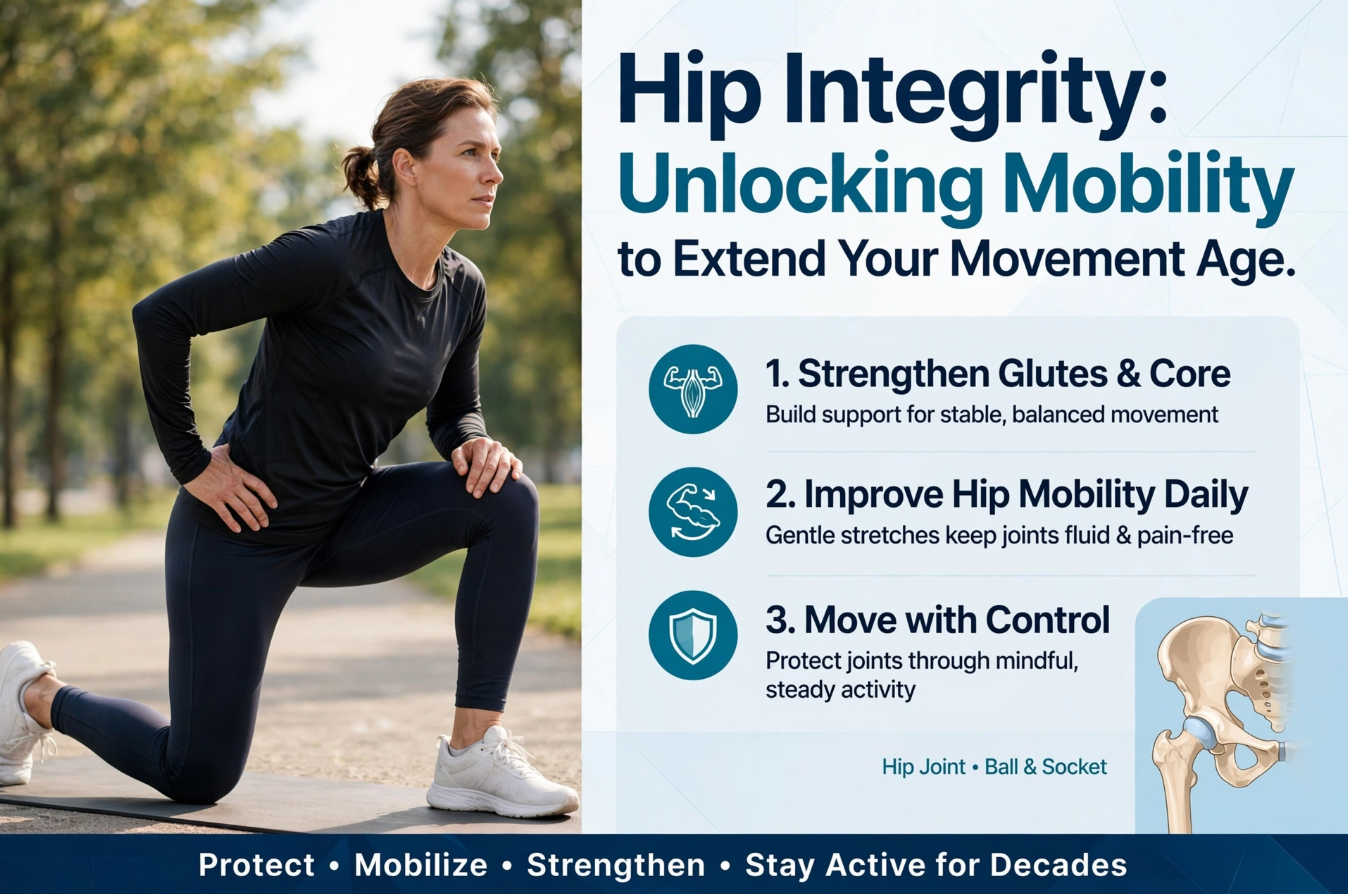
- Hip Integrity: Unlocking Mobility to Extend Your Movement Age
- Fast-Twitch After 50: Why Power (Not Just Strength) Prevents Falls
- The Essential Recovery Toolkit: Anti-Inflammatory Nutrition for Joint Preservation
Introduction: The Hips Are the Command Center
If the knees are the innocent victims of poor body mechanics, and the core is the protective canister, then the hips are the command center. They are the central junction where force transfers from your legs to your spine and where your ability to walk, squat, bend, and rotate originates. Healthy hips govern the alignment of everything above and below them.
Yet, for the modern man over 40, the hips have become a biological disaster zone.
The average American adult now spends 6.5 to 8 hours per day seated. In this prolonged flexed position, the powerful psoas major muscle—which runs from the lumbar spine, through the pelvis, and attaches to the top of the femur—shortens and thickens. A chronically tight psoas tilts the pelvis forward, compresses the lumbar discs, and forces the gluteal muscles into a stretched, inhibited state where they cannot fire properly.
This condition, clinically known as “Lower Crossed Syndrome,” is the hidden driver behind a cascade of seemingly unrelated problems: chronic low back tightness, anterior knee pain, plantar fasciitis, and even forward head posture. The hip command center is sending bad orders to the entire skeletal system, and the body is compensating its way toward injury.
Reclaiming hip integrity is not about achieving a yoga-level lotus pose. It is about restoring the fundamental, functional ranges of motion that allow you to tie your shoes without groaning, get down on the floor to play with a grandchild, and walk with a fluid, powerful stride rather than a shuffling gait.
Section 1: The Capsule Problem — Why Stretching Alone Fails
A critical distinction in functional anatomy is the difference between the hip joint capsule and the surrounding muscles. The joint capsule is a watertight, fibrous sac that surrounds the ball-and-socket joint. It contains the synovial fluid that lubricates the cartilage. When you don’t take your hip through its full range of motion regularly, this capsule shrinks and stiffens, like a plastic bag left in the sun. Muscles can be stretched, but a stiff capsule will not yield. It requires specific, slow, rotational pressure to remodel.
This is where Controlled Articular Rotations (CARs) become the most powerful tool in the age-defying arsenal. Popularized by functional range systems, CARs are not stretches; they are active, circular movements taken to the absolute furthest edge of your current range. You are using your own muscular strength to explore the boundaries of your joint capsule, signaling to your nervous system that this extreme range is safe and usable.
Protocol 1: The Standing Hip CAR (The Capsule Opener)
- Set-Up: Stand upright, holding onto a wall or chair for light balance. Elevate one knee toward your chest as high as possible.
- The Rotation: From this high-knee position, rotate the knee out to the side, opening the groin, and drive it back as if trying to point your knee behind you. Do not let your pelvis or low back move. The motion must be pure hip rotation.
- The Full Circle: From the back position, sweep the leg down and around in the widest circle you can create, returning to the starting high-knee position. Imagine drawing a giant circle with your knee on the wall beside you.
- Target: 3 slow, maximally controlled circles in each direction, per leg. Pause briefly at any “sticky” or pinching spots and breathe into them. This is you physically scraping the capsule back into its original capacity. Perform this daily, ideally in the morning to clear overnight stiffness.
Section 2: The Psoas Release — Freeing the Anterior Chain
After mobilizing the capsule, the next priority is quieting the overactive anterior hip muscles, specifically the psoas and rectus femoris (the central quadricep that crosses the hip joint). A common mistake is aggressively stretching a chronically tight psoas with deep lunges, which can trigger a protective stretch reflex and cause the muscle to tighten further. A more effective neurological approach is a contract-relax sequence.
Protocol 2: The Active Psoas Lengthener (Thomas Test Position)
- Set-Up: Lie on your back at the edge of a bed or high table. Hug one knee tightly to your chest. Allow the other leg to hang freely off the edge. If the hanging leg’s thigh cannot fall below parallel to the floor, your psoas is pathologically tight.
- The Activation: Press the heel of the hanging leg down toward the floor with about 20% effort, as if trying to push a pedal. Contract the psoas and quad for 10 seconds.
- The Release: Exhale deeply and completely relax the leg. It should drop a few degrees lower. The brain, having just signaled the muscle to contract, is now willing to grant a deeper relaxation response.
- Target: 3 contract-relax cycles per leg. Follow this immediately with a gentle, passive lunge to integrate the new range, keeping the back glute squeezed to protect the lumbar spine.
Section 3: The 90-Degree Rule — The Biomarker of Independence
There is a stark correlation between hip mobility and all-cause mortality in aging populations. Studies on longevity have consistently demonstrated that the ability to sit down and rise from the floor without using hands—the “Sitting-Rising Test”—is a powerful predictor of survival in middle-aged and older adults.
This test is fundamentally a hip mobility and leg strength assessment. To descend to the floor and rise again with control, you must have sufficient hip flexion, internal and external rotation, and the strength to lower and elevate your body mass. This is not a party trick; it is the ultimate functional biomarker.
The gateway to this skill is rebuilding a comfortable, deep resting squat position—often called the “Asian squat” or primal squat. Many Western adults lose this ability by age 10, trading it for chair dependence.
Protocol 3: The Supported Primal Squat (The Hip Prying Drill)
- Set-Up: Stand with feet slightly wider than hip-width, holding onto a sturdy doorknob, TRX straps, or a railing in front of you. Use your arms for assistance, taking much of your body weight.
- The Descent: Slowly lower your hips straight down toward your heels, driving your knees outward with your elbows to open the groin. Your objective is not to drop straight down; it’s to sink the hips between the legs. Let your lumbar spine round gently—this is a resting posture, not a loaded lift.
- The Prying: At your deepest comfortable point, shift your weight gently from foot to foot. Rock forward to stretch the Achilles and back to sink deeper into the hips. Take 5 deep, diaphragmatic breaths here, allowing the pelvis to relax fully.
- Target: 2 minutes of accumulated time in this assisted squat, daily. Over weeks, reduce the arm assistance until your body weight holds you in the bottom position with heels down and no hand support. This alone can add years of functional independence to your life.
Section 4: Strengthening the New Range — The Glute Bridge Progression
Mobility without strength is instability. Once the hips can access a new range of motion, the musculature must be trained to control it. The posterior chain—glutes and hamstrings—must learn to pull the hip into full extension, counteracting the years of sitting-induced flexion dominance.
Protocol 4: Single-Leg Elevated Glute Bridge with Hip Circle
- Set-Up: Lie on your back, heels on a couch or low bench, a resistance band just above your knees. Extend one leg straight.
- The Cue: Before lifting, press the knee of the extended leg toward the wall. This activates the antagonist hip flexor, which neurologically signals the glute on the working side to fire harder (reciprocal inhibition).
- The Lift: Drive through the heel of the working leg and lift your hips until your body forms a straight line. Do not hyperextend the low back; squeeze the glute so hard it cramps. At the top, your hips should be fully open, perpendicular to the ground.
- Target: 3 sets of 12 slow, controlled reps per leg, with a 3-second hold at the top. This isolates and builds the hip extension power that translates directly to a stronger, faster walking stride and effortless stair climbing.
Section 5: The GLP-1 Hip Preservation Priority
As discussed in our previous articles, the dramatic caloric deficits created by GLP-1 weight-loss medications pose a specific threat to the hip girdle. The gluteus maximus is the largest, most metabolically active muscle in the human body. During rapid weight loss, a non-selective catabolic state can siphon amino acids from this massive depot, literally shrinking the muscle that powers locomotion.
A shrinking glute is not just a cosmetic concern. It destabilizes the pelvis, causing a Trendelenburg gait—a side-to-side waddling walk that places shearing stress on the lumbar spine and the knee’s medial collateral ligament. For men on a medically supervised weight loss journey, preserving hip strength and mobility through the protocols outlined here is not supplementary; it is a core component of safe, functional transformation. You must feed the hips with targeted protein and challenge them with loaded extension to signal to your body, “This tissue is metabolically essential; preserve it at all costs.”
Section 6: The 5-Minute Morning Hip Flow
Consistency trumps intensity for hip longevity. Below is a daily flow that can be performed in five minutes before your morning shower to set the tone for a pain-free day.
- Standing Hip CARs (1 minute): 3 slow circles per direction, each leg.
- Kneeling Psoas Contract-Relax (1 minute): 2 cycles per side.
- Supported Primal Squat Pry (2 minutes): Accumulate depth and breath.
- Standing Glute Squeeze Hold (1 minute): Stand tall, squeeze both glutes maximally for 10-second holds. This re-engages the posterior chain after the squat’s flexed position and reinforces the upright posture for your day.
Conclusion: The Mobility Investment
Hip integrity is a use-it-or-lose-it proposition. Every day you sit for prolonged periods without taking your hip joints through their full functional arc, you deposit a small withdrawal from your mobility bank account. Every daily 5-minute CAR and primal squat session is a deposit that earns compound interest. The goal is not to become a contortionist; the goal is to arrive at age 80 still able to rise from a chair with power, walk a golf course without pain, and sit cross-legged on the floor with your grandchildren. That future is built, one slow, intentional hip circle at a time.