

Author: Vigor Forty Editorial Team
Medically Reviewed By: Editorial Review Board
Disclaimer: This article is for informational purposes only and is not a substitute for professional medical advice. Read our full Medical Disclaimer.
Key Takeaways
- The Mind-Body Bridge: Psychoneuroimmunology (PNI) is the scientific study of how your psychological state directly interacts with, alters, and dictates your nervous, endocrine, and immune systems.
- Immune Cell Paralysis: Sustained, high levels of cortisol bind directly to white blood cells (lymphocytes), suppressing their ability to multiply and fight off viral or bacterial infections.
- The Healing Deliberation: Chronic stress diverts cellular energy away from long-term tissue repair and immune surveillance to prioritize immediate, short-term physical survival.
- Clinical Alignment: The National Institutes of Health (NIH) and the British Society for Immunology recognize that psychological stress significantly reduces vaccine efficacy and delays wound healing timelines.
Read Related Articles:
- The Cortisol Reset Protocol
- The Anatomy of Breathwork
- Meditation for the Stressed Brain
- The Vagal Tone: Your Nervous System’s Volume Knob
- The Circadian Stress Connection
- The Gut-Brain Axis: Neurochemistry of Stress
- Hormesis: Building Stress Resilience Through Physical Adversity
- Neuro-Architecture: Designing Spaces to De-Excite the Amygdala
- Social Jetlag and Chrono-Stress
- Digital Dopamine Detox: Rewiring the Attention-Stressed Brain
- Psychoneuroimmunology: How Stress Paralyzes Your Immune System
- Autophagy: The Cellular Housekeeping of Stress Recovery
- Decision Fatigue and Executive Stress
- Epigenetics: Rewriting Your Inherited Stress Response
- The Endocannabinoid System: The Body’s Equilibrium Engine
Introduction: The Biological Cost of Worry
We are used to thinking of the mind and the body as completely separate entities. We treat psychological worry with therapy or meditation, and we treat physical sickness with medication or rest. However, your immune cells do not recognize this boundary. To your white blood cells, a bitter thought, a stressful work deadline, and a physical virus look completely identical.
Data from the field of psychoneuroimmunology (PNI) reveals that psychological stress is a potent immunomodulator. When you live in a state of persistent emotional strain, your brain sends chemical messages that physically alter your immune response. This is not a metaphor; it is a direct physiological mechanism. To build robust, long-term immunity, we must understand the precise pathways through which stress renders us vulnerable to illness.
Section 1: The Cellular Mechanics of Stress-Induced Immunity Deficits
Your immune system relies on a complex army of specialized cells—such as T-cells, B-cells, and Natural Killer (NK) cells—to patrol your body, identify mutated cells, and neutralize pathogens. When your brain perceives a psychological threat, it activates the sympathetic nervous system, shifting your cellular priority from maintenance to defense.
If this survival state becomes chronic, it degrades your immune defenses across three distinct pathways:
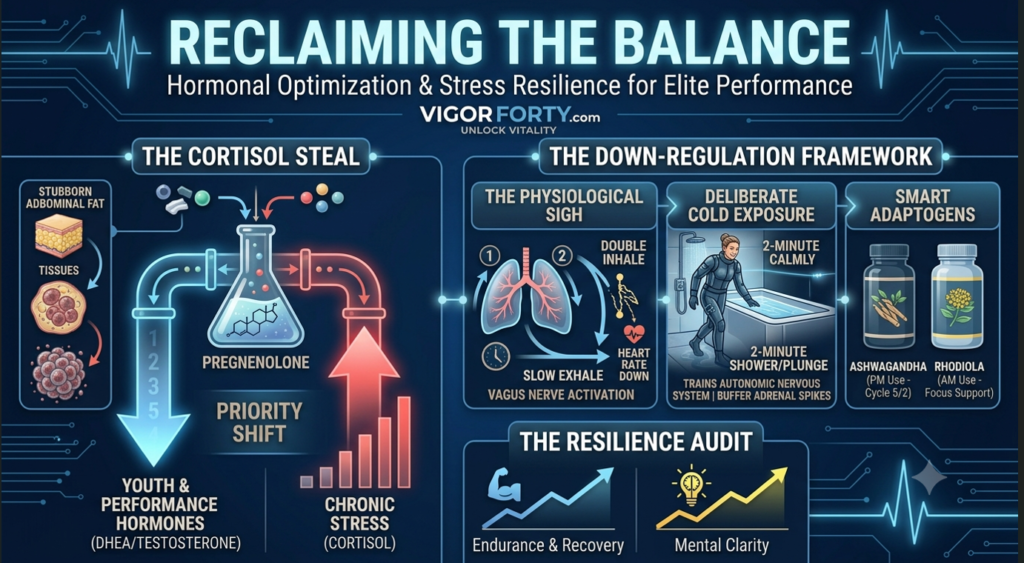
- Lymphocyte Down-Regulation: Cortisol is an inherently immunosuppressive hormone. When cortisol levels remain elevated, it floods the receptor sites on your lymphocytes. This stops them from communication properly, effectively paralyzing your body’s front-line defense against common respiratory infections.
- Pro-Inflammatory Cytokine Dysregulation: Under normal conditions, your body uses short-term inflammation to heal wounds. However, chronic stress desensitizes immune cell receptors to cortisol’s regulatory signals. The immune system goes haywire, overproducing pro-inflammatory cytokines that drive up systemic, low-grade joint and arterial inflammation.
- Telomere Atrophy: Chronic psychological distress accelerates the shortening of telomeres—the protective caps on the ends of your chromosomes. When telomeres become too short, immune cells can no longer divide to protect the body, effectively accelerating the biological aging of your entire immune apparatus.
Section 2: Immunological Protection Matrix (Visual Resiliency Swaps)
Protecting your immune health from stress-induced decline requires moving away from superficial immune-boosting trends and focusing on habits that lower nervous system distress.
The table below details strategic lifestyle adjustments to actively shield your immune cells from chronic stress hormones:
| Immune-Depleting Stress Habit | Neuro-Protective Immune Swap | Why It Matters |
| Pushing through intense, exhaustive workouts while deeply burned out | Shifting to gentle, restorative movement like yoga, walking, or tai chi | Intense exercise on top of high psychological stress overloads the HPA axis, driving cortisol higher and suppressing immune function for up to 24 hours. Restorative movement lowers cortisol while circulating immune cells. |
| Isolating yourself socially when feeling overwhelmed by life | Scheduling a brief, meaningful conversation with a trusted friend or loved one | Chronic loneliness stimulates a specific genetic pattern in white blood cells that increases inflammation. Positive social connection releases oxytocin, which calms the amygdala. |
| Suppressing or ignoring emotional anger, grief, or frustration | Utilizing expressive writing or journaling for 15 minutes to process emotions | Suppressing intense emotions keeps your autonomic nervous system in a constant state of tension. Writing down feelings helps organize thoughts, reducing baseline physiological stress. |
| Relying on high-dose Vitamin C supplements to override chronic fatigue | Focusing on a consistent, dark bedroom environment to optimize deep sleep | Supplements cannot override the damage of poor sleep. Deep sleep is when your body produces cytokines and stores immunological memories, making it the ultimate non-negotiable immune regulator. |
Section 3: The Medical Block (NIH & Immunological Consensus)
The clinical validation of psychoneuroimmunology has firmly established emotional management as a foundational requirement for immune and longevity protocols.
The National Institutes of Health (NIH)
The NIH’s clinical research initiatives highlight that long-term stress exposure significantly impairs the body’s ability to mount an immune response. Their clinical briefs confirm that psychological distress directly correlates with delayed dermal wound healing and diminished antibody responses to medical vaccinations. The federal agency formally advocates for incorporating cognitive stress-reduction protocols within standard immunological and surgical recovery treatments.
The British Society for Immunology
Clinical positions published by the British Society for Immunology demonstrate that chronic nervous system activation shifts the body’s white blood cell distribution patterns unfavorably. Their research frameworks explicitly link sustained stress to an increased susceptibility to autoimmune flare-ups and chronic viral reactivation. Clinical consensus emphasizes that balancing autonomic nervous system tone is mandatory to maintain long-term immune system integrity.