
Author: Vigor Forty Editorial Team
Medically Reviewed By: Editorial Review Board
Disclaimer: This article is for informational purposes only and is not a substitute for professional medical advice. Read our full Medical Disclaimer.
Key Takeaways
- The Master Clock: Your brain houses a master clock called the Suprachiasmatic Nucleus (SCN), which uses environmental light cues to time the daily release of stress and sleep hormones.
- The Evening Cortisol Trap: Exposure to artificial blue light between 10:00 PM and 4:00 AM suppresses melatonin production and creates abnormal spikes in nighttime cortisol.
- The Temperature Anchor: Your body must drop its core temperature by roughly 2°F to trigger deep, stress-reducing slow-wave sleep.
- Clinical Alignment: The National Sleep Foundation and the Lancet Neurology formally connect disrupted circadian rhythms to a compromised immune system, accelerated aging, and chronic mental burnout.
Read Related Articles:
- The Cortisol Reset Protocol
- The Anatomy of Breathwork
- Meditation for the Stressed Brain
- The Vagal Tone: Your Nervous System’s Volume Knob
- The Circadian Stress Connection
- The Gut-Brain Axis: Neurochemistry of Stress
- Hormesis: Building Stress Resilience Through Physical Adversity
- Neuro-Architecture: Designing Spaces to De-Excite the Amygdala
- Social Jetlag and Chrono-Stress
- Digital Dopamine Detox: Rewiring the Attention-Stressed Brain
- Psychoneuroimmunology: How Stress Paralyzes Your Immune System
- Autophagy: The Cellular Housekeeping of Stress Recovery
- Decision Fatigue and Executive Stress
- Epigenetics: Rewriting Your Inherited Stress Response
- The Endocannabinoid System: The Body’s Equilibrium Engine
Introduction: The Misaligned Body
Every single cell in your body runs on an internal, 24-hour biological clock. This circadian rhythm determines when your blood pressure peaks, how efficiently your cells burn glucose, and how your brain processes psychological stress.
Data shows that modern society is suffering from a massive systemic misalignment. By living under constant artificial lighting, eating late into the night, and skipping morning sunlight, we disorient our internal master clock. This disorientation causes your body to secrete cortisol at the wrong times—leaving you exhausted during the day when you need to be sharp, and wide awake at night when your brain needs to repair itself. To conquer stress, we must synchronize our lifestyle with our biology.
Section 1: The Hormonal See-Saw of Light and Dark
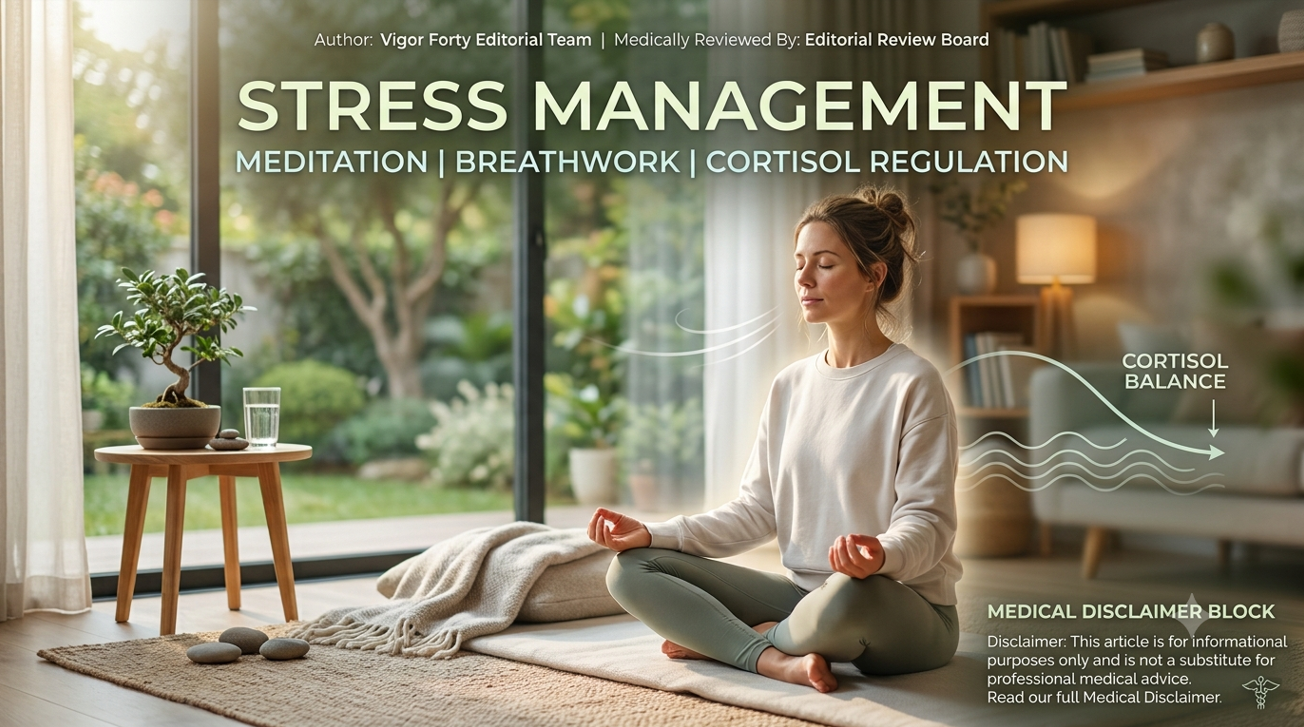
Your stress levels and your sleep habits are governed by an elegant, hormonal see-saw involving two primary chemicals: Cortisol and Melatonin.
In a healthy system, these hormones operate in strict opposition:
- The Morning Spike: As the sun rises, your master clock signals the adrenal glands to release a massive wave of cortisol. This is known as the Cortisol Awakening Response (CAR). It clears out residual grogginess, sharpens focus, and kickstarts your metabolism.
- The Nighttime Drop: As natural light fades, cortisol production should plummet to zero. This allows the pineal gland to flood your system with melatonin—the powerful antioxidant hormone responsible for putting you into deep, restorative sleep.
When you disrupt this see-saw with artificial stress—such as checking a stressful work project under bright fluorescent lights late at night—you trigger an artificial cortisol spike. This instantly suppresses melatonin, keeping your body trapped in an unremitting state of survival mode during its critical recovery window.
Section 2: The Circadian Realignment Protocol (Visual Schedule Guide)
Re-anchoring your master biological clock doesn’t require complex medical procedures. It relies on consistent, environmental anchors that signal time-of-day directly to your brain.
The table below provides simple, strategic adjustments to realign your daily habits with your internal biological clock:
| Current Disrupted Routine | Circadian-Aligned Swap | Why It Matters |
| Eating a heavy, carbohydrate-dense snack at 10:30 PM | Closing your kitchen by 8:00 PM (at least 3 hours before sleep) | Late-night digestion forces insulin and cortisol up, preventing your core body temperature from dropping and disrupting your deep sleep stages. |
| Keeping your bedroom warm and brightly lit until bedtime | Dropping the thermostat to 65–68°F and switching to warm, dim floor lamps | A cool environment mimics the natural outdoor drop in temperature, signaling to the brain that it is safe to down-regulate and rest. |
| Staying indoors or behind glass windows all morning | Stepping outside for 10 minutes of unfiltered outdoor light before 9:00 AM | Even on a cloudy day, outdoor light is thousands of lux brighter than indoor lighting. This resets your master clock and establishes a healthy hormone timeline. |
| Using your phone at full brightness to wind down in bed | Putting on blue-light blocking glasses or turning your screens to a deep red hue | Eliminates high-frequency blue wavelengths that tell your brain’s master clock that it is noon, completely preserving your natural melatonin production. |
Section 3: The Medical Block (Sleep Foundation & Lancet Findings)
The synchronization of our biology to natural environmental cycles is recognized by leading global medical institutions as a prerequisite for long-term health.
The National Sleep Foundation
The National Sleep Foundation’s clinical directives state that circadian integrity is directly tied to neural health and emotional resilience. Their research emphasizes that individuals with fractured sleep schedules exhibit a hyper-reactive emotional response due to compromised communication between the prefrontal cortex and the amygdala. The foundation advocates for strict environmental hygiene to protect the body’s natural hormonal timelines.
The Lancet Neurology
Long-term epidemiological studies published in The Lancet Neurology explicitly link chronic circadian disruption to accelerated neurodegenerative decline, severe metabolic dysfunction, and mood disorders. Clinical consensus dictates that optimizing your sleep-wake architecture through targeted lifestyle anchors is an essential clinical component for treating chronic stress, mitigating systemic inflammation, and ensuring long-term neurological health.