
We live in an era of unprecedented cognitive hijacking. You sit down to tackle a highly important, complex project—writing a report, learning a new skill, or analyzing data. Within minutes, an invisible pull tugs at your attention. You check your phone, open a new browser tab, check your metrics, or grab a snack.
When you try to force your mind back to the task, it feels physically uncomfortable. The task itself feels dull, agonizing, and impossibly heavy.
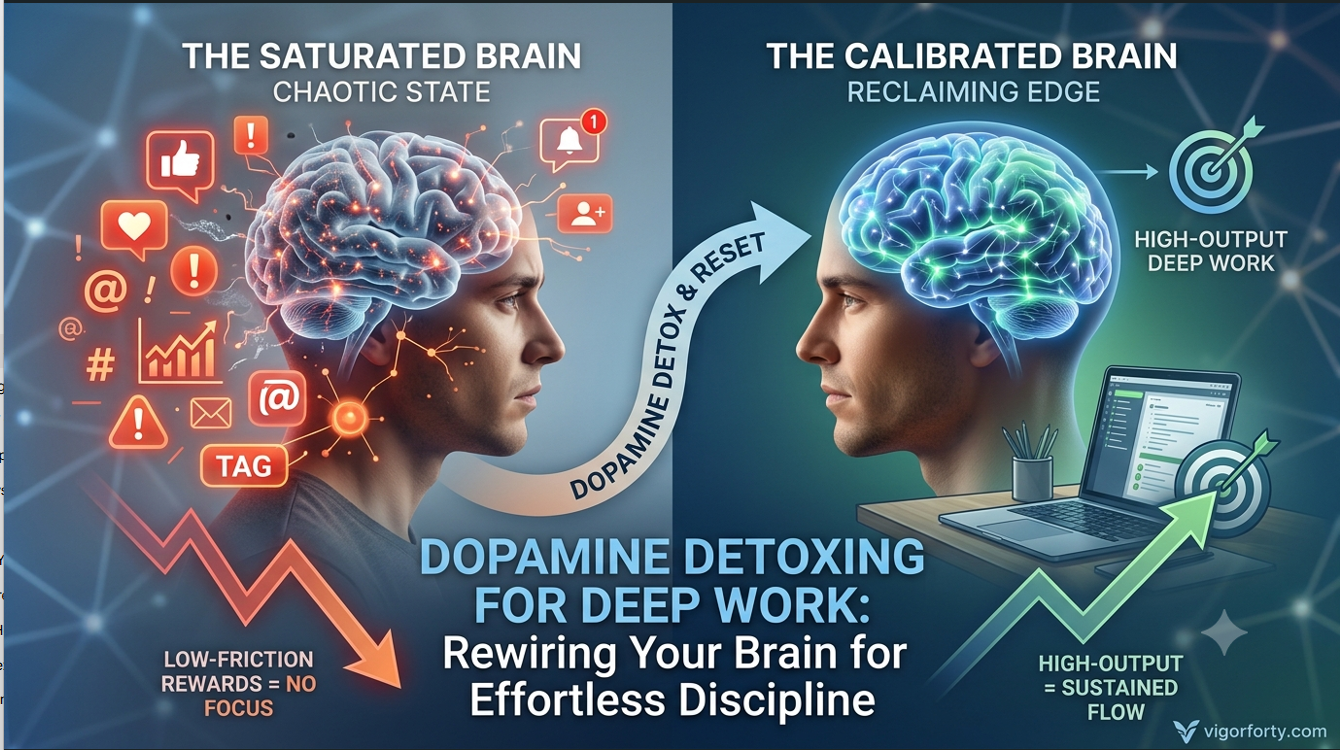
This isn’t a lack of discipline or a flaw in your work ethic. It is a state of neurological saturation. Your brain has been conditioned by an environment of hyper-stimulation, rendering normal, deeply productive tasks unappealing.
To reclaim your edge, you don’t need more motivation. You need a structural reset of your brain’s primary driver: dopamine.
1. The Dopamine Myth: It’s Not About Pleasure
To successfully optimize your brain for deep work, you must first understand what dopamine actually does. Most popular media describes dopamine as the “pleasure molecule.” This is scientifically incorrect.
Dopamine is the molecule of anticipation, motivation, and pursuit. It rises not when you receive a reward, but when you are seeking it. It is the chemical engine that drives you to act.
[Baseline Dopamine] ──> High-Stimulus Trigger (Social Media/Notifications) ──> [Massive Peak]
                                                                                      │
[Inability to Focus on Hard Tasks] <── [Below-Baseline Dip] <─────────────────────────┘
Your brain maintains a constantly fluctuating pool of this chemical, known as your dopamine baseline. When you experience a high-stimulus event—like checking a smartphone notification, playing a video game, or eating highly processed sugar—your brain experiences a massive dopamine spike.
The biological law of homeostasis dictates that every spike must be followed by an equal and opposite crash. Following a massive surge, your dopamine drops below its baseline level. When your dopamine is depleted, ordinary, low-stimulus tasks—like reading a book or writing code—feel entirely unrewarding. Your brain enters a state of artificial boredom, desperately craving another quick spike to escape the deficit.
2. The Science of High-Friction Tasks
Why does your brain fight you when you attempt “Deep Work”? Deep work is, by definition, a high-friction task. It requires intense concentration, sustained neural firing, and delayed gratification.
When your dopamine baseline is chronically depleted by low-friction rewards (like infinite scrolling on social media), the neural pathways governing your prefrontal cortex lose their driving force.
| Task Type | Cognitive Friction | Dopamine Dynamics | Long-Term Brain Impact |
| Low-Friction (Digital Distractions) | Extremely Low | Immediate, massive spikes followed by steep baseline drops. | Eradicates attention span; induces chronic restlessness. |
| High-Friction (Deep Work/Study) | High | Slow, metered, sustained release over hours. | Stabilizes baseline dopamine; strengthens neural pathways for focus. |
To make your brain enjoy—and even crave—high-friction tasks, you must intentionally lower the environmental stimulation around you. This drops your brain’s reward threshold, allowing ordinary levels of dopamine to feel highly motivating once again.
3. The VigorForty Deep Work Reset Protocol
A true “dopamine detox” does not mean turning off your brain or living like a monk. It means systematically eliminating low-friction dopamine traps to restore your baseline focus. Implement this practical framework to prime your brain for high-output deep work.
Step 1: The 90-Minute Morning Fast
The first hour of your day sets your dopamine baseline for the entire afternoon. If you check your smartphone immediately upon waking, you introduce a massive wave of synthetic stimulation before your feet even touch the floor.
- The Action: For the first 90 minutes of your day, do not check social media, news outlets, or personal messaging apps. Dedicate this window to hydration, natural morning light, and your highest-priority, high-friction cognitive task.
Step 2: Introduce Environmental Friction
Willpower is a finite resource. Instead of fighting temptation, eliminate it. If a distraction is physically close to you, your brain expends continuous, unconscious energy resisting it.
- The Action: When entering a deep work block, place your smartphone in another room completely out of sight. Use website blockers to restrict access to distracting tabs. By forcing your brain to exert high physical effort to get a cheap distraction, you break the automated craving loop.
Step 3: Embrace “Boredom Micro-Breaks”
When you hit a difficult patch in your work, your natural instinct is to reach for a distraction to relieve the mental strain. This rewards your brain for giving up.
- The Action: When you feel stuck, sit still and do absolutely nothing for 2 to 3 minutes. Stare at the wall or close your eyes. This brief window of absolute boredom drops your stimulation levels, allowing your brain to reset and re-engage with the task at hand with renewed clarity.
4. References & Scientific Frameworks
To maintain absolute authoritative integrity, this protocol is anchored in established neurobiological research:
- Dopamine Dynamics and Baseline Reward Circuitry: Schultz, W. (2015). Neuronal Reward and Decision Signals: From Theories to Data. Physiological Reviews.
- Cognitive Friction and Attention Retention: Newport, C. (2016). Deep Work: Rules for Focused Success in a Distracted World. Behavioral Architecture Analysis.
- Homeostasis and the Pain-Pleasure Balance: Lembke, A. (2021). Dopamine Nation: Finding Balance in the Age of Indulgence. Neuroscience of Addiction and Focus Over-saturation.
Read Related Articles
- The Anatomy of Brain Fog: Why You Feel Sluggish and How to Reset in 24 Hours
- The Glucose Rollercoaster: How Blood Sugar Spikes Are Sabotaging Your Afternoon Focus
- Sleep Architecture and Clarity: The Exact Nighttime Routine to Prevent Morning Brain Fog
- Dopamine Detoxing for Deep Work: Rewiring Your Brain to Love Hard Tasks
- The Science of Flow State: Neurochemicals Needed to Trigger Peak Concentration
- The VigorForty Focus Protocol: A Step-by-Step Daily Routine for Uninterrupted Work
- Working Memory vs. Long-Term Storage: How Your Brain Decides What to Keep