Author: Vigor Forty Editorial Team
Medically Reviewed By: Editorial Review Board
Disclaimer: This article is for informational purposes only and is not a substitute for professional medical advice. Read our full Medical Disclaimer.
📌 Key Takeaways
- Not All Stretches Are Safe After 40: The lumbar spine undergoes degenerative changes—disc dehydration, facet joint arthritis, and spinal stenosis—that make traditional “hamstring” and “back” stretches dangerously compressive or shearing.
- The Standing Toe-Touch Is a Disc Bulge Waiting to Happen: Flexing the spine under load (even just your torso weight) maximizes intradiscal pressure and can squeeze the nucleus pulposus posteriorly toward the spinal nerves.
- The Hurdler’s Stretch (Sitting Toe-Touch) Shears the Sacroiliac Joint: This asymmetrical position places immense torque on the SI joint and the lumbar facet joints, often triggering sciatica or SI joint dysfunction in susceptible individuals.
- The Yoga Plough Pose (Halasana) Is a Cervical and Lumbar Nightmare: Forcing a compressed neck flexion while simultaneously loading the lumbar spine is a recipe for nerve root impingement and ligamentous strain—especially if you have undiagnosed cervical spondylosis.
- The Fix: Replace spinal flexion with spinal extension (McKenzie press-ups), segmental cat-camel (not the full yoga version), and gentle rotation that avoids end-range compression. Stability, not mobility, is the key to a pain-free 50s and 60s.
Introduction: The Stretch That Cripples
There is a cultural obsession in America with “stretching out” a sore lower back. If it hurts, we bend over and try to pull it loose. High school gym class taught us toe-touches. Yoga studios popularized the Plough. Physical therapy handouts from the 1980s prescribed the sitting hurdler’s stretch for “hamstring tightness.”
Here is the brutal truth: The lumbar spine is not a rope; it is a load-bearing column. After 40, the intervertebral discs lose hydration and become less resilient to compression. The facet joints (the small hinges at the back of the spine) develop osteoarthritis. The ligaments that stabilize the spine lose elasticity.
When you aggressively flex (bend forward) or twist under load, you are not “releasing tension.” You are pinching facet joints, stretching the posterior longitudinal ligament, and potentially forcing the disc’s gelatinous center (nucleus) backward—directly toward the spinal cord and nerve roots.
This article identifies the three most dangerous stretches still commonly performed by Americans over 40—and provides safer, evidence-based alternatives that actually reduce pain by stabilizing rather than mobilizing the spine.
Section 1: The Biomechanics of the Aging Spine (A Quick Primer)
Before we name names, you must understand what happens to your spine between 40 and 60.
Disc Degeneration:
The intervertebral disc is 80% water at age 20. By age 50, that drops to ~65%. The outer annulus (the fibrous ring) develops micro-tears. Flexion (bending forward) increases pressure on the anterior (front) of the disc and stretches the posterior (back) annulus. If that annulus is already compromised, repeated flexion can cause a disc bulge or herniation.
Facet Joints:
These are the small synovial joints at the back of the spine. They are weight-bearing in extension (leaning back). But in flexion with rotation, they get compressed and pinched, leading to sharp, localized pain.
Spinal Stenosis:
The central canal and the foramina (the holes where nerves exit) narrow with age due to bone spurs and ligament hypertrophy. Extending the neck (looking up) or flexing the lower back can compress these already-tight spaces, causing radiating leg pain (neurogenic claudication).
The Golden Rule After 40: “If it pinches or compresses, it’s out. If it stabilizes and mobilizes gently, it’s in.”
Section 2: Worst Stretch #1—The Standing Toe-Touch (Forward Fold)
Why you do it: You think your hamstrings are tight. You want to “release” your lower back.
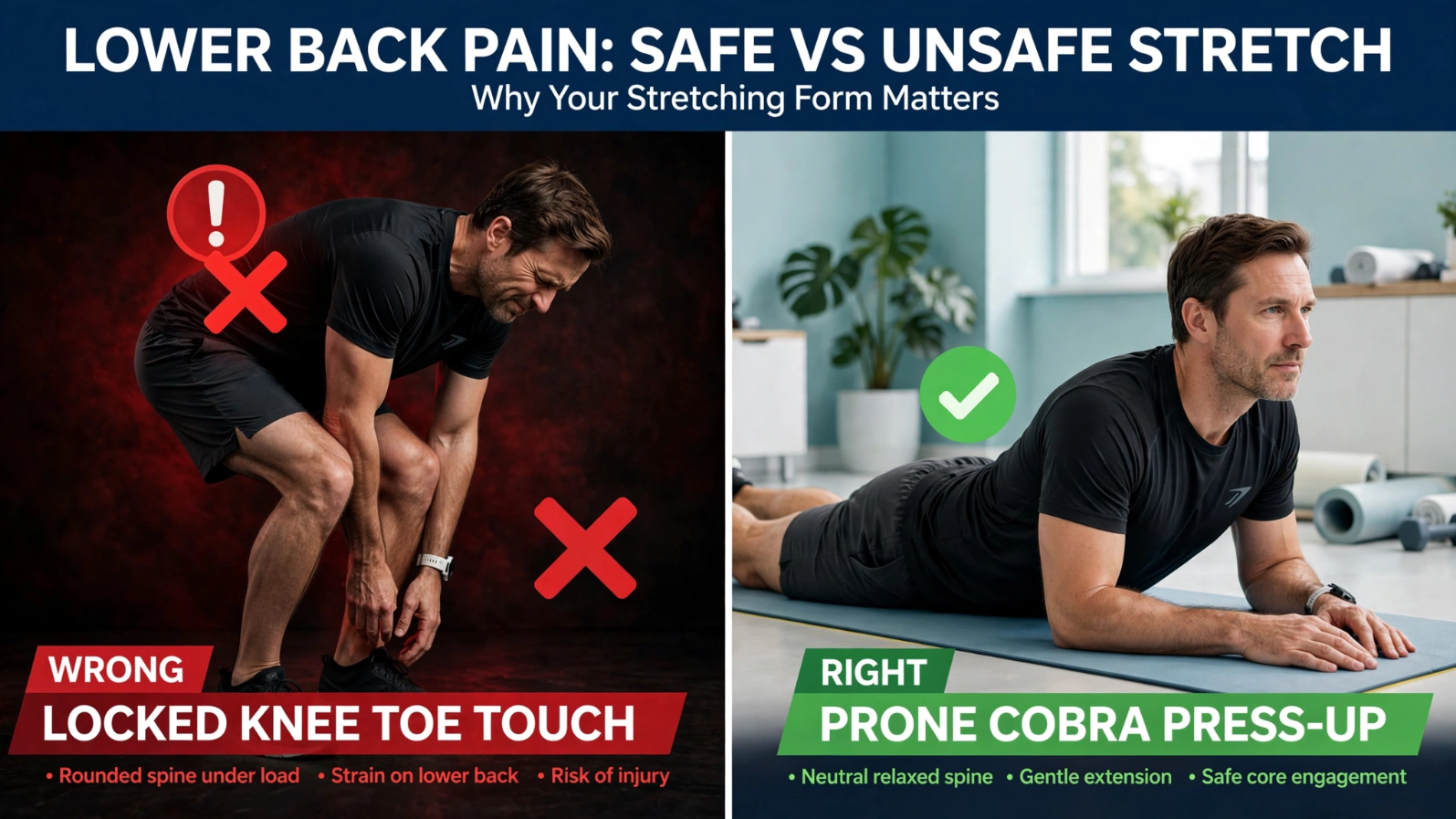
Why it is dangerous: When you bend at the waist with locked knees, you lose the lumbar lordosis (the natural inward curve). Your spine goes into full flexion. The intradiscal pressure in the L4-L5 and L5-S1 segments spikes dramatically. If you have a pre-existing annular tear, the nucleus pulposus is squeezed backward like toothpaste from a tube—directly toward the sciatic nerve roots.
The Statistics:
A 2015 study published in Spine demonstrated that lumbar flexion under load (even just body weight) increases posterior disc pressure by over 100% compared to standing upright. Repeated toe-touches are a primary driver of recurrent disc bulges in the 40–55 demographic.
The Safer Alternative: The “McKenzie Press-Up” (Prone Extension)
This is the gold standard for discogenic pain. It encourages the disc nucleus to migrate anteriorly (away from the nerves).
- How: Lie on your stomach. Place your forearms on the floor under your shoulders. Gently press up, straightening your elbows, allowing your lower back to sag into extension. Keep your hips glued to the floor. Hold for 5 seconds, then lower.
- Sets: 10 repetitions, performed every 2 hours during a flare-up.
- Why: This centralizes pain (pulls it from the leg into the back), which is a positive sign. It improves disc nutrition by alternating pressure gradients.
Section 3: Worst Stretch #2—The Hurdler’s Stretch (Sitting Toe-Touch)
Why you do it: You sit on the floor, one leg straight, the other bent, and reach for your toes. It feels like a deep hamstring and lower back pull.
Why it is dangerous: This stretch combines flexion + rotation + asymmetry. The pelvis is not neutral. One side of the sacrum is fixed, the other is free. When you fold forward in this position, you place massive asymmetrical torque on the Sacroiliac (SI) joint and the lumbosacral facet joints.
The Mechanism of Injury:
The SI joint has very little movement (only 2–4 degrees). When you force a forward fold with one leg bent, you shear the joint surfaces against each other. For individuals with pre-existing SI joint laxity (common after 40 due to hormonal changes and ligamentous laxity), this can trigger acute SI joint dysfunction—a sharp, stabbing pain just above the buttock that mimics sciatica.
The Safer Alternative: The “Seated Figure-4” Stretch (Piriformis Focus)
This targets the gluteal muscles (which often refer pain to the back) without compromising lumbar posture.
- How: Sit on a chair with a tall spine, feet flat on the floor. Cross your right ankle over your left knee (Figure-4). Keeping your back perfectly straight, gently lean forward from the hips until you feel a stretch in your right glute. Do not round your back.
- Sets: Hold for 30 seconds, 2–3 times per side.
- Why: This isolates the external rotators of the hip without loading the lumbar discs. It respects the SI joint’s limited range of motion.
Section 4: Worst Stretch #3—The Yoga Plough Pose (Halasana)
Why you do it: A yoga instructor told you it “calms the nervous system” and “stretches the spine.”
Why it is dangerous: This is arguably the most dangerous “stretch” for the over-40 population for two reasons:
- Cervical Compression: Lying on your back and lifting your legs over your head forces your neck into extreme flexion. The cervical spine is not designed to bear 80–100 lbs of body weight through the neck joints. This can impinge the vertebral arteries (reducing blood flow to the brain) and compress cervical nerve roots C5-C7, causing radiating arm pain or, worse, transient ischemic events.
- Lumbar Hyperflexion: The Plough forces the lumbar spine into its maximal end-range flexion while simultaneously loading it with the weight of the legs. This is a classic mechanism for producing a central disc herniation in patients with undiagnosed disc degeneration.
The Safer Alternative: “Supine Knee-to-Chest” with Pelvic Tilt (Single Leg Only)
Do not lift both legs simultaneously. Keep the neck fully supported on the mat.
- How: Lie on your back, knees bent, feet flat. Gently pull one knee toward your chest while keeping the other foot planted. Press your lower back into the floor (posterior pelvic tilt) before you pull. Hold for 20 seconds. Switch legs.
- Sets: 3 reps per side, alternating.
- Why: This gently mobilizes the lumbosacral junction and stretches the paraspinal muscles without the extreme disc pressure of a double-leg lift.
Section 5: The Core Philosophy—Stability Over Stretch
The American obsession with “stretching the back” is medically backward. Chronic lower back pain is almost always a problem of instability (weak core, weak glutes) or overprotection (muscle spasms), not “tightness.”
The “Stiff” vs. “Unstable” Spectrum:
- If your back is stiff, you need gentle mobility (extension, rotation within pain-free range).
- If your back is painful, you need stability (isometric core holds, transverse abdominis activation) to splint the spine and allow healing.
The “Bracing” Exercise (Dead Bug / Modified Plank):
Instead of folding your spine, brace it.
- How: Lie on your back, knees bent at 90 degrees (shins parallel to the floor), arms extended upward. Press your lower back flat into the floor. Slowly lower your right arm above your head and your left leg toward the floor without arching your back. Return to center. Switch.
- Sets: 3 sets of 6 reps per side.
- Why: This trains the deep core stabilizers (transversus abdominis) to fire before movement, creating a natural corset that protects your discs during daily activities.
Section 6: The VigorForty Lower Back Protocol (Daily 6-Minute Routine)
If your back is currently sore, stop stretching it entirely for 72 hours. Do this instead:
| Order | Exercise | Duration/Reps | Purpose |
|---|---|---|---|
| 1 | McKenzie Press-Up (Prone extension) | 10 reps, hold 5s each | Migrates disc nucleus forward, reduces leg pain |
| 2 | Single Knee-to-Chest (Press back flat first) | 3 reps/side, 20s holds | Gentle flexion without disc overload |
| 3 | Seated Figure-4 Glute Stretch (Tall spine) | 3 reps/side, 30s holds | Releases gluteal tension, protects SI joint |
| 4 | Dead Bug (Contralateral Reach) | 3 sets of 6/side | Activates deep core stabilizers |
| AVOID | Standing Toe-Touch, Hurdler’s Stretch, Plough Pose | (Eliminate) | Prevents disc bulges and facet impingement |
Pro Tip: For acute flare-ups (sharp pain), use ice (not heat) in the first 48 hours to reduce inflammation. Follow with gentle walking—walking is the single best recovery tool for the lumbar spine, as it promotes disc hydration through natural pumping action.
Section 7: FAQ—Your Top Lower Back Questions
Q: My physical therapist told me to stretch my hamstrings for back pain. Should I ignore them?
A: No, but you should specify how. Hamstring tightness contributes to back pain by pulling on the pelvis. However, if you stretch them via toe-touch, you are using your back to stretch your hamstrings—which defeats the purpose. Use the supine hamstring stretch with a strap (lying on your back, leg extended straight up, strap around the foot) while keeping your back flat. This isolates the hamstring without flexing the spine.
Q: What if I have arthritis (spinal stenosis)? Does this advice change?
A: Yes, significantly. If you have spinal stenosis, extension (leaning back) often worsens symptoms, and flexion (leaning forward on a shopping cart) relieves them. If that is you, skip the McKenzie Press-Up. Instead, perform gentle pelvic tilts and cat-camel (on all fours) in a slow, pain-free range—never forcing end-range. Always consult your orthopedist.
Q: I hear a “crunch” or “click” when I stretch my back. Is that bad?
A: It depends. If it is painless, it is likely gas bubbles (cavitation) in the facet joints—harmless. If it is accompanied by sharp pain or a “grinding” sensation, it is arthritis (crepitus). Stop moving into that range immediately and switch to isometric stability holds.
Q: Can I still play golf or pickleball with back issues?
A: Yes, but rotate through your hips and shoulders, not your lumbar spine. The torque in a golf swing should come from the hip turn, not a twisting of the lower back. Work with a coach to fix your swing mechanics, and always do the McKenzie Press-Up before you play to “open up” the discs.
The VigorForty Take
We have been sold a dangerous lie: that a stiff lower back needs to be “unlocked” by bending, pulling, and twisting. For the over-40 American spine—dehydrated, arthritic, and often already destabilized—these aggressive flexions are not therapy; they are trauma.
The three stretches we have retired today (Toe-Touch, Hurdler’s, and Plough) are relics of an era that treated the spine like a rubber band. We now know that the spine functions best when it is braced, supported, and gently moved within a neutral zone.
Replace the urge to stretch with the discipline to stabilize. Press up into extension, gently glide your knees to your chest, and strengthen your core. Your discs will thank you, your sciatic nerve will calm down, and you will finally be able to play with your kids or grandkids without dreading the next day’s stiffness.
Your 14-day challenge: Eliminate these three stretches completely. Follow the protocol above. On day 15, tell us in the comments if your standing forward fold (if you must do it) feels dramatically less painful. We predict it will—because you finally stopped abusing your spine.
Read All Realated Articles
- The Complete Guide to Heart Health: Beyond Omega-3s—CoQ10, Magnesium, Potassium, and Nitric Oxide Support After 40
- Why Your Hamstrings Are Tight (And Stretching Them Won’t Fix It)—The Real Causes & 4 Fixes for Men Over 40
- The 3 Worst Stretches for the Over-40 Lower Back (And What to Do Instead)
- Pickleball and Your Knees: 4 Preventative Exercises to Bulletproof Your Joints (For Men Over 40)
- The Desk Chair Evaluation: How to Setup Your Home Office to Protect Your Neck, Shoulders, and Upper Back (For Men Over 40)
- The 5-Minute Morning Mobility Routine for Americans Over 40—Start Your Day Pain-Free
- Is Your Pillow Causing Your Neck Pain? The Over-40 Guide to Sleep Posture, Pillow Selection, and Morning Relief
- Collagen vs. Glucosamine vs. Omega-3s: The 3 Best Supplements for Joint Pain (2026 Update for Men Over 40)
- Sciatica vs. Piriformis Syndrome: How to Tell the Difference and Find the Right Treatment (For Men Over 40)
- The 3 Worst Exercises for Bad Knees (And What to Do Instead)—A 40+ Gym Survival Guide
- How to Improve Your Balance After 40—The Underrated Longevity Skill Every Man Needs