
Author: Vigor Forty Editorial Team
Medically Reviewed By: Editorial Review Board
Disclaimer: This article is for informational purposes only and is not a substitute for professional medical advice. Read our full Medical Disclaimer.
📌 Key Takeaways
- “Sit Up Straight” Is Outdated and Harmful: Static, rigid posture—even “good” posture—is biomechanically stressful. The human spine thrives on variation, not fixation. Your chair setup should promote frequent, micro-movements, not a single “correct” position.
- The Monitor Is the Primary Culprit: When your screen is too low or too close, your neck flexes forward (forward head posture). This increases the effective weight of your head from 10–12 lbs to over 40 lbs at a 45-degree angle. This is the primary driver of cervical disc degeneration and tension headaches in the 40+ demographic.
- The Elbow Rule: Your forearms should be parallel to the floor (or slightly angled down) when typing. If your elbows are elevated (shoulder shrug) or your wrists are bent (carpal tunnel risk), your chair height or desk height is wrong.
- The 20-20-20 Rule Is Non-Negotiable: Every 20 minutes, look at something 20 feet away for 20 seconds. This resets the ciliary muscles of the eyes and allows the cervical spine to extend out of flexion.
- The Chair Is Not a Throne; It’s a Tool: The best ergonomic chair is useless if you don’t adjust its tension, lumbar support, and armrests to your specific anthropometry. Most Americans buy expensive chairs and never adjust them beyond seat height.
Introduction: The Home Office Is a Biomechanical Minefield
The pandemic permanently changed how Americans work. The commute is now 30 feet from the bedroom to the home office. The “office” is often a kitchen table, a dining chair, or a hand-me-down desk from a neighbor. And the result? Orthopedic clinics are seeing a surge in cervicogenic headaches, thoracic outlet syndrome, and rotator cuff impingement—all directly linked to prolonged, poorly supported seated work.
The problem is not that you have “bad posture.” The problem is that you have stuck posture. When your head drifts forward, your upper trapezius and levator scapulae muscles enter a sustained isometric contraction to hold your skull in place. Over 8 hours, these muscles become ischemic (deprived of blood flow), spasm, and refer pain up into the head and down into the shoulder blade.
The solution is not to “sit up straight” like a Victorian schoolboy. The solution is to engineer your workspace so that your natural, relaxed posture—the one you adopt when standing tall and breathing deeply—is the path of least resistance. When your monitor, keyboard, mouse, and chair are aligned with your skeletal structure, your muscles relax, your discs decompress, and your brain gets the blood flow it needs to stay sharp.
This article is a step-by-step, evidence-based guide to evaluating and optimizing your home office. We will cover the chair, the monitor, the keyboard, and the movement breaks. By the end, you will have a workstation that supports your longevity—not just your productivity.
Section 1: The 5-Point Ergonomic Evaluation
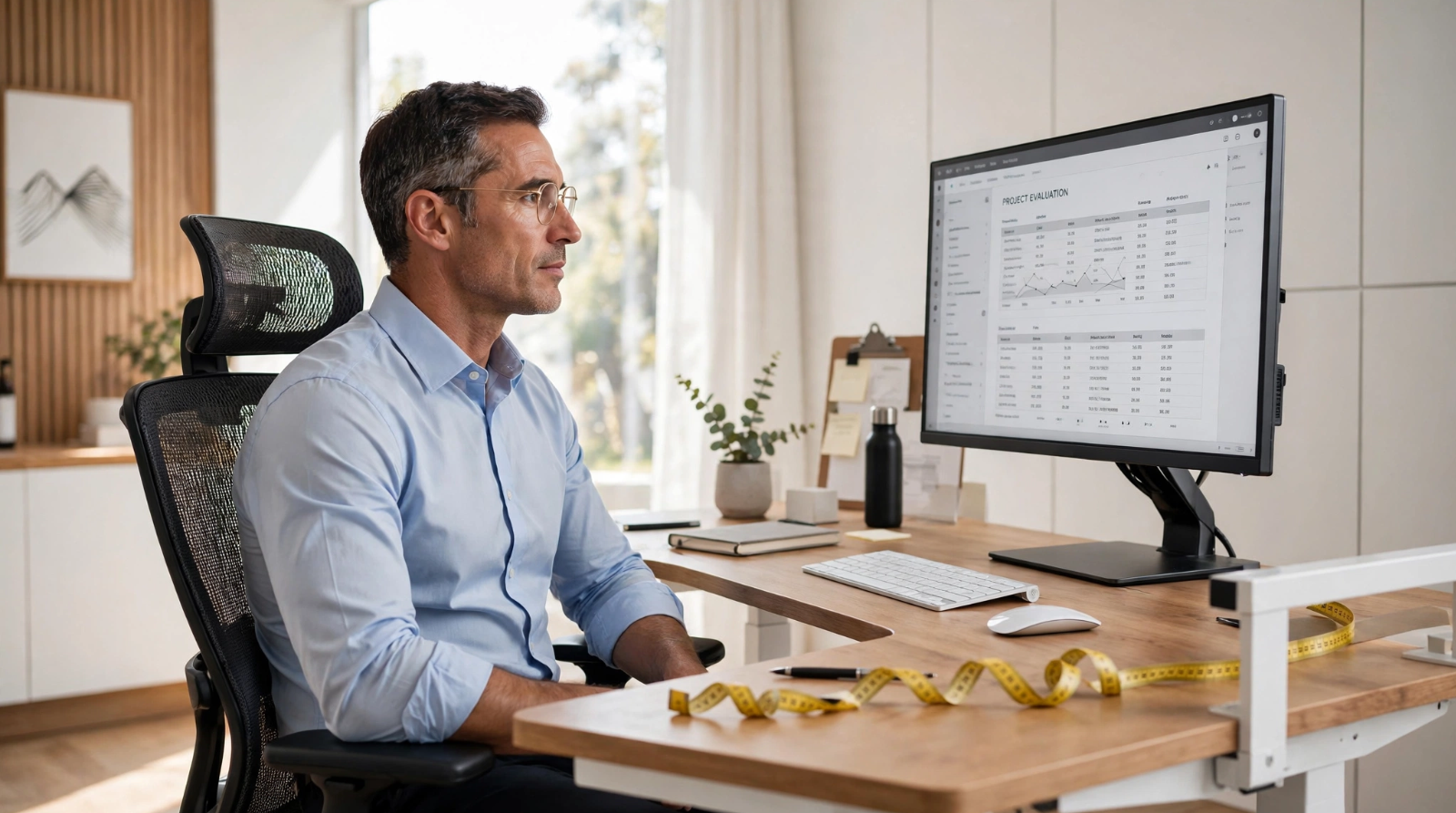
Before you buy anything, evaluate what you have. Use this 5-point checklist. You will need a tape measure, a level, and a friend to take a photo of you from the side while you are seated.
Point 1: Feet
Your feet should be flat on the floor (or on a footrest). If your thighs are compressed by the seat edge, your seat is too high. If your heels float, your seat is too high or your desk is too low. Feet flat = pelvic stability.
Point 2: Hips
Your hips should be slightly higher than your knees (a 100–110 degree hip angle). This encourages a natural lumbar lordosis (inward curve) and reduces pressure on the sacrum. If your hips are lower than your knees, your pelvis tilts backward, flattening your lower back and forcing your neck to compensate.
Point 3: Elbows
With your hands resting on the keyboard, your elbows should form a 90–100 degree angle. Your shoulders should be relaxed—not shrugged up toward your ears. If your shoulders are elevated, your desk is too high, or your chair armrests are too high.
Point 4: Eyes
Your monitor’s top bezel should be at or slightly below eye level. You should be looking slightly down (about 15–20 degrees) at the center of the screen. This is the neutral cervical position. If you are looking up, your neck is extended; if you are looking down more than 30 degrees, your neck is flexed and loaded.
Point 5: Wrists
Your wrists should be neutral (straight, not bent up or down) when typing. If your wrists are extended upward, your keyboard is too high. If they are flexed downward, your keyboard is too low. A wrist rest can help, but only if it is level with the keyboard.
Section 2: The Chair—Beyond the “Gaming” Gimmick
The chair is the foundation of your setup. But chair marketing is full of nonsense. Here is what actually matters for the over-40 spine:
Lumbar Support:
The lumbar spine (L1-L5) naturally curves inward. Your chair must have adjustable lumbar support that fits into the small of your back. If the support is too high, it pushes on your thoracic spine; if too low, it does nothing.
- Test: Sit in your chair. Slide your hand behind your lower back. There should be a firm but gentle pressure filling the gap. If there is a gap, your lumbar muscles are working overtime to hold your spine upright—which leads to chronic fatigue and pain.
Seat Depth:
The seat pan should be deep enough to support your thighs but short enough that you have 2–3 inches of space between the back of your knee and the seat edge. If the seat is too deep, it compresses the popliteal vessels and nerves behind your knee, causing leg fatigue and reducing circulation.
Tilt Tension:
The chair should recline slightly (5–15 degrees) to offload your spine. You should not be locked at a rigid 90-degree angle. A slight recline shifts weight from the discs to the skeletal structure and allows your back muscles to relax. The tilt tension should allow you to lean back without falling backward.
Armrests:
Armrests are optional. If you use them, they must be adjustable in height and width. They should support your forearms at a 90-degree angle without raising your shoulders. If they are too high, they cause shoulder impingement; if too low, they are useless.
The “No-Go” Chairs:
- Dining chairs: Zero lumbar support, no adjustability.
- “Racing” gaming chairs: Often have rigid, fixed bolsters that force your shoulders forward and do not accommodate the natural hip-width of a 40+ male.
- Kneeling chairs or ball chairs: These force static muscle activation and are not suitable for 8-hour workdays; they are okay for 20-minute intervals but not as a primary chair.
Section 3: The Monitor—The Neck’s Primary Frenemy
The monitor is the single most important ergonomic variable. Most Americans use a laptop as their primary screen, which forces them to look down for hours. This is catastrophic.
Laptop Users:
Do not use a laptop on your lap or on a low desk. The screen and keyboard are coupled. To get the screen to eye level, you must elevate the laptop, which makes typing impossible. The solution is a separate external monitor and a wireless keyboard/mouse.
Monitor Height Protocol:
- Sit in your chair with your back supported and your feet flat.
- Close your eyes. Relax your neck. Open your eyes.
- Your natural, relaxed gaze should land at the top third of your monitor.
- The monitor should be arms-length away from your eyes (approximately 20–26 inches).
- Tilt the monitor back 10–15 degrees to reduce glare and to create a slight downward gaze angle.
The Golden Rule: If you find yourself craning your neck forward to read small text, you need to zoom in (increase font size to 110% or 125%) or move the monitor closer. Do not lean in; bring the monitor to you.
Multiple Monitors:
If you use two monitors, place your primary monitor directly in front of you. Place the secondary monitor to the side, at the same height, at a 20–30 degree angle. Do not split your gaze equally between two monitors—you will end up with a rotated cervical spine for hours, which is a recipe for scalene and sternocleidomastoid strain.
Section 4: The Keyboard and Mouse—The Wrist Savers
Your hands are the extension of your nervous system. Poor keyboard positioning leads to carpal tunnel syndrome, cubital tunnel syndrome, and de Quervain’s tenosynovitis.
Keyboard:
- The keyboard should be flat or slightly negatively tilted (angled away from you). A negative tilt reduces wrist extension.
- Your wrists should float above the keyboard, not rest on a wrist pad. Wrist pads compress the carpal tunnel and can exacerbate symptoms.
- The “B” key on a QWERTY keyboard should be directly in line with your sternum. You should not have to reach or rotate your torso to type.
Mouse:
- The mouse should be at the same height as the keyboard, within easy reach without extending your arm.
- Use your arm to move the mouse, not your wrist. This engages larger muscle groups and reduces repetitive strain on the flexor tendons.
- Consider a vertical mouse to keep your forearm in a neutral, handshake position—this reduces supination stress.
Section 5: The Movement Protocol—Sitting Is the New Smoking
No ergonomic setup, no matter how perfect, can counteract 8 hours of continuous sitting. The spine needs movement to pump nutrients into the discs and clear metabolic waste.
The 30-Minute Rule:
Stand up and change posture every 30 minutes. Even 30 seconds of standing or walking resets the pressure gradient in your lumbar discs.
The “Desk Stretch” Sequence (60 seconds):
- Chin Tucks: Sit tall. Gently draw your chin straight back (as if making a double chin). Hold for 3 seconds. Repeat 5 times. This activates the deep neck flexors and stretches the suboccipital muscles.
- Shoulder Blade Squeezes: Interlace your fingers behind your head. Gently squeeze your shoulder blades together, opening your chest. Hold for 5 seconds. Repeat 5 times. This counters the forward-rounded posture.
- Thoracic Extensions: Place your hands on your lower back. Gently lean back over the back of your chair, opening your chest to the ceiling. Hold for 3 seconds. Repeat 5 times.
The Standing Desk Option:
A sit-stand desk is excellent, but only if used correctly. The same ergonomic rules apply: monitor at eye level, elbows at 90 degrees, feet flat. Alternate between sitting and standing every 30–45 minutes. Standing for 8 hours is just as bad as sitting for 8 hours—variation is the key.
Section 6: The VigorForty Home Office Protocol (Daily Implementation)
| Order | Action | Frequency | Purpose |
|---|---|---|---|
| 1 | Evaluate your setup (5-point checklist) | Once, then monthly | Ensures all elements are aligned |
| 2 | Monitor height check (Top bezel at eye level) | Daily check | Reduces forward head posture |
| 3 | Chin tucks + Shoulder squeezes | 5 reps every 60 min | Resets cervical and thoracic position |
| 4 | 30-Minute Stand/Walk | Every 30 min | Decreases disc pressure, improves circulation |
| 5 | 20-20-20 Rule (Eyes) | Every 20 min | Reduces eye strain and resets neck extension |
Section 7: FAQ—Your Top Home Office Questions
Q: Is a standing desk worth the investment?
A: Yes, if you use it as a tool for variation, not a permanent fixture. A mid-range sit-stand desk ($400–$800) is a worthwhile investment if you spend 6+ hours at your desk. However, a $15 monitor riser and a $30 keyboard tray can often fix your posture without a new desk.
Q: My neck hurts when I look down at my phone. How is this related?
A: “Tech neck” from phones adds additional load to the same cervical spine you are already stressing at your desk. Limit phone use to 15-minute sessions. Hold your phone up to eye level (not down in your lap). Use voice-to-text to reduce typing time.
Q: I have a “dowager’s hump” at the base of my neck. Can I fix it?
A: That is a fatty or bony prominence at C7-T1, often accompanied by thoracic kyphosis. It is rarely reversible once calcified, but you can prevent it from worsening by aggressively focusing on chin tucks and thoracic extension exercises. Physical therapy can help improve your range of motion, but the hump itself is not a pain generator; it is a sign of prolonged posture.
Q: What if my company won’t pay for ergonomic equipment?
A: Many states have ergonomic reimbursement programs, or you can write it off on your taxes as a home office expense (if self-employed). Start with the cheapest fixes: a rolled-up towel for lumbar support (free), a stack of books for a monitor riser ($0), and a cardboard box for a footrest ($0). Test these for 2 weeks, then invest in the items that provide the most relief.
The VigorForty Take
Your home office is not neutral. It is either a place of recovery or a place of injury. The distinction comes down to millimeters and degrees of angulation.
The “5-Point Ergonomic Evaluation” is your diagnostic tool. The Monitor Height Protocol is your prescription. The movement breaks are your healing balm.
You cannot undo 8 hours of poor posture with a 15-minute yoga session at the end of the day. Pain prevention requires 8 hours of adequate posture followed by movement. The goal is not perfection; it is variation. Your spine thrives on motion.
Take 15 minutes this weekend to perform the full setup. Take a photo of yourself sitting before and after. The difference in your neck angle and shoulder position will shock you. And then, when you work on Monday, set a timer for every 30 minutes. Get up. Walk. Stretch. Your neck, shoulders, and upper back will thank you—and your productivity will actually increase as your brain receives better blood flow and less nociceptive (pain) input.
Your Challenge: Perform the 5-Point Evaluation right now. Adjust your chair height, monitor, and keyboard. Set a 30-minute timer. Do this for 5 consecutive workdays. On day 6, notice if your afternoon tension headache has disappeared. We predict it will.
Read All Realated Articles
- The Complete Guide to Heart Health: Beyond Omega-3s—CoQ10, Magnesium, Potassium, and Nitric Oxide Support After 40
- Why Your Hamstrings Are Tight (And Stretching Them Won’t Fix It)—The Real Causes & 4 Fixes for Men Over 40
- The 3 Worst Stretches for the Over-40 Lower Back (And What to Do Instead)
- Pickleball and Your Knees: 4 Preventative Exercises to Bulletproof Your Joints (For Men Over 40)
- The Desk Chair Evaluation: How to Setup Your Home Office to Protect Your Neck, Shoulders, and Upper Back (For Men Over 40)
- The 5-Minute Morning Mobility Routine for Americans Over 40—Start Your Day Pain-Free
- Is Your Pillow Causing Your Neck Pain? The Over-40 Guide to Sleep Posture, Pillow Selection, and Morning Relief
- Collagen vs. Glucosamine vs. Omega-3s: The 3 Best Supplements for Joint Pain (2026 Update for Men Over 40)
- Sciatica vs. Piriformis Syndrome: How to Tell the Difference and Find the Right Treatment (For Men Over 40)
- The 3 Worst Exercises for Bad Knees (And What to Do Instead)—A 40+ Gym Survival Guide
- How to Improve Your Balance After 40—The Underrated Longevity Skill Every Man Needs