
Author: Vigor Forty Editorial Team
Medically Reviewed By: Editorial Review Board
Disclaimer: This article is for informational purposes only and is not a substitute for professional medical advice. Read our full Medical Disclaimer.
📌 Key Takeaways
- Not All “Knee” Exercises Are Knee-Friendly: Many standard gym movements—often prescribed by well-meaning trainers—place excessive shear forces, patellofemoral compression, and rotational stress on aging knees. After 40, the risk-benefit calculation shifts dramatically.
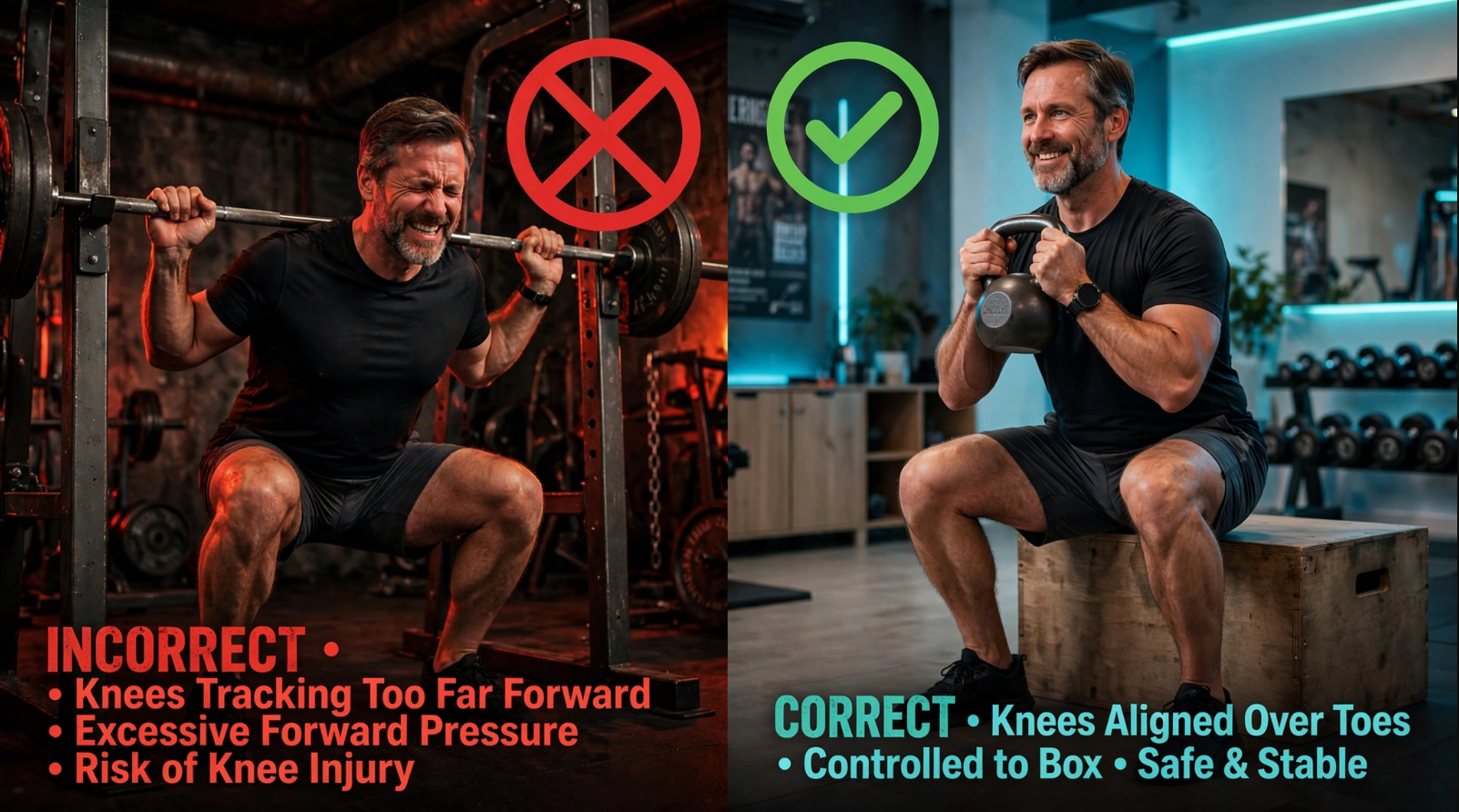
- Worst Exercise #1—Full Depth Squats (Especially with a Smith Machine): Deep squats (below parallel) load the posterior cruciate ligament (PCL) and menisci at their end-range. The Smith machine forces an unnatural bar path, increasing shear on the patellar tendon. Alternative: Box Squats (to parallel) or Goblet Squats with a controlled tempo.
- Worst Exercise #2—Leg Extension Machine (Full Range): This machine isolates the quadriceps but places immense compressive force on the patellofemoral joint. At full extension, the patella is jammed against the femur, accelerating cartilage wear. Alternative: Terminal Knee Extensions (TKEs) with a resistance band or wall sits.
- Worst Exercise #3—Deep Walking Lunges: The forward lunge with a long stride places the front knee in a vulnerable position, increasing shear and patellar tendon stress, especially during deceleration. Alternative: Reverse Lunges or Step-Ups (with controlled eccentric lowering).
- The Golden Rule After 40: Do not sacrifice form for weight. Do not go to end-range under load. And always prioritize eccentric control over concentric power. Strong muscles protect knees—but only when loaded in safe ranges.
Introduction: The Gym Is Not Your Knee’s Friend
You walk into the gym with good intentions. You want to strengthen your legs, protect your knees, and stay fit. You hop on the leg extension machine, crank up the weight, and pump out 12 reps. You move to the squat rack, drop below parallel, and feel the burn. You finish with walking lunges across the floor, pushing through the lactic acid.
And then, the next morning, your knees ache. You feel a sharp twinge when you walk up stairs. A grinding sensation when you straighten your leg.
You are not alone. Orthopedic clinics are filled with men in their 40s and 50s who have accelerated their knee arthritis by performing “knee-strengthening” exercises that were never designed for aging joints. The problem is twofold:
- Many gym exercises were designed for 20-year-old athletes with pristine cartilage and robust neuromuscular control.
- The average gym-goer prioritizes weight and reps over form and joint mechanics.
As we age, the menisci become less resilient, the patellar tendon loses elasticity, and the articular cartilage thins. The biomechanical rules of the gym change. What was safe at 25 is dangerous at 45.
This article identifies the three most damaging exercises for the over-40 knee—movements that are still widely performed in commercial gyms across America—and provides safer, more effective alternatives that build strength without destroying cartilage. You will walk away with a knee-friendly gym protocol that allows you to train hard and stay pain-free.
Section 1: Exercise #1—The Deep Smith Machine Squat
What It Is:
A barbell squat performed on a Smith machine (the barbell is fixed to vertical guides), often taken below parallel (hips lower than knees).
Why It Is Dangerous:
- The Smith Machine Forces an Unnatural Bar Path: In a free-weight squat, the barbell follows a natural, slight diagonal path that keeps the center of mass over the midfoot. The Smith machine locks the bar in a strict vertical plane, forcing your knees and hips to move in a way that increases anterior knee shear.
- Deep Squats (Below Parallel) Load the Menisci and PCL: When you squat below parallel, the femur rotates internally on the tibia, increasing shear stress on the posterior horn of the meniscus and the posterior cruciate ligament (PCL). For healthy 20-year-olds, this is safe. For a 45-year-old with age-related meniscal fraying, it is a tear waiting to happen.
- The “Stretch Reflex” Trap: Deep squats rely on the stretch reflex at the bottom to bounce back up. This rapid loading increases peak patellofemoral joint stress, accelerating cartilage wear.
The Evidence:
A 2010 study in the Journal of Bone and Joint Surgery found that patellofemoral joint stress increases exponentially as squat depth increases below parallel. At 130 degrees of knee flexion (deep squat), the stress is nearly 3x higher than at 90 degrees (parallel). Over hundreds of repetitions, this cumulative load damages articular cartilage.
The Safer Alternative: The Box Squat (To Parallel)
- How:
- Place a box or bench behind you at a height where your thighs are parallel to the floor (or slightly above) at the bottom of the squat.
- Perform a squat, touching the box lightly with your glutes. Do not sit down or “rest” on the box—just use it as a depth guide.
- Keep your chest up, knees tracking over your toes. Do not let your knees cave inward.
- Drive through your heels to stand back up.
- Why It Is Safer: The box limits depth, reducing patellofemoral stress and meniscal shear. The “touch and go” tempo eliminates the stretch reflex bounce, encouraging controlled eccentric loading.
- Progression: Start with bodyweight box squats. Add a kettlebell or dumbbell goblet style before progressing to barbell.
Section 2: Exercise #2—The Leg Extension Machine (Full Range)
What It Is:
The seated leg extension machine—you sit, hook your ankles under the pads, and extend your legs until they are straight.
Why It Is Dangerous:
- Maximum Patellofemoral Compression at Full Extension: At the terminal phase of the leg extension (the last 15–20 degrees of knee extension), the patella is compressed against the femur with maximal force. This is precisely where the patellar cartilage is thinnest and most vulnerable.
- Shear Forces on the Patellar Tendon: The leg extension is an open-chain exercise (the foot is not planted). This creates a high shear force at the tibiofemoral joint, which is stressful to the cruciate ligaments.
- No Glute Involvement: The leg extension isolates the quadriceps but fails to activate the hamstrings or glutes, which are essential for knee stability. This creates a muscular imbalance, pulling the tibia forward and stressing the ACL.
The Evidence:
A 2012 study in the Journal of Orthopaedic & Sports Physical Therapy found that leg extensions at 90° of knee flexion produced significantly less patellofemoral joint stress than at 15° of knee flexion (near full extension). In other words, the full range of motion is the danger zone. Another study found that individuals with patellofemoral pain who performed leg extensions had significantly worse symptoms than those who performed closed-chain exercises (squats, step-ups).
The Safer Alternative: Terminal Knee Extensions (TKEs) with Resistance Bands
- How:
- Anchor a resistance band behind you (or have a partner hold it). Loop it around the back of your knee.
- Stand facing away from the anchor. Step forward slightly to create tension.
- Slowly straighten your knee against the resistance of the band, stopping at about 30 degrees of flexion (not full extension). Your knee should not lock out.
- Pause for 2 seconds at the top (isometric contraction of the quadriceps).
- Slowly lower back to 60 degrees of flexion.
- Why It Is Safer: The band provides resistance only in the mid-range (30–60 degrees), avoiding the high-compression zone at full extension. The isometric hold at the top builds quad strength without joint shear. It also trains the vastus medialis oblique (VMO)—the “teardrop” muscle that stabilizes the patella.
- Alternative: Wall sits (isometric quad contractions) with a ball between your knees to engage the adductors.
Section 3: Exercise #3—Deep Walking Lunges
What It Is:
The classic lunge—you step forward with a long stride, drop your back knee toward the floor, and push off to return to standing, then immediately step forward with the opposite leg.
Why It Is Dangerous:
- High Deceleration Forces on the Patellar Tendon: In a walking lunge, the front knee must decelerate the forward momentum of your body weight. This eccentric braking force places immense strain on the patellar tendon and the patellofemoral joint.
- Excessive Anterior Shear: A long stride places the front knee in deep flexion (often >100 degrees), increasing anterior shear forces on the tibia. If your hamstrings are weak (as they are for many gym-goers), the ACL must take up the slack.
- Poor Foot Strike Pattern: Fatigue often causes the front knee to drift inward (valgus collapse) or the heel to lift, further stressing the MCL and lateral meniscus.
The Evidence:
A 2017 biomechanical analysis found that peak patellofemoral joint stress during a forward lunge is significantly higher than during a squat or step-up. The deceleration phase—the “braking” as you plant the front foot—creates a rapid loading rate that is poorly tolerated by degenerative cartilage.
The Safer Alternative: Reverse Lunges or Controlled Step-Ups
- Reverse Lunge (How):
- Stand tall. Step backward with your right foot, landing on the ball of your foot.
- Lower your right knee toward the floor. The front (left) leg bears most of the load, but the backward step reduces the braking forces and the anterior shear on the patella.
- Push through your front heel to return to standing. Repeat.
- Why It Is Safer: The reverse lunge eliminates the forward deceleration phase. The loading is more controlled, and the knee is less likely to drift past the toes.
- Controlled Step-Ups (How):
- Place one foot on a bench or box (height should allow your knee to bend to ~90 degrees).
- Step up, driving through the heel of the elevated foot. Do not push off with the back foot.
- Slowly lower back down (take 3–4 seconds) to the starting position.
- Why It Is Safer: The step-up is a closed-chain, controlled movement with no deceleration impact. The slow eccentric lowering phase builds strength without joint trauma. Add a dumbbell for increased load.
Section 4: The “Knee-Friendly” Gym Protocol
Now that you know what to avoid, here is a replacement protocol. This full lower-body workout takes 30 minutes and is safe for the over-40 knee.
| Order | Exercise | Sets x Reps | Tempo (Eccentric/Pause/Concentric) | Purpose |
|---|---|---|---|---|
| 1 | Box Squats (to Parallel) | 3 x 10 | 3-0-1 | Quad/glute strength without deep flexion stress |
| 2 | Reverse Lunges | 3 x 10 (per leg) | 3-0-1 | Quad/glute strength without deceleration trauma |
| 3 | Terminal Knee Extensions (TKEs) | 3 x 12 | 2-2-1 | VMO activation, patellar stability |
| 4 | Single-Leg RDLs | 3 x 8 (per leg) | 3-0-1 | Hamstring/glute strength, ACL protection |
| 5 | Lateral Band Walks | 3 x 10 steps (each way) | Continuous tension | Glute medius activation, knee valgus prevention |
| 6 | Wall Sits (isometric) | 3 x 30-60 seconds | N/A | Quad endurance, joint-friendly load |
Warm-Up (5 Minutes):
- Stationary bike or elliptical: 5 minutes (light resistance).
- Leg swings: 10 each leg, forward and lateral.
- Bodyweight box squats: 10 reps to engage the glutes.
Progression Guidelines:
- Increase weight before increasing reps. Heavier weight with controlled form is safer than higher reps with sloppy form.
- Never perform an exercise if it causes sharp joint pain. A “burn” in the muscle is fine; sharp, pinpoint pain in the joint is a stop sign.
- Train legs 2–3 times per week. Allow 48 hours between sessions for recovery.
Section 5: The “Knee Whisperer” Guidelines—General Principles
Beyond specific exercises, follow these four principles to protect your knees for life.
1. Prioritize Eccentric Control:
The lowering phase of any exercise is where the damage occurs. Take 3–4 seconds to lower the weight. This not only builds strength but also reduces the rapid loading rate that traumatizes cartilage.
2. Never Let Your Knee Cave Inward (Valgus):
During squats, lunges, or step-ups, your knee should track directly over your second toe. If it drifts inward, you are placing excessive stress on the medial meniscus and MCL. Use a mirror or video yourself to check.
3. Strengthen the Posterior Chain:
Most gym-goers over-train their quads and under-train their hamstrings and glutes. Strong hamstrings pull the tibia backward, protecting the ACL. Strong glutes prevent the knee from caving inward. Perform RDLs, hip thrusts, and lateral band walks religiously.
4. Listen to the “Noise”:
Grating, clicking, or popping in the knee is called crepitus. If it is painless, it is usually harmless (gas bubbles or mild cartilage roughening). If it is painful, stop. Pain is your joint’s way of saying, “The mechanical environment is hostile.”
Section 6: FAQ—Your Top Knee Exercise Questions
Q: I’ve been doing leg extensions for years and my knees feel fine. Should I stop?
A: The damage is cumulative and often asymptomatic until it is not. The patellofemoral cartilage has no nerve endings, so you may not feel the wear until it is advanced. It is a high-risk, low-reward exercise. Switch to TKEs—you will get the same quad-strengthening benefit with significantly less joint stress.
Q: What about leg press machines? Are they safe?
A: Yes, but with significant modifications:
- Do not go to full extension (locking out). Stop 10–15 degrees short to avoid patellofemoral compression.
- Do not go too deep (your hips should not round up off the seat).
- Keep your feet high and wide to engage the glutes and hamstrings, reducing quad-dominant knee stress.
- Avoid heavy weight. Focus on slow, controlled reps (4-second eccentric, 1-second concentric).
Q: I have a meniscus tear. Can I still squat?
A: Yes, but only to a pain-free range. For a meniscus tear, squat depth should stop before you feel any sharp pain. Box squats set to a height above the painful range are excellent. Avoid deep squats and heavy loads. And always consult your orthopedist or physical therapist.
Q: Are elliptical machines and stationary bikes safe for bad knees?
A: Yes, both are excellent low-impact options.
- Stationary bike: Keep the seat height so your knee has a slight bend (15–20 degrees) at the bottom of the pedal stroke. A low seat increases knee flexion and stress.
- Elliptical: Use a low resistance, and avoid the “reverse” direction, which can increase patellofemoral stress.
Q: I have patellar tendinopathy (“jumper’s knee”). What should I avoid?
A: Avoid deep squats, lunges, and leg extensions that load the patellar tendon in a lengthened position (flexed knee). Focus on isometric quad contractions (wall sits, TKEs) and slow, heavy, eccentric decline squats (single-leg decline squats—but only under the guidance of a physical therapist). Avoid explosive movements (jumping) entirely.
Q: Can swimming replace leg exercises?
A: Swimming is excellent for cardiovascular health and low-impact movement, but it does not provide the mechanical loading necessary to maintain bone density and muscle mass. You still need resistance training. Use swimming as your cardio, but continue the knee-friendly protocol above for strength.
The VigorForty Take
Your knees are the shock absorbers of your body. They endure 2–3 times your body weight with every step, and up to 8–10 times with a squat or lunge. After 40, they do not have the regenerative capacity to withstand the same exercises you performed in your 20s.
The three exercises we have retired today—deep Smith machine squats, full-range leg extensions, and deep walking lunges—are not inherently evil. They are simply inappropriate for the aging knee. They load cartilage and menisci in vulnerable end-ranges, create high shear forces, and accelerate the wear-and-tear that leads to osteoarthritis.
The safer alternatives—box squats, terminal knee extensions, reverse lunges, and step-ups—provide the same strength benefits without the joint trauma. They build quadriceps and glute strength, stabilize the knee, and allow you to remain active and pain-free for decades.
Your 30-Day Challenge:
- Eliminate deep squats, leg extensions, and forward lunges from your routine.
- Replace them with the knee-friendly protocol listed above.
- Train legs 2x per week with a focus on controlled eccentrics (3–4 seconds lowering).
- After 30 days, assess your knee pain during daily activities (stairs, walking, sitting).
We predict your knees will feel significantly more stable, less achy, and more capable of handling whatever your life throws at them—whether it is a pickleball match, a weekend hike, or simply carrying groceries up the stairs. Your knees will thank you.
Read All Realated Articles
- The Complete Guide to Heart Health: Beyond Omega-3s—CoQ10, Magnesium, Potassium, and Nitric Oxide Support After 40
- Why Your Hamstrings Are Tight (And Stretching Them Won’t Fix It)—The Real Causes & 4 Fixes for Men Over 40
- The 3 Worst Stretches for the Over-40 Lower Back (And What to Do Instead)
- Pickleball and Your Knees: 4 Preventative Exercises to Bulletproof Your Joints (For Men Over 40)
- The Desk Chair Evaluation: How to Setup Your Home Office to Protect Your Neck, Shoulders, and Upper Back (For Men Over 40)
- The 5-Minute Morning Mobility Routine for Americans Over 40—Start Your Day Pain-Free
- Is Your Pillow Causing Your Neck Pain? The Over-40 Guide to Sleep Posture, Pillow Selection, and Morning Relief
- Collagen vs. Glucosamine vs. Omega-3s: The 3 Best Supplements for Joint Pain (2026 Update for Men Over 40)
- Sciatica vs. Piriformis Syndrome: How to Tell the Difference and Find the Right Treatment (For Men Over 40)
- The 3 Worst Exercises for Bad Knees (And What to Do Instead)—A 40+ Gym Survival Guide
- How to Improve Your Balance After 40—The Underrated Longevity Skill Every Man Needs