Author: Vigor Forty Editorial Team
Medically Reviewed By: Editorial Review Board
Disclaimer: This article is for informational purposes only and is not a substitute for professional medical advice. Read our full Medical Disclaimer.
📌 Key Takeaways
- Pickleball Knee Injuries Are Epidemic in the 40+ Demographic: The sport’s combination of sudden lateral stops, deep lunges, and hard court surfaces places immense stress on the patellar tendon, MCL, and menisci. Injury rates have surged alongside the sport’s popularity.
- The “Low Stance” Is the Culprit: Pickleball requires a low, athletic stance with bent knees. This position demands massive eccentric quadriceps control. Weak quads and glutes fail to absorb shock, transferring load directly to the ligamentous structures of the knee.
- Prevention Is Strength, Not Rest: You cannot “rest” your way to resilient knees. The solution is targeted strengthening of the kinetic chain—glutes, quads, hamstrings, and calves—to create a shock-absorbing system that protects the joint capsule.
- Meniscus Tears Are the #1 Warning Sign: A popping sensation during a quick pivot often signals a meniscal tear. Strengthening the hamstrings and glute medius reduces the rotational torque that causes these tears.
- The 4-Exercise Protocol: Eccentric Step-Downs (patellar tendon), Lateral Band Walks (glute medius), Single-Leg RDLs (hamstrings/ACL support), and Paused Calf Raises (shock absorption). Perform these 3x/week to stay on the court.
Introduction: The Sport That’s Killing Knees (Gently)
Pickleball is addictive. It is social, low-impact in theory, and perfectly suited for the 40+ demographic looking for a competitive outlet without the wear-and-tear of tennis. But here is the catch: orthopedic surgeons are reporting a staggering increase in pickleball-related knee injuries. The American Academy of Orthopaedic Surgeons (AAOS) now classifies it as a significant source of sports-related musculoskeletal trauma in the over-50 set.
The irony is that players feel good while playing. The ball is slow, the court is small, and the rallies are quick. But the mechanics are vicious:
- The low squat position needed for dinking and volleying.
- The sudden, explosive lateral lunges to reach a wide shot.
- The hard, unforgiving court surface that transmits shock straight up the kinetic chain.
- The pivoting on a planted foot during a backhand or forehand.
Your knee is essentially a hinge joint held together by ligaments (ACL, MCL, PCL, LCL) and cushioned by cartilage (menisci). If the muscles around that hinge (quads, glutes, hamstrings) are weak or slow to fire, the ligaments and cartilage take the brute force. That leads to patellar tendinopathy (jumper’s knee), MCL sprains, and the dreaded meniscus tear.
This article is your 10-minute, twice-weekly insurance policy. These four exercises are not complicated. They are not sexy. But they are the exact drills physical therapists prescribe to professional pickleball players to keep them dominating the kitchen line well into their 60s.
Section 1: Why the Knee Fails in Pickleball
To prevent injury, you must understand the loading patterns.
The Lunge:
Every time you reach for a short dink, you perform a deep forward lunge. In a proper lunge, your front knee should track over your toes, and your glute should absorb the deceleration. However, in a rushed pickleball game, fatigue sets in. Your quads take over, your glutes shut down, and your knee drifts inward (valgus collapse). This inward collapse places a massive shear force on the MCL and the lateral meniscus.
The Pivot:
Pickleball requires rapid changes of direction. When you pivot with a slightly bent knee and your foot is planted, the femur rotates over the tibia. The menisci are designed to handle some rotational force, but if the hamstrings (which protect the ACL) are weak, the rotational laxity increases, leading to meniscal tearing.
The Hard Court:
Asphalt or acrylic courts have zero give. Every landing—even a soft one—sends a shock wave through the heel, ankle, knee, and hip. The calves and quads are your natural shock absorbers. If they are tight or weak, that shock wave transfers directly to the knee joint capsule.
Section 2: Exercise #1—The Eccentric Step-Down (Patellar Tendon Protection)
This is the single best exercise for preventing “jumper’s knee” (patellar tendinopathy). It trains your quad to control your body weight during descent, exactly what you do in a pickleball lunge.
- How:
- Stand on a sturdy box or step (4–6 inches high) with your right foot. Your left foot hangs off the edge.
- Slowly—take a full 3 seconds—lower your left heel toward the floor, bending your right knee. Keep your chest up and your knee tracking straight over your second toe. Do not let your knee cave inward.
- Touch the floor gently with your left heel, then drive through your right heel to return to the starting position. Do not push off with the left foot.
- Sets: 3 sets of 8–10 reps per leg.
- The Key: The tempo. The eccentric (lowering) phase is the magic. It lengthens the quadriceps tendon and improves its tolerance to load. If it burns, you are doing it right.
Section 3: Exercise #2—Lateral Band Walks (Glute Medius Activation)
The gluteus medius is the forgotten hero of knee stability. It sits on the side of your hip and prevents your knee from collapsing inward during lateral movements. Weak glute medius = knee valgus = MCL strain and IT band syndrome.
- How:
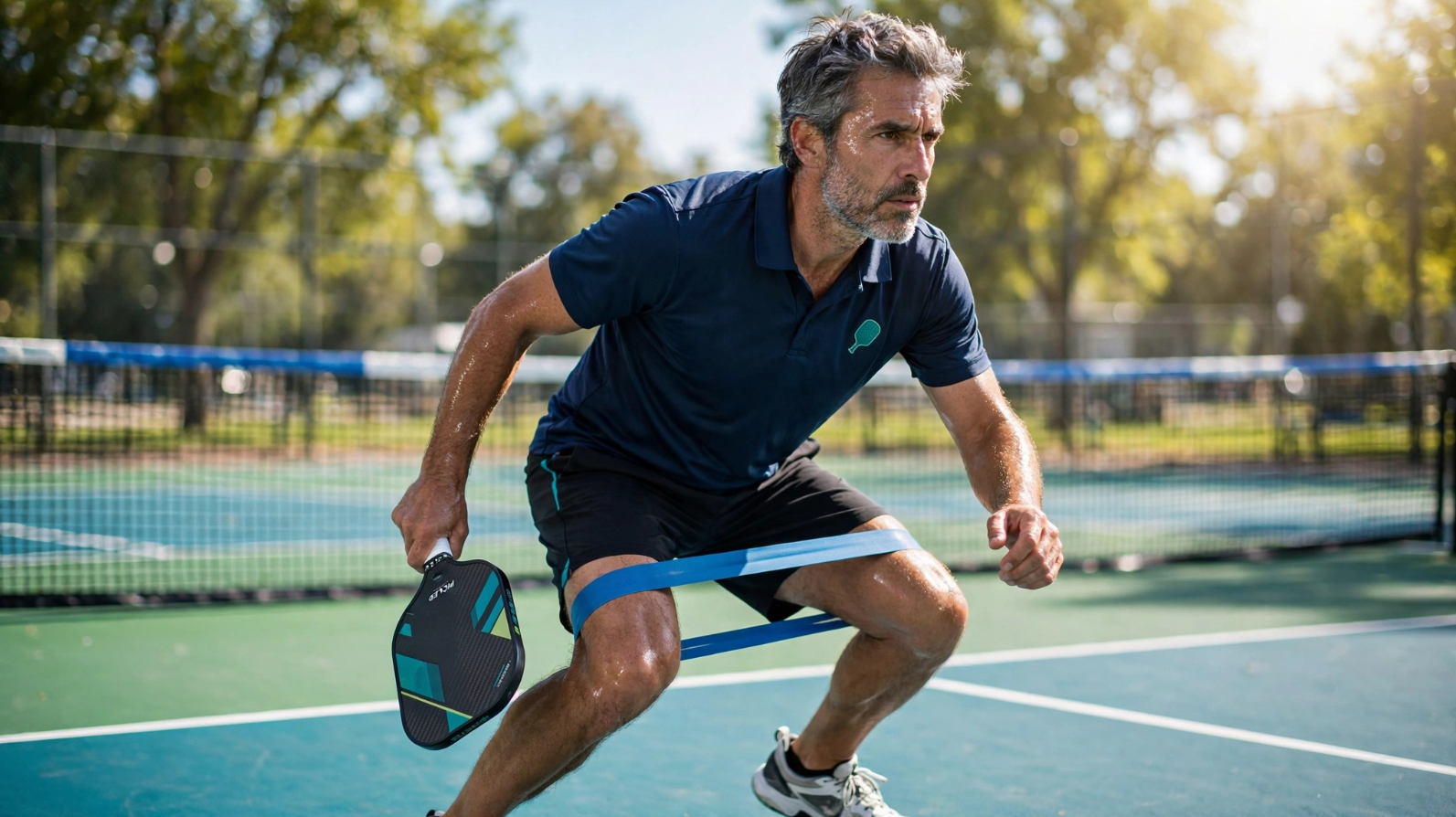
- Place a mini resistance band (light to medium resistance) just above your knees (or around your ankles for a greater challenge).
- Get into a slight squat position—your pickleball stance. Keep your chest up and your core tight.
- Take a slow, controlled step to the side, maintaining constant tension on the band. Do not let your knees cave inward.
- Bring your trailing foot back to shoulder-width apart. Continue stepping for 10 steps in one direction, then 10 steps back.
- Sets: 3 sets of 10 steps per direction (total 20 steps = 1 set).
- The Key: Keep the tension constant. The movement is not about distance; it is about the burn in the side of your glute. If you feel it in your quad or back, your hips are too high.
Section 4: Exercise #3—Single-Leg Romanian Deadlift (RDL) (Hamstring & ACL Support)
Strong hamstrings are your ACL’s best friend. The hamstrings pull the tibia backward, counteracting the ACL’s function of preventing the tibia from sliding forward. In pickleball, a strong hamstring reduces the rotational stress on the ACL during pivots.
- How:
- Stand on one leg, holding a light dumbbell or kettlebell in the opposite hand (contralateral loading) to challenge your balance.
- Keep a soft bend (10-15 degrees) in the standing knee. Hinge at your hips, sending the weight straight down toward the floor and your free leg straight back behind you.
- Keep your back flat—do not round your spine. Your hips should rotate, not your back.
- Lower until you feel a comfortable stretch in the standing hamstring, then squeeze your glute to return to standing.
- Sets: 3 sets of 8–10 reps per leg.
- The Key: This is not a heavy deadlift; it is a stability and hamstring-strengthening drill. Use a weight that challenges your balance without breaking your form.
Section 5: Exercise #4—Paused Calf Raises (Shock Absorption)
When you land from a jump shot or stop suddenly, your calves (gastrocnemius and soleus) act as hydraulic shock absorbers. If they are weak, the shock transfers to your knees.
- How:
- Stand on the edge of a step or a flat surface. Raise up onto your toes.
- Slowly—take a full 3 seconds—lower your heels down as far as they can go (deep stretch in the calf).
- Pause at the bottom for 2 seconds.
- Explosively push up to the top. Hold for 1 second. Repeat.
- Sets: 3 sets of 10–15 reps.
- The Key: The pause at the bottom is what differentiates this from a standard calf raise. It stretches the Achilles and builds strength in the lengthened position, which is exactly where your calf operates when you are in a low lunge.
Section 6: The Pre-Game Pickleball Warm-Up (5 Minutes)
Do not show up to the court cold. Static stretching before playing decreases power and increases injury risk. Instead, use this dynamic warm-up:
- Leg Swings (Forward & Lateral): 10 each leg, each direction. Gently swings to increase hip mobility.
- Walking Knee Hugs: Pull your knee to your chest as you walk forward. 10 steps.
- Walking Quad Stretches: Pull your heel to your glute as you walk. 10 steps.
- Lateral Shuffles: Low stance, shuffle 10 yards down and back.
- Bodyweight Squats: 10 reps, just to depth, to activate the glutes and quads.
The “Golden Rule”: Never play Pickleball within 60 minutes of a heavy leg workout. Muscle fatigue reduces your proprioception (joint awareness), making you significantly more injury-prone.
Section 7: FAQ—Your Top Pickleball Knee Questions
Q: My knee hurts on the inside of the joint after playing. What is it?
A: This is classic MCL (Medial Collateral Ligament) strain or meniscal irritation. It is almost always caused by your knee caving inward during lunges (valgus collapse). Immediately prioritize Lateral Band Walks (Exercise #2) to strengthen your glute medius. Ice the knee after playing and avoid deep lunges for a week.
Q: What shoe type protects my knees best?
A: Court shoes designed for Pickleball/Tennis, not running shoes. Running shoes have elevated, cushioned heels, which raise your center of gravity and reduce ankle stability, forcing the knee to compensate. Court shoes have a flatter, wider sole that provides lateral stability. Look for shoes with a thick, durable toe cap for dragging.
Q: I have bone-on-bone arthritis. Can I still play?
A: Yes, but with modifications. Wear a knee brace (unloader or neoprene sleeve for proprioception). Use a softer ball (like the X-40) and consider playing on a cushioned court surface (like a basketball gym floor) rather than asphalt. Most importantly, avoid deep lunges—step into the ball rather than reaching for it. Hyaluronic acid injections and anti-inflammatory supplements (like Omega-3s) can also help. Consult your orthopedist first.
Q: How long should I rest after a knee flare-up before playing again?
A: Wait until you can perform a bodyweight squat without pain, and you have no swelling. Then, perform the 4 exercises above for 1 week before returning to the court. When you return, play for only 15 minutes the first day to test the joint. Do not play back-to-back days until you are symptom-free for two weeks.
The VigorForty Take
Pickleball is a gift to the over-40 generation. It is social, accessible, and genuinely fun. But the court does not care about your enthusiasm—it cares about your biomechanics.
The 4 exercises in this protocol—Eccentric Step-Downs, Lateral Band Walks, Single-Leg RDLs, and Paused Calf Raises—are your membership fee for a long, pain-free pickleball career. They take 10 minutes to perform, 3 times a week. They are not glamorous. They do not burn 500 calories. But they build the “muscular armor” around your knee joint that allows you to lunge for that dink, pivot for that backhand, and walk off the court without limping.
Your Challenge: Commit to these 4 exercises for 4 weeks (3x/week). On week 5, play a match. Pay attention to how stable your knees feel during the lateral movements. We guarantee you will feel more planted, more powerful, and far less fearful of reaching for that wide shot. Your knees are the only ones you have; bulletproof them now, and you’ll be dominating the kitchen line well into your 70s.
Read All Realated Articles
- The Complete Guide to Heart Health: Beyond Omega-3s—CoQ10, Magnesium, Potassium, and Nitric Oxide Support After 40
- Why Your Hamstrings Are Tight (And Stretching Them Won’t Fix It)—The Real Causes & 4 Fixes for Men Over 40
- The 3 Worst Stretches for the Over-40 Lower Back (And What to Do Instead)
- Pickleball and Your Knees: 4 Preventative Exercises to Bulletproof Your Joints (For Men Over 40)
- The Desk Chair Evaluation: How to Setup Your Home Office to Protect Your Neck, Shoulders, and Upper Back (For Men Over 40)
- The 5-Minute Morning Mobility Routine for Americans Over 40—Start Your Day Pain-Free
- Is Your Pillow Causing Your Neck Pain? The Over-40 Guide to Sleep Posture, Pillow Selection, and Morning Relief
- Collagen vs. Glucosamine vs. Omega-3s: The 3 Best Supplements for Joint Pain (2026 Update for Men Over 40)
- Sciatica vs. Piriformis Syndrome: How to Tell the Difference and Find the Right Treatment (For Men Over 40)
- The 3 Worst Exercises for Bad Knees (And What to Do Instead)—A 40+ Gym Survival Guide
- How to Improve Your Balance After 40—The Underrated Longevity Skill Every Man Needs