
Author: Vigor Forty Editorial Team
Medically Reviewed By: Editorial Review Board
Disclaimer: This article is for informational purposes only and is not a substitute for professional medical advice. Read our full Medical Disclaimer.
📌 Key Takeaways
- Chronic Hamstring Tightness Is Rarely a Muscle Length Problem: In most adults over 40, the hamstrings are not actually short. The sensation of “tightness” is often a protective neurological reflex triggered by weakness, neural tension, or pelvic positioning.
- Static Stretching Can Actually Make It Worse: Repeatedly forcing a “pulled” stretch on an already-overlengthened, weak hamstring (common in desk workers with anterior pelvic tilt) can strain the proximal tendon (high hamstring tendinopathy) and worsen the very pain you’re trying to fix.
- Weak Glutes Are the Primary Culprit: When your gluteus maximus fails to fire during walking, running, or squatting, your hamstrings take over as primary hip extensors. They become overworked, fatigued, and “tight” as a cry for help—not a demand for elongation.
- Sciatic Nerve Tension Mimics Muscle Tightness: The sciatic nerve runs directly under the hamstrings. If that nerve lacks “slide” (glide), raising your leg straight up triggers a tug on the nerve, which your brain interprets as a painful muscle stretch. You cannot stretch a nerve like a rubber band—you must glide it.
- The Real Fix: Strengthen the glutes, perform eccentric hamstring loading (Romanian Deadlifts), and incorporate nerve glides. Flexibility will improve as a byproduct of stability.
Introduction: The Hamstring Trap
If you are over 40, you have likely spent hundreds of hours stretching your hamstrings. You sit on the floor, reach for your toes, hold for 30 seconds, wince, and repeat. Yet, somehow, they feel just as tight tomorrow as they did yesterday.
You are not alone. “Tight hamstrings” are the most common musculoskeletal complaint in the American adult population. But here is the uncomfortable truth that most fitness influencers won’t tell you: Stretching is often the worst thing you can do for tight hamstrings.
This isn’t pseudoscience; it’s basic neuromechanics. The hamstring is a powerful, multi-articular muscle group. Its perceived “tightness” is usually a symptom of three deeper dysfunctions:
- Reciprocal Inhibition: Your glutes are asleep, so your hamstrings are overworked.
- Neural Tension: Your sciatic nerve is stuck, and stretching pulls on it.
- Eccentric Weakness: The muscle is lengthening under load, tearing microfibers, and tightening up as a protective splint.
This article will dismantle the outdated “stretch-to-lengthen” dogma. We will give you a 10-minute daily protocol—heavy on activation and nerve glides—that will restore functional length, protect your lower back, and finally get you touching your toes without pain.
Section 1: The Myth of the “Short” Hamstring
The standard narrative is simple: if your hamstring feels tight, it must be short. You need to make it longer. It makes intuitive sense. Unfortunately, human physiology is rarely intuitive.
Is it actually short?
To determine if a muscle is genuinely short (sarcomeres in series), you must measure it with the pelvis in a neutral position. However, most Americans have an Anterior Pelvic Tilt (APT)—a posture where the front of the pelvis drops and the back of the pelvis rises. In this position, the hamstrings are already stretched over the sitting bones (ischial tuberosities).
- The Trap: If you have APT, your hamstrings are already at a mechanical disadvantage and are overlengthened. When you perform a standing toe-touch stretch in this posture, you are pulling on an already-strained muscle. This often leads to tugging at the origin point—resulting in proximal hamstring tendinopathy (pain deep in the buttock near the sit bone).
The “Tightness” Signal
Your nervous system uses “tightness” as a protective mechanism. When the hamstring senses excessive load or potential injury, the muscle spindles (sensory receptors) fire, causing the muscle to contract to prevent tearing. So, when you feel “tight,” your brain is saying, “Stop pulling, I am weak and vulnerable!”—not, “Please lengthen me.”
Section 2: Culprit #1—The Sleeping Glutes (Reciprocal Inhibition)
Your body operates on a push-pull system. When you extend your hip (moving your leg backward), the gluteus maximus is supposed to be the primary engine. The hamstring is a secondary helper.
What goes wrong:
Sitting for 8+ hours a day deactivates the glutes. This is called “gluteal amnesia.” When you stand up and walk, your brain sends a signal to extend the hip. Because the glute is inhibited, the brain recruits the hamstring to do the heavy lifting instead.
- This is Reciprocal Inhibition: the hamstring becomes the prime mover of hip extension.
- Over time, this constant over-activation causes the hamstring to fatigue, develop trigger points, and “tighten” to protect itself from the excessive workload.
The Fix:
You don’t need to stretch the hamstring; you need to wake up the glute so the hamstring can relax. If the glute takes over the job, the hamstring is released from duty and its protective tightness vanishes.
Section 3: Culprit #2—Sciatic Nerve Tension (The Slider Problem)
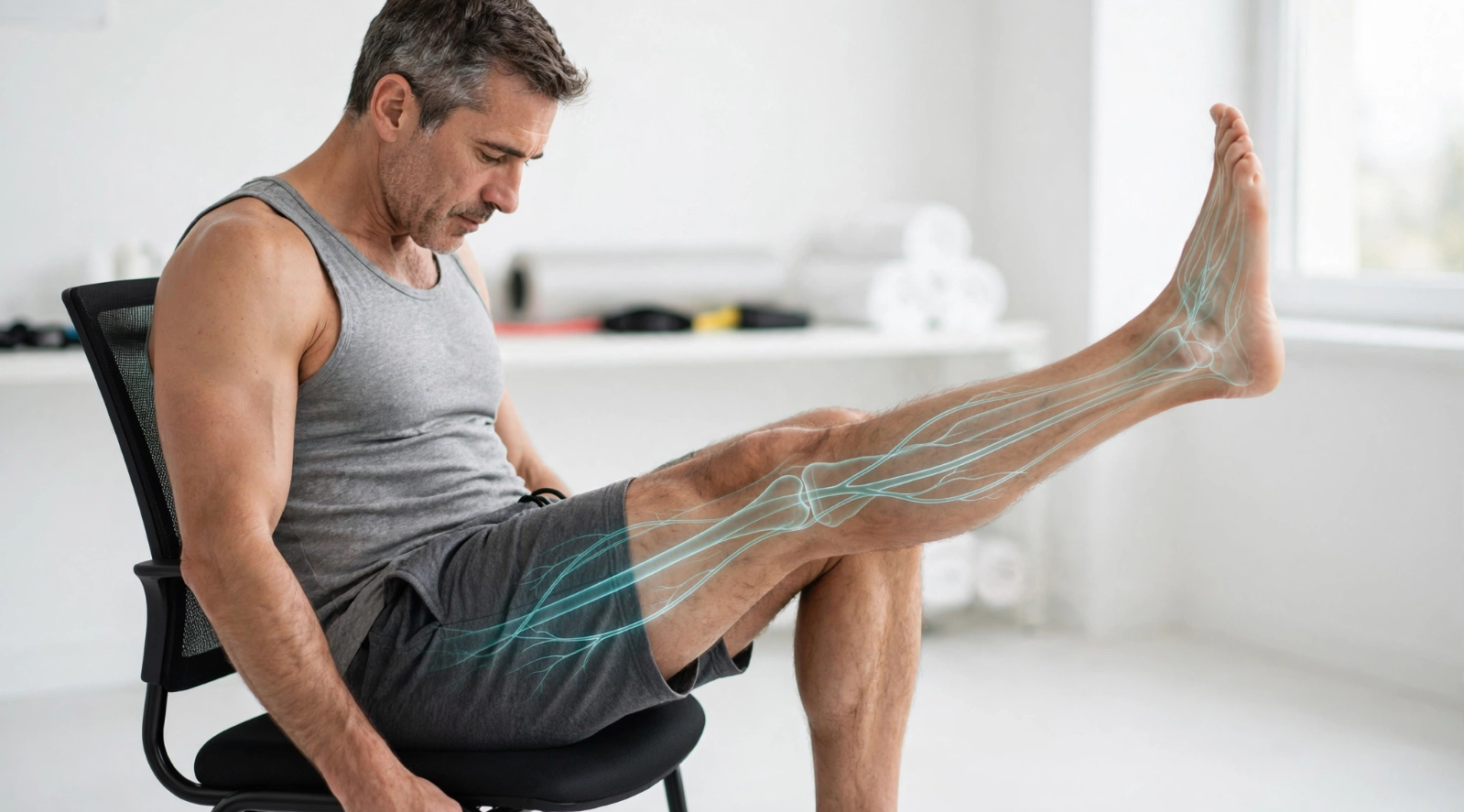
This is the most overlooked factor in chronic hamstring tightness. The sciatic nerve—the largest nerve in your body—exits the spine, passes through the glutes, and runs down the back of your thigh directly under the hamstring muscles.
The Mechanism:
Your nerves are designed to slide and glide within their sheaths as you move. But as we age, fascia tightens, and inflammation decreases neural mobility.
- If the sciatic nerve is “stuck” (adhered) somewhere along its path—often in the lumbar spine or piriformis—it has less “slack.”
- When you perform a straight-leg raise or a forward fold, you are putting tension on the sciatic nerve.
- Your brain cannot distinguish between muscle stretch and nerve traction. It interprets the nerve tug as a threat and triggers a pain reflex.
- The Result: You feel a deep, burning, or tight stretch in the back of your thigh. You think you are stretching the muscle, but you are actually choking a nerve.
The Danger of “Nerve Stretching”:
You cannot stretch a nerve like a muscle without damaging it. Nerves require gliding (sliding back and forth), not tensioning (pulling). Static stretching with a locked knee often exacerbates nerve root irritation, leading to sciatica or radiating pain down the calf.
Section 4: The Fix #1—The Glute Activation Protocol
Stop stretching. Start activating. This is a 5-minute daily routine to perform before any workout or as a morning warm-up.
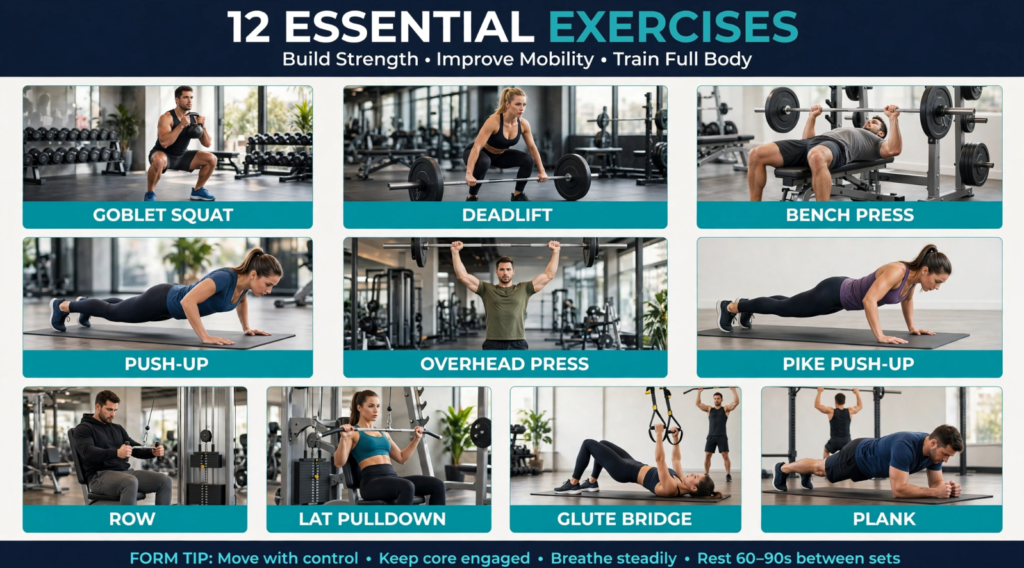
Exercise A: The Glute Bridge (Isometric Hold)
- How: Lie on your back, knees bent, feet flat on the floor. Squeeze your glutes and lift your hips toward the ceiling. Do not push with your lower back.
- The Cue: Imagine you are holding a $100 bill between your glutes—squeeze it tightly.
- Sets: 3 sets of 30-second holds. Rest 30 seconds between.
- Why: Isometric holds fire the slow-twitch fibers of the glute, overriding the brain’s pattern of using the hamstring.
Exercise B: Bird-Dog (Hip Extension with Knee Bent)
- How: Start on all fours. Keep your knee bent at 90 degrees and lift your heel straight up toward the ceiling, pressing your foot into an imaginary wall. Do not arch your lower back.
- The Cue: The movement comes from the hip, not the lower back.
- Sets: 3 sets of 10 reps per side.
- Why: This isolates the glute without lengthening the hamstring, training the brain to use the correct muscle for hip extension.
Section 5: The Fix #2—Nerve Glides (Sciatic Flossing)
This is the game-changer. Instead of pulling the nerve, you slide it. The goal is to move the nerve within its bed to reduce friction.
The Seated Sciatic Nerve Glide:
- Sit on the edge of a chair with a tall spine.
- Straighten one leg out in front of you, heel on the floor, toe pointing up.
- Crucial: Simultaneously flex your ankle (toes toward you) and extend your neck (look up slightly). This puts tension on the nerve along its entire path.
- Immediately point your toes (plantarflex) and flex your neck (chin to chest). This releases the tension and allows the nerve to slide back.
- Move back and forth rhythmically. Tension (toes up/neck back) -> Release (toes down/chin down).
- Sets: 15 to 20 rhythmic repetitions per leg. Do this gently. It should feel like a slight tug, not a screaming stretch.
- Why: This flosses the nerve through the sciatic notch and the hamstring compartment, freeing up adhesions without traumatizing the neural tissue.
Section 6: The Fix #3—Eccentric Hamstring Loading (The Real Lengthener)
To truly “loosen” a hamstring, you must strengthen it in a lengthened position. Eccentric contractions (muscle lengthening under tension) remodel the muscle fibers and increase their tolerance to stretch without triggering a protective spasm.
The Single-Leg Romanian Deadlift (RDL) with a Light Dumbbell:
- Stand on one leg. Keep a slight bend (10-15 degrees) in the standing knee. This takes the nerve off tension and puts the load on the muscle.
- Hinge at your hips, sending the opposite leg straight back. Keep your back flat.
- Lower the weight until you feel a comfortable stretch in the standing hamstring—stop before it hurts.
- Squeeze the glute of the standing leg to return to standing.
- Sets: 3 sets of 8-10 reps per leg.
- Why: This strengthens the hamstring in its vulnerable, lengthened state. A stronger hamstring feels less tight because it is capable of handling the load your body demands.
Section 7: The VigorForty Hamstring Protocol (Daily Schedule)
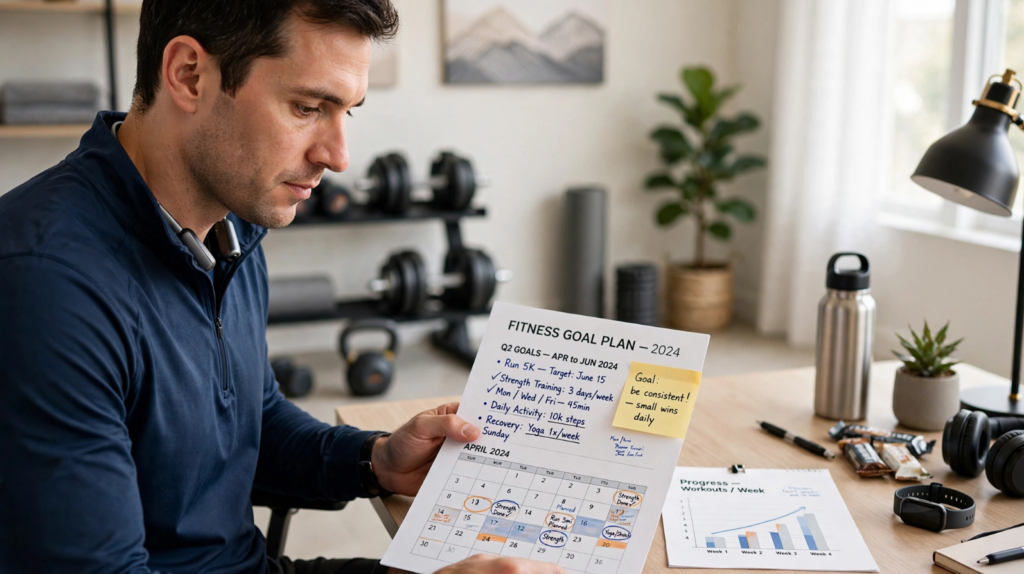
Forget the 30-second toe-touch. Here is your 10-minute daily investment.
| Time | Action | Duration |
|---|---|---|
| Morning | Sciatic Nerve Glides (Seated). Prep the nervous system for the day. | 2 minutes |
| Pre-Workout | Glute Bridges (Isometric holds) + Bird-Dogs. Activate the engine. | 5 minutes |
| Post-Workout | Eccentric RDLs (Light load). Strengthen the lengthened position. | 3 minutes |
| AVOID | Static Toe-Touches with locked knees. Never do these cold. | (Eliminate) |
Progression: As your glute strength improves over 2-3 weeks, you will notice that your “tight” hamstring sensation diminishes significantly. You will also find that you can bend forward further—not because you stretched the muscle, but because your nervous system feels safe enough to allow the muscle to relax into a longer range.
Section 8: FAQ—Your Top Hamstring Questions
Q: I’ve been stretching for years. Why can’t I touch my toes?
A: Because your nervous system is protecting you from perceived injury—either from weak glutes or a trapped sciatic nerve. The physical length of your hamstring has not changed; your brain’s tolerance to the stretch is the issue. Strength training and nerve flossing increase that tolerance.
Q: Is it ever okay to static stretch my hamstrings?
A: Yes, but only at the end of a workout when the muscle is warm, and only for 15–20 seconds, not 60+ seconds. And never with a completely locked knee—keep a slight bend to offload the sciatic nerve.
Q: I have pain right where my butt meets my hamstring. Is this normal?
A: This is suspicious for Proximal Hamstring Tendinopathy. Static stretching will severely aggravate this. Stop stretching immediately and focus exclusively on isometric glute holds (Bridges) and eccentric RDLs without going into deep pain. If it persists, see a physical therapist for a diagnostic ultrasound.
Q: Can tight hamstrings cause lower back pain?
A: Absolutely. When hamstrings are tight (or perceived as tight), they pull on the pelvis, tilting it backward during movement (or straining the lower back during forward folds). This loads the lumbar discs. Additionally, the “neural tension” from a stuck sciatic nerve often originates in the spine, so addressing the nerve glide can relieve both back and leg symptoms.
The VigorForty Take
Chronic hamstring tightness is not a flexibility deficit; it is a neurological output triggered by weak glutes, overworked muscles, and a tense nervous system. The American obsession with “stretching out” the back of the legs is a cultural mistake that has led to a generation of people with persistent tendonitis and sciatic irritation.
It is time to pivot. Replace your long, painful static holds with glute activation, nerve glides, and eccentric strengthening. This approach doesn’t just fix tight hamstrings—it improves your walking gait, protects your knees, and unloads your lower back.
Your challenge: For the next 14 days, do not do a single standing toe-touch. Instead, perform the Glute Bridge and the Seated Nerve Glide daily. On day 15, attempt to touch your toes. We are willing to bet you will reach further than you have in a decade—without a single “stretch.”
Your hamstrings aren’t too short; they are just too weak and stressed. Give them strength and gliding space, and they will finally let you go.
Read All Realated Articles
- The Complete Guide to Heart Health: Beyond Omega-3s—CoQ10, Magnesium, Potassium, and Nitric Oxide Support After 40
- Why Your Hamstrings Are Tight (And Stretching Them Won’t Fix It)—The Real Causes & 4 Fixes for Men Over 40
- The 3 Worst Stretches for the Over-40 Lower Back (And What to Do Instead)
- Pickleball and Your Knees: 4 Preventative Exercises to Bulletproof Your Joints (For Men Over 40)
- The Desk Chair Evaluation: How to Setup Your Home Office to Protect Your Neck, Shoulders, and Upper Back (For Men Over 40)
- The 5-Minute Morning Mobility Routine for Americans Over 40—Start Your Day Pain-Free
- Is Your Pillow Causing Your Neck Pain? The Over-40 Guide to Sleep Posture, Pillow Selection, and Morning Relief
- Collagen vs. Glucosamine vs. Omega-3s: The 3 Best Supplements for Joint Pain (2026 Update for Men Over 40)
- Sciatica vs. Piriformis Syndrome: How to Tell the Difference and Find the Right Treatment (For Men Over 40)
- The 3 Worst Exercises for Bad Knees (And What to Do Instead)—A 40+ Gym Survival Guide
- How to Improve Your Balance After 40—The Underrated Longevity Skill Every Man Needs