
In a world full of notifications, open-plan offices, and endless digital tabs, human focus has become a rare commodity. Most professionals approach their workday reactively: they sit down, open their email inbox, and let everyone else dictate their cognitive energy for the rest of the day.
By the afternoon, their mental energy is entirely depleted, leaving them stressed, unproductive, and trapped in chronic brain fog.
High-output cognitive work does not happen by accident. It is the result of a deliberate, structured framework that matches your work tasks with your natural biology.
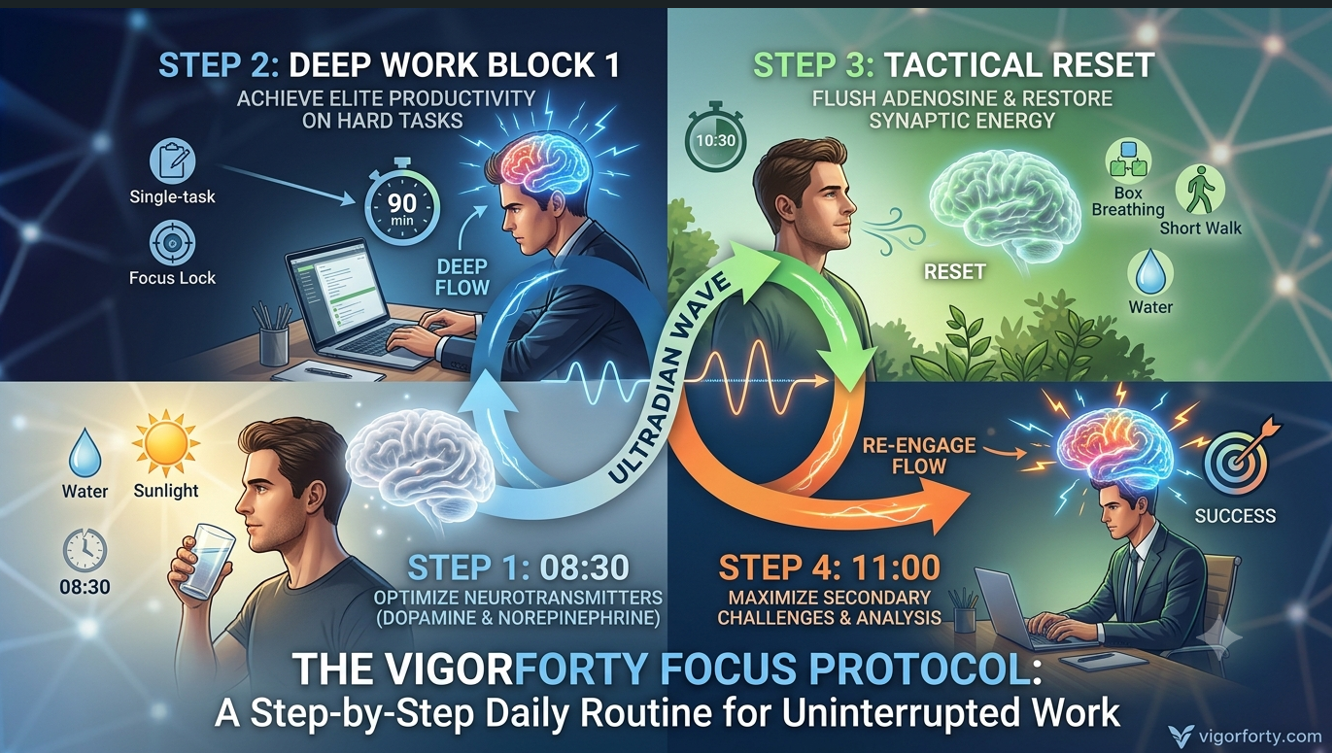
The VigorForty Focus Protocol is a science-backed, step-by-step daily routine designed to optimize your neurotransmitters, leverage your natural energy peaks, and protect your mind from distractions. Here is your operational blueprint for effortless, elite productivity.
1. The Biology of the Protocol: Aligning with Ultradian Rhythms
To design a perfect focus routine, you must understand your brain’s natural operational cycles. Just as your body has a 24-hour circadian rhythm for sleep, it also operates on 90-to-120-minute ultradian rhythms throughout the day.
[00 mins] ──> Neurotransmitters Build up ──> Peak Flow State (at ~60 mins)
                                                    │
                                                    ▼
[90 mins] ──> Synaptic Fatigue Sets in  ──> 20-Minute Cognitive Reset Needed
During the first portion of an ultradian cycle, your brain builds up the neurotransmitters required for focus (dopamine and norepinephrine), reaching a peak performance state. After roughly 90 minutes of intense focus, synaptic fatigue sets in. Your brain runs low on cellular fuel, signaling a necessary down-cycle characterized by restlessness, distraction, or minor fatigue.
The VigorForty Focus Protocol divides your day into dedicated High-Output Blocks and Cognitive Recovery Windows, aligning your workload directly with these biological cycles rather than fighting against them.
2. The Operational Blueprint: The Daily Protocol
| Phase | Time Block | Core Focus | Biological Mechanism |
| Phase 1: Cognitive Priming | 07:00 AM – 08:30 AM | Low-stimulus preparation, natural hydration, and morning light. | Sets baseline cortisol and dopamine levels for the afternoon. |
| Phase 2: Deep Work Block 1 | 09:00 AM – 10:30 AM | Your absolute highest-priority, high-friction cognitive task. | Capitalizes on your peak natural morning alertness. |
| Phase 3: Tactical Reset | 10:30 AM – 11:00 AM | Active rest, hydration, and low-stimulus movement. | Flushes out adenosine and restores cellular ATP. |
| Phase 4: Deep Work Block 2 | 11:00 AM – 12:30 PM | Secondary creative tasks, problem-solving, or deep analysis. | Utilizes the final high-energy morning ultradian wave. |
| Phase 5: Administrative Buffer | 01:30 PM – 03:00 PM | Email responses, calls, scheduling, and meetings. | Protects your high-energy windows from low-value tasks. |
3. Step-by-Step Breakdown of Execution
Phase 1: Priming Your System (Morning)
- The Action: Delay caffeine consumption for 90 to 120 minutes after waking up. Getting natural light and hydrating before using caffeine allows your body to naturally clear out adenosine (the molecule that makes you sleepy). This simple delay protects you from a severe afternoon energy crash.
- The Setup: Write down your single most important objective for the day on a physical note or index card before opening your computer.
Phases 2 & 4: Deep Work Execution
- The Action: Initiate a 90-Minute Focus Lock. Put your phone in a drawer, close all browser tabs unrelated to the task, and launch your environmental sensory anchors (such as noise-canceling headphones or a specific instrumental playlist).
- The Mindset: Accept that the first 15 minutes of any deep work block will feel slightly uncomfortable as your brain transitions away from distraction and begins synthesizing dopamine.
Phase 3: The Tactical Reset
- The Action: When your 90-minute timer sounds, step away from your workstation completely. Do not check your phone or read articles. Walk outside for 5 minutes, practice a brief box-breathing exercise, or drink a glass of water.
- The Reason: Giving your brain true down-time allows your neural networks to consolidate the information you just processed, preparing your synapses for the next high-output block.
Phase 5: Managing the Outflow (Afternoon)
- The Action: Group your emails, meetings, and messaging apps into a single afternoon window.
- The Reason: Constantly checking notifications throughout the morning induces cognitive switching costs, splintering your attention span and destroying your ability to enter a deep flow state.
4. References & Scientific Frameworks
This protocol consolidates recognized clinical insights and behavioral productivity research:
- Ultradian Performance Rhythms: Kleitman, N. (1982). Basic Rest-Activity Cycles in Biological Systems: The Foundation of Ultradian Rhythms. Sleep and Performance Medicine Studies.
- Adenosine Clearance & Caffeine Timing: Lovallo, W. R., et al. (2005). Caffeine Stimulation of Cortisol Secretion Across Waking Hours in Relation to Regular Caffeine Use. Psychosomatic Medicine.
- Cognitive Switching Costs and Interruption Harm: Mark, G., et al. (2008). The Cost of Interrupted Work: More Speed and More Stress. ACM Conference on Human Factors in Computing Systems.
Read Related Articles
- The Anatomy of Brain Fog: Why You Feel Sluggish and How to Reset in 24 Hours
- The Glucose Rollercoaster: How Blood Sugar Spikes Are Sabotaging Your Afternoon Focus
- Sleep Architecture and Clarity: The Exact Nighttime Routine to Prevent Morning Brain Fog
- Dopamine Detoxing for Deep Work: Rewiring Your Brain to Love Hard Tasks
- The Science of Flow State: Neurochemicals Needed to Trigger Peak Concentration
- The VigorForty Focus Protocol: A Step-by-Step Daily Routine for Uninterrupted Work
- Working Memory vs. Long-Term Storage: How Your Brain Decides What to Keep