
Have you ever slept for a full eight hours, only to wake up feeling as though your brain was wrapped in heavy wet wool? You dragged yourself out of bed, drank a cup of coffee, and still struggled to remember where you left your keys.
This happens because when it comes to mental clarity, sleep duration is a vanity metric.
You do not just need sleep; you need optimized sleep architecture. Your brain possesses a highly sophisticated, automated waste-disposal system that only turns on during specific phases of your sleep cycle. If your routine disrupts these phases, metabolic debris builds up, leaving you with a “sleep hangover.”
Here is the neurological blueprint of how your brain cleanses itself at night, and the exact protocol to ensure you wake up sharp, energized, and clear-headed.
1. The Anatomy of Nightly Brain Laundering
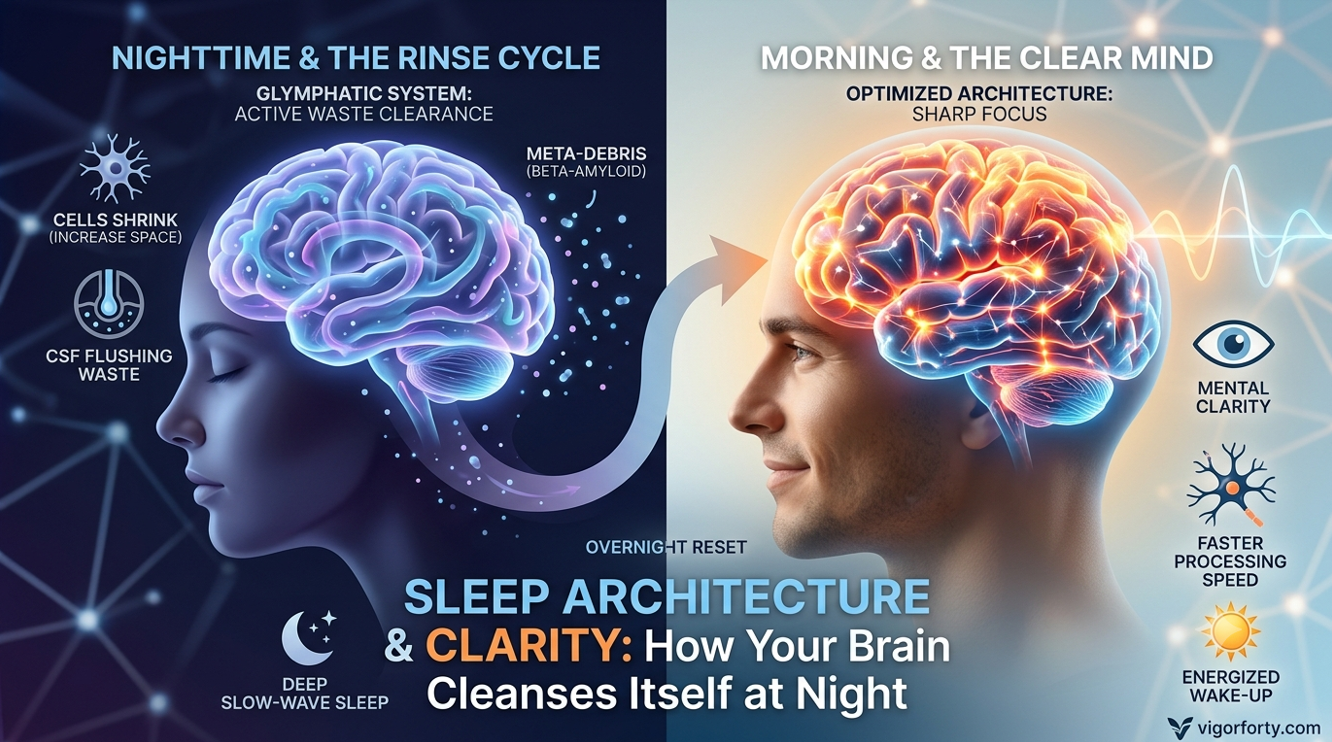
To understand why you wake up foggy, we have to look at what happens inside your skull while you are unconscious. The brain clears out cellular waste through an active filtration system called the glymphatic system.
During your waking hours, your neurons are firing constantly, creating metabolic byproducts. The most notable of these is beta-amyloid—a sticky protein fragment that, when left to accumulate, slows down communication between neurons and induces cognitive fatigue.
[Awake & Working] ──> Metabolic Waste (Beta-Amyloid) Accumulates
                             │
                             ▼
[Slow-Wave Sleep]  ──> Glial Cells Shrink by 60% ──> CSF Flushes Waste Away
                             │
                             ▼
[Result Next Day]  ──> Clean Brain Architecture = Sharp Focus & Memory
During Slow-Wave Sleep (SWS)—the deepest phase of non-REM sleep—your brain’s glial cells physically shrink by roughly 60%. This shrinkage dramatically increases the interstitial space between your brain cells, allowing cerebrospinal fluid (CSF) to rush through the tissue like a dishwasher cycle, flushing the accumulated metabolic waste out of your brain and into your lymphatic system for disposal.
If your sleep architecture is fragmented, your brain terminates this rinse cycle early. The result? You wake up with a literal accumulation of yesterday’s biochemical trash still clouding your synapses.
2. The Architecture Destroyers: Why Your Brain Stays Dirty
Three main disruptors can completely sabotage your deep slow-wave sleep, even if you are unconscious for 8 full hours:
| Disruptor | Neurological Impact | Impact on Next-Day Clarity |
| Late-Night Alcohol | Suppresses REM and fragments slow-wave sleep blocks. | Massive reduction in glymphatic clearance; severe morning brain fog. |
| Evening Cortisol Spikes | Keeps the sympathetic nervous system active, preventing deep sleep entry. | Tossing and turning; waking up feeling physically unrefreshed. |
| Artificial Blue Light | Suppresses melatonin production by tricking the master circadian clock. | Shifts your sleep cycle later, cutting off the deep sleep window entirely. |
3. The VigorForty Nighttime Protocol for Morning Clarity
To maximize your glymphatic clearance and protect your sleep architecture, implement this multi-step evening routine.
Step 1: The 3-2-1 Rule for Metabolic Peace
To ensure your body shifts its energy away from digestion and into neural repair, follow this countdown before your target sleep time:
- 3 Hours Before Bed: Stop eating all food. Digestion raises your core body temperature and heart rate, both of which prevent your brain from slipping into deep slow-wave sleep.
- 2 Hours Before Bed: Stop drinking large amounts of liquids. This prevents micro-awakenings overnight driven by your bladder, which fracture your sleep cycles.
- 1 Hour Before Bed: Eliminate all screens and bright overhead lighting.
Step 2: The Circadian Temperature Drop
Your brain cannot initiate deep sleep unless your core body temperature drops by roughly 1°C (2°F).
- The Action: Take a hot shower or bath 90 minutes before bed. While this seems counterintuitive, the hot water draws blood flow to the surface of your skin (vasodilation). When you step out of the shower, that heat rapidly evaporates, causing a rapid plunge in your core body temperature that signals your brain it is time for deep sleep.
Step 3: Optimize Your Sleep Environment
- Keep it Cool: Set your bedroom thermostat between 15°C and 19°C (60°F to 67°F).
- Total Blackout: Use blackout curtains or an eye mask. Even tiny amounts of ambient light hitting your closed eyelids can register in your suprachiasmatic nucleus (the brain’s master clock) and lower overall sleep quality.
4. References & Scientific Frameworks
This article relies on foundational neuro-architecture and sleep medicine data:
- The Glymphatic System and Waste Clearance: Nedergaard, M., et al. (2013). The Glymphatic System: A Discovery That Rewrites Brain Clean-up Mechanics. Science Translational Medicine.
- Temperature Regulation & Sleep Induction: Murphy, P. J., & Campbell, S. S. (1997). Nighttime Drop in Core Body Temperature and its Direct Link to Deep Sleep Initiation. Journal of Sleep Research.
- Melatonin Suppression by Blue Light: Gooley, J. J., et al. (2011). Exposure to Room Light before Bedtime Suppresses Melatonin Onset and Shortens Melatonin Duration in Humans. The Journal of Clinical Endocrinology & Metabolism.
Read Related Articles
- The Anatomy of Brain Fog: Why You Feel Sluggish and How to Reset in 24 Hours
- The Glucose Rollercoaster: How Blood Sugar Spikes Are Sabotaging Your Afternoon Focus
- Sleep Architecture and Clarity: The Exact Nighttime Routine to Prevent Morning Brain Fog
- Dopamine Detoxing for Deep Work: Rewiring Your Brain to Love Hard Tasks
- The Science of Flow State: Neurochemicals Needed to Trigger Peak Concentration
- The VigorForty Focus Protocol: A Step-by-Step Daily Routine for Uninterrupted Work
- Working Memory vs. Long-Term Storage: How Your Brain Decides What to Keep