
Author: Vigor Forty Editorial Team
Medically Reviewed By: Editorial Review Board
Disclaimer: This article is for informational purposes only and is not a substitute for professional medical or psychological advice. Read our full Medical Disclaimer.
📌 Key Takeaways
Most Health Efforts Fail Because of Poor Habit Design, Not Poor Willpower: After 40, life is complex and energy is finite. Relying on motivation alone is a losing strategy. The science of habit design—tiny behaviors, environmental cues, and identity shifts—creates automatic routines that conserve willpower and last for decades.
Sustainable Routines Are Built on the “Tiny Habits” and “Habit Stacking” Frameworks: A 2-minute walk after coffee or one push-up before a shower can be the seed of a robust fitness habit. These micro-behaviors bypass the brain’s resistance to big changes and, over time, compound into transformative health outcomes.
Tracking Health Metrics Is Non-Negotiable for Midlife Longevity—But It Must Remain Simple: Heart rate variability (HRV), resting heart rate, sleep duration and quality, blood pressure, step count, and body weight are the highest-yield markers for the 40+ American. The goal is trend awareness, not obsessive perfection.
The “VigorForty Habit Loop” Creates Autopilot Health: Combining a tiny behavior with an existing routine, an immediate reward, and a visible tracking method wires your brain for consistency. This loop lowers the perceived effort of exercise, sleep hygiene, and medication adherence until they feel as natural as brushing your teeth.
American Life Demands Specific Habit-Proofing Strategies: Business travel, holiday seasons, shift work, and the standard American diet are not excuses—they are design challenges. Your habit system must include “never miss twice” rules, travel-sized cues, and a simple paper or digital tracker to survive real-world disruption.
Introduction: Your Best Health Intentions Deserve a System That Works
Every January, millions of Americans join a gym, buy a fitness tracker, and swear this is the year they’ll get healthy. By February, 80% have quit. The problem isn’t their character or their goals—it’s that they’re trying to power a 45-year-old life with 25-year-old willpower.
After 40, the biological and social landscape shifts. Recovery takes longer, stress is higher, and responsibilities multiply. The all-or-nothing approach to health stops working. What does work is deliberately designing your environment and your daily micro-actions so that healthy choices become the path of least resistance. This is the essence of habit design: engineering your life so that you do the right things automatically, without having to be the hero every morning.
This article gives you a complete, evidence-based blueprint for building sustainable health routines. You’ll learn why tiny habits outperform grand resolutions, how to stack new behaviors onto existing ones, which health metrics to track and how to track them without burnout, and how to fuse this system with the VigorForty supplement protocol. This is not a 30-day challenge. This is a lifelong operating system for a resilient, high-energy American life.
Section 1: Why Habit Design Matters More After 40
Understanding why standard advice fails is the first step to fixing it. After midlife, you face a unique set of biological and behavioral hurdles.
Declining Cognitive and Physical Reserves
Executive function—the mental energy required to make decisions and override impulses—naturally declines with age and stress. A 50-year-old who has already made 200 decisions at work, managed family logistics, and dealt with traffic has a nearly empty tank for “choosing” a workout or cooking a healthy meal. A well-designed habit removes the choice. It just happens.
The Allostasis of Chronic Stress
The American 40-something often exists in a state of chronic sympathetic nervous system activation (fight or flight). This elevated cortisol drives cravings for high-calorie comfort foods, disrupts sleep, and makes the prospect of intense exercise feel overwhelming. Habit design counteracts this by lowering the activation energy for recovery behaviors like a 5-minute evening walk or a pre-bed gratitude journal, which actively down-regulate the stress response.
Identity Lock-In and the “Midlife Narrative”
By 40, many Americans have told themselves a story: “I’m not a morning person,” “I’ve never been athletic,” “My whole family is big-boned.” These identity statements are habits of thought that block behavior change. The most powerful habit shift is not a new action but a new self-story: “I’m the kind of person who moves every day, no matter what.” Tiny actions provide the evidence that makes this new identity stick.
The Compounding Power of Time
A 20-year-old can afford to experiment for a decade. A 50-year-old cannot. But the mirror is also a gift: a small, consistent health habit started at 45—like a 15-minute daily walk or an extra serving of vegetables—can prevent or delay hypertension, diabetes, and frailty for decades. Habit design after 40 is the highest-leverage investment you can make.
Section 2: The Tiny Habits Method—Start So Small You Can’t Fail
The core methodology comes from Dr. BJ Fogg’s Stanford Behavior Design Lab. His central insight: the smaller the behavior, the less motivation it requires, and the more reliably it can become automatic.
The Fogg Behavior Model (B = MAP)
A behavior happens when three elements converge in the same moment: Motivation, Ability, and a Prompt. After 40, you cannot rely on high motivation—it fluctuates with sleep, stress, and life chaos. So you must make the behavior so easy (high Ability) and the prompt so obvious that the behavior happens even when motivation is low.
Practical Tiny Habit Recipes for Americans Over 40:
- Exercise: After I pour my morning coffee, I will do 2 bodyweight squats. (That’s it. Often, you’ll do 10, but the commitment is just 2.)
- Hydration: After I flush the toilet in the morning, I will drink a small glass of water I keep on the bathroom counter.
- Sleep: After I plug in my phone for the night, I will read one page of a physical book.
- Stress: After I sit in my car in the work parking lot before driving home, I will take 3 slow, deep breaths.
- Nutrition: After I open the fridge for dinner, I will put one handful of greens on the plate first.
Why This Works Neurobiologically:
Your brain’s basal ganglia, the habit center, responds to repetition linked to a stable cue. A tiny behavior, successfully performed, releases dopamine—a small reward that strengthens the neural pathway. Over weeks, the behavior becomes automatic. You’re not fighting your brain; you’re reprogramming it. The American obsession with extreme transformation fails because it demands too much dopamine upfront and delivers too much pain. Tiny habits flip the equation.
Section 3: Habit Stacking—The Superglue for Your Routine
Habit stacking, popularized by James Clear in Atomic Habits, is a practical implementation of the Fogg model. You identify a current habit you already do without fail and “stack” a new tiny behavior right after it.
The Formula:
“After [CURRENT HABIT], I will [NEW TINY BEHAVIOR].”
Habit Stacking Chains for Midlife Health:
The Morning Energy Chain:
After I turn off my alarm → I will sit on the edge of my bed and drink 8 oz of water.
After I drink water → I will step outside my front door for 2 minutes of daylight.
After those 2 minutes → I will do 5 wall push-offs.
After wall push-offs → I will take my supplements (omega-3s, D3+K2, CoQ10).
The Work Day Decompression Chain:
After I close my laptop at 5:30 PM → I will put on my walking shoes.
After I put on my shoes → I will walk around the block once (10 minutes).
After my walk → I will change into comfortable clothes.
After changing → I will drink a glass of water with electrolyte powder.
The Evening Wind-Down Chain:
After I set my phone to “Do Not Disturb” at 9:00 PM → I will lower the lights in the living room.
After lowering lights → I will spend 5 minutes stretching or foam rolling while listening to jazz or ambient music.
After stretching → I will read a fiction book in bed for 10 minutes.
After reading → I will place my sleep mask over my eyes.
American Adaptations:
- For the parent with school-age kids: “After I pack the lunchboxes, I will eat one piece of fruit standing at the counter.”
- For the frequent business traveler: “After I place my hotel key card in the slot by the door, I will do 10 air squats. No equipment, no excuses.”
- For the shift worker coming off a graveyard rotation: “After I park my car in the driveway, I will sit for one minute with my eyes closed before going inside—this marks the transition to sleep mode.”
Section 4: Tracking Health Metrics That Actually Matter (Without Obsession)
You can’t improve what you don’t measure. But for Americans over 40, the goal is trend awareness, not data perfection. Tracking becomes a reinforcing habit itself when it’s simple, visual, and rewarding.
The VigorForty Core Metric Shortlist:
These five metrics provide a 360-degree view of cardiovascular, metabolic, and resilience status with minimal time investment.
| Metric | Why It Matters After 40 | Tracking Method |
|---|---|---|
| Resting Heart Rate (RHR) | A rising RHR can signal overtraining, stress, poor sleep, or low cardiovascular fitness. A stable or declining RHR means your heart is becoming more efficient. | Any wearable (Apple Watch, Fitbit, Oura) or manual radial pulse count for 30 seconds x2 upon waking. |
| Blood Pressure | Hypertension is the silent killer. Home readings are more predictive than in-office readings. | Upper-arm cuff monitor (Omron), 3 mornings per week, sitting for 5 minutes first. |
| Sleep Duration & Quality | Sleep after 40 is the foundation of hormone balance, cognitive function, and habit willpower. | Wearable sleep tracker or a simple notebook: record time to bed, wake time, and a subjective 1–5 rating. |
| Daily Step Count | Correlates strongly with all-cause mortality. 7,000–10,000 steps/day is the longevity sweet spot. | Phone pedometer or inexpensive clip-on pedometer. Start by simply tracking your baseline, then increase by 500 steps per week. |
| Body Weight (Weekly Average) | Weight creeps up insidiously after 40. A weekly average (weigh-in 3x/week) smooths daily fluctuations and catches trends early. | Digital scale, same time, same conditions. Record in an app or notebook. |
Low-Tech Tracking: The “Seinfeld Strategy”
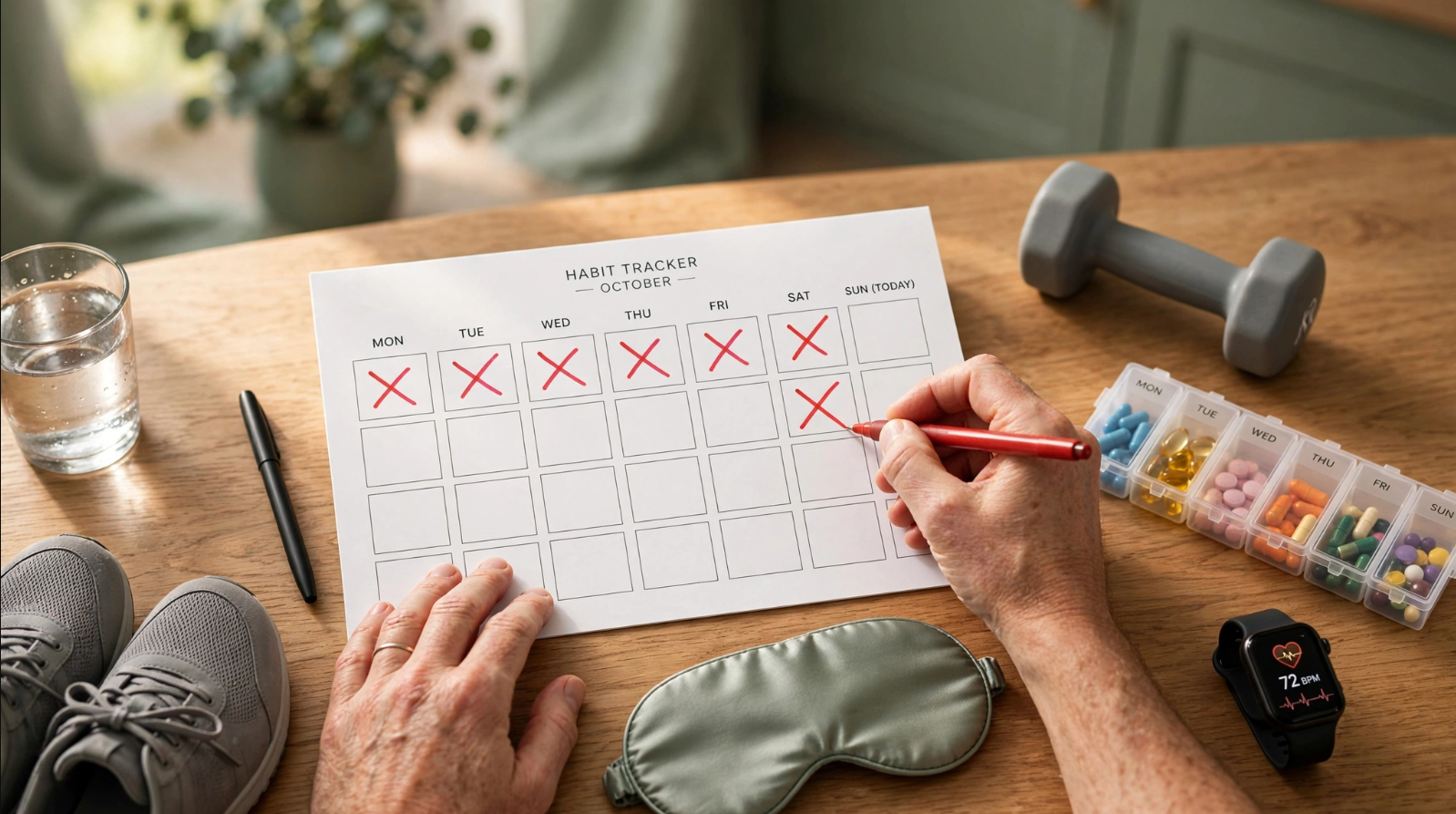
For those overwhelmed by apps, a simple wall calendar and a red marker are transformative. Every day you complete your tiny habit (e.g., “morning squats” or “10-minute walk”), you draw a big red X on that day. The goal is not to break the chain. This visual feedback is a potent dopamine reward, and the growing chain of X’s becomes a valuable asset you will not want to lose.
High-Tech Tracking: Wearables and the American Quantified Self
Apple Watch, Oura Ring, Whoop, and Garmin are powerful tools, but they can lead to orthosomnia (obsessive perfectionism). Use them to observe trends, not to judge your daily worth. Check your HRV and readiness score in the morning, note it, then move on. If your HRV is low, treat it as information—a signal to prioritize a 10-minute walk and an earlier bedtime—not a failure.
Section 5: The VigorForty Habit Design Protocol
This protocol integrates habit design principles with your existing supplement stack, creating a seamless daily flow that conserves mental energy and builds health capital.
Daily Habit Loop (The “AMA” Framework: Anchor, Micro-behavior, Acknowledgment):
| Time of Day | Anchor (Current Habit) | Micro-behavior (New Tiny Habit) | Acknowledgment (Immediate Reward) |
|---|---|---|---|
| Morning | Coffee maker finishes brewing | Take supplements with a full glass of water | Say “I am caring for my future self” (internal celebration) |
| Mid-Morning | Stand up to use restroom | 2-minute stretch or walk to the farthest restroom in the office | Notice how your body feels more energized |
| After Work | Close laptop / clock out | Put on walking shoes and step outside for 10 minutes | Listen to a favorite podcast or call a friend |
| Evening | After kitchen is closed for the night | Prepare tomorrow’s supplement organizer and water bottle | The visual of the ready-to-go kit; a sense of calm control |
Integration with the VigorFive Supplement Routine:
The VigorFive (Vitamin D3+K2, Magnesium, Omega-3s, Creatine, Protein) becomes its own habit stack. Place the daily pill organizer next to your coffee maker or toothbrush. The act of taking supplements is a trigger to also drink a full glass of water—two habits in one. If you use a protein shake, prepare the dry ingredients the night before in the blender cup. This small environmental design cuts morning friction to zero.
The “Never Miss Twice” Rule:
Perfection is impossible. The defining habit of people who succeed long-term is not that they never miss a day—it’s that they never miss two days in a row. Life will throw travel, illness, and family emergencies at you. When you inevitably miss your walk or eat poorly, your only job is to re-engage the very next day. No guilt, no self-flagellation—just the immediate next tiny step.
Section 6: Habit-Proofing Your American Life
Your environment is not neutral. It is filled with cues engineered by a food and tech industry that profits from your inactivity and poor nutrition. Reclaiming control means redesigning your personal world.
Environment Design for Nutrition Habits:
- Place a fruit bowl on the kitchen counter, and move chips and cookies to a high shelf or the back of the pantry. You eat what you see.
- Use smaller plates. Americans serve themselves 30% more food on larger plates. A 9-inch plate becomes a passive portion-control habit.
- At restaurants, ask for a to-go box with your meal and immediately pack half. The “portion-size” habit is stronger than your in-the-moment willpower.
Environment Design for Movement Habits:
- Sleep in your workout clothes (or at least the shorts and t-shirt). The friction of changing is eliminated at 6:00 AM.
- Keep a set of resistance bands and a yoga mat visible in the living room, not hidden in a closet. Visibility is a prompt.
- Park at the far end of the grocery store lot. This single tiny decision adds hundreds of steps per trip with zero conscious effort.
Habit Design for the American Holiday Gauntlet (Thanksgiving to New Year’s):
This 6-week period destroys more health progress than any other. Your protocol: maintain a single non-negotiable “anchoring habit.” It could be a 10-minute morning walk, drinking a green smoothie, or taking your supplements without fail. One unbroken habit chain through the holidays preserves your identity as a healthy person and makes January 1st a gentle re-acceleration, not a crisis rescue.
Section 7: FAQ—Your Top Habit Design Questions
Q: I’ve tried and failed so many times. What makes this different?
A: You weren’t the problem. The size of the behavior was. If you set a goal like “exercise 45 minutes, 5 days a week,” you’re demanding high motivation every single day. A 2-minute tiny habit removes the failure point. You can always do 2 minutes. Success builds self-efficacy, which fuels bigger changes organically. This isn’t a motivational speech; it’s a behavioral technology.
Q: How long until a new habit actually feels automatic?
A: The “21 days” myth is false. Research suggests that simpler behaviors can become automatic in 18 days, while more complex routines (like a gym session) can take closer to 66 days or longer. But with tiny habits and habit stacking, you’ll feel a significant reduction in internal resistance within 2–4 weeks. The goal is not a specific number; it’s the day you notice you did the behavior without having to consciously force it.
Q: I feel overwhelmed tracking so many metrics. Can I just track one?
A: Yes. If you only track one thing, track your blood pressure and resting heart rate. Buy a reliable home monitor and record them three mornings a week. This single habit gives you a direct window into your cardiovascular trajectory. Add sleep duration once that feels effortless. Never add a second metric until the first is automatic.
Q: I have a chaotic, unpredictable schedule. How can I build a routine?
A: Anchor your habits to the most stable events in your day: waking up, using the bathroom, eating a meal, or going to bed. Even on a chaotic day, you will use the bathroom and you will eat something. Attach a tiny 30-second micro-habit to one of those absolute constants. Travel? Your anchor is “after I check into the hotel room.” The routine travels with you.
Q: How do I use a habit tracker if I’m not tech-savvy?
A: The best tracker is the one you’ll use. Go to any dollar store, buy a large paper wall calendar and a red Sharpie. Hang it in the bathroom or kitchen. Every day you do your tiny habit, mark a big X. That’s it. It’s cheap, deeply satisfying, and impossible to ignore. My 72-year-old father lowered his blood pressure 15 points using this method for his daily walk.
The VigorForty Take
Building health after 40 is not about more willpower, more discipline, or another unsustainable 90-day program. It is about respecting the psychology and biology of midlife and working with them, not against them. Your brain is wired to automate repeated behaviors in response to stable cues. Your body responds beautifully to consistent, small inputs—a few extra steps, one more serving of greens, consistent supplement intake, a nightly wind-down ritual. These tiny habits, tracked simply and celebrated briefly, compound into the most valuable asset you will ever own: a resilient, capable, vibrant body that carries you through your 50s, 60s, and beyond.
Start today with a single tiny habit. Perhaps it’s drinking a glass of water after you brush your teeth. Put the red X on the calendar tonight. The health you want is not built in a weekend transformation—it is built in the quiet, ordinary moments you design, one small, successful step at a time. Your future self, the one with strong bones, flexible arteries, and morning energy, will thank you for the system you begin today.
Read All Related Articles
- The Complete Guide to Heart Health: Beyond Omega-3s—CoQ10, Magnesium, Potassium, and Nitric Oxide Support After 40
- The Complete Guide to Habit Design After 40: Building Sustainable Health Routines and Tracking What Matters
- The 8 Health Metrics Every American Over 40 Should Track (And How to Do It Without Obsession)
- Habit Stacking for Busy Americans: A 10-Minute Morning Routine That Actually Sticks
- Sleep Tracking Demystified: How to Use Your Apple Watch/Oura Ring to Wake Up Refreshed
- Habit Design 101: Why You Fail (And the Tiny Fix That Changes Everything)
- From Couch to Consistent: The 30-Day ‘Exercise Snack’ Habit Plan
- The Mediterranean Diet Habit Blueprint (For Americans Who Hate Meal Prep)
- HRV Explained: Why It Matters and How to Improve It Without Chasing Numbers
- Whoop vs. Oura vs. Fitbit: Which Health Tracker Fits Your Lifestyle?
- How to Keep Your Health Habits Alive During BBQ & Travel Season
- 5-Minute Poolside/Patio Workouts (No Equipment, No Sweat)
- Half-Year Habit Audit: A Simple Framework to Review What’s Working
- Reader Stories: 3 Americans Who Transformed Their Health with One Tiny Habit