
Author: Vigor Forty Editorial Team
Medically Reviewed By: Editorial Review Board
Disclaimer: This article is for informational purposes only and is not a substitute for professional medical advice. Read our full Medical Disclaimer.
📌 Key Takeaways
- The Best Tracker Is the One You’ll Wear Consistently: For Americans over 40, the ideal device depends on comfort, battery life, the metrics you actually care about, and whether you can tolerate a subscription fee. A $300 gadget sitting in a drawer provides zero insight.
- Oura Ring Excels at Sleep and Recovery Tracking With a Discreet Form Factor: Its ring design is comfortable for 24/7 wear, battery lasts up to a week, and it delivers excellent sleep staging, HRV, and readiness scoring. It’s ideal if your primary goal is sleep optimization and stress management, not intense workout tracking.
- Whoop Provides Elite-Level Strain and Recovery Analytics for the Dedicated Self-Optimizer: It has no screen, focuses heavily on heart rate variability and recovery, and requires a monthly subscription. It’s best for those who exercise regularly and want to fine-tune their training load and sleep debt.
- Fitbit Offers the Most Versatile, Mainstream Ecosystem With No Mandatory Subscription (for Basics): With a screen, GPS, step counting, and a wide range of models, Fitbit suits the all-around user who wants activity tracking, sleep insights, and smartwatch features in one device. Some advanced analytics now require Fitbit Premium.
- Apple Watch Is the Best Smartwatch Hybrid—If You Already Live in the Apple Ecosystem: It’s a full-featured smartwatch with strong health tracking (ECG, SpO2, HRV), but daily charging and a higher price point can be barriers for those who simply want a sleep-and-recovery wearable. It’s the top pick for the tech-savvy 40+ American who also wants calls, messages, and apps.
Introduction: Choosing a Tracker Should Be About Your Life, Not the Spec Sheet
Walk into any electronics store, and you’ll find a wall of wearables promising to transform your health. For the American over 40, who is now tracking blood pressure, trying to improve sleep, and building sustainable movement habits, a wearable can be a powerful ally—or an expensive source of confusion. The three names that dominate the recovery and health tracking conversation are Whoop, Oura, and Fitbit. (And the Apple Watch looms large as a hybrid contender.)
Each device has a distinct philosophy. Whoop is a coach that lives on your bicep and tells you how hard to train. Oura is a discreet ring that whispers about your sleep quality and readiness. Fitbit is a familiar wrist-based companion that counts your steps and increasingly offers deep health insights. Apple Watch is the supercomputer on your wrist that happens to track your health beautifully. The choice isn’t just about which has the most accurate sensor—it’s about which device fits seamlessly into your daily American life, whether that life is spent in an office, on a construction site, chasing kids, or traveling.
This article gives you a clear, head-to-head comparison focused on the metrics that matter after 40: sleep, heart rate variability, resting heart rate, activity, and blood oxygen. You’ll see a straightforward comparison table, walk through real-life lifestyle scenarios, and learn how each device integrates with the VigorForty supplement and habit tracking system. By the end, you’ll know exactly which tracker, if any, belongs on your body.
Section 1: What Actually Matters in a Health Tracker After 40
Before comparing devices, identify what you need to measure. A 25-year-old CrossFitter has different priorities than a 50-year-old who wants to lower blood pressure, sleep better, and stay active.
Core Metrics for Midlife Health (Our Dashboard):
- Sleep Duration and Quality: Can it accurately tell how long you slept and distinguish deep, light, and REM sleep?
- Resting Heart Rate and HRV: Does it provide a reliable overnight or morning HRV reading to gauge recovery and autonomic balance?
- Activity Tracking: Does it capture daily steps, general movement, and intentional exercise without needing manual input?
- Blood Oxygen (SpO2): Optional but valuable for screening sleep-disordered breathing, which becomes more common after 40.
- Trending and Context: Does the app help you see long-term patterns, or does it just throw daily numbers at you?
Usability Factors That Matter More Than Specs:
- Form Factor: Will you wear it every night? Rings are often more comfortable for sleep than wristbands. Biceps bands avoid wrist movement artifacts but require a band. Wristwatches are familiar but can disrupt sleep for sensitive sleepers.
- Battery Life: Daily charging is a habit barrier. A device that lasts 4–7 days reduces the chance of missed data.
- Subscription Model: Whoop requires a monthly/yearly membership. Oura charges a monthly fee for full features. Fitbit has Premium for deeper analytics. Apple Watch has no mandatory health subscription. The total cost of ownership matters.
- Screen or No Screen: A screen gives you real-time data but can be distracting. A screenless device forces you to the app, which can reduce obsessive checking.
Section 2: The Contenders—A Detailed Breakdown
Oura Ring (Gen3, Horizon, or Stealth)
Philosophy: 24/7 health monitoring in a ring. Discreet, comfortable, focused on sleep and readiness.
Best For: The sleep-prioritizing, low-key tracker who wants deep recovery insights without another screen. Excellent for those who dislike wristbands at night. Very popular with the 40+ demographic for its elegant, jewelry-like form factor.
Key Strengths:
- Best-in-class sleep staging accuracy for a consumer wearable (validated against polysomnography in multiple studies).
- Excellent HRV tracking (overnight average), which feeds a simple Readiness Score.
- Long battery life (4–7 days).
- Automatically detects naps and activity; good temperature sensing for illness prediction.
- No screen; the ring is unobtrusive.
Key Weaknesses:
- Not an activity tracker in the traditional sense. Step count and workout HR are decent but not as real-time accurate as a wrist-based device.
- Monthly subscription (~$5.99/month) required for most of the deep analytics; without it, you get only three daily scores.
- Ring sizing must be precise; fingers swell with heat and exercise.
Whoop (4.0 Band, with Biceps or Wrist Options)
Philosophy: A 24/7 performance optimization tool for the serious self-tracker. It measures Strain (how hard your day was) and Recovery (how ready you are).
Best For: The active 40+ individual who exercises regularly—especially if you do varied activities (cycling, weightlifting, running) and want to optimize training load and sleep debt. Also great for those who want zero screen time on the device.
Key Strengths:
- Highly detailed recovery metrics built around HRV and resting heart rate.
- Strain Score quantifies cardiovascular load from any activity, including non-exercise stress.
- Excellent sleep tracking with a powerful Sleep Coach that recommends bedtimes and wake times based on sleep debt.
- Biceps band option improves accuracy during workouts by avoiding wrist motion artifacts.
- No screen; the device is a simple sensor band.
Key Weaknesses:
- No step counting. Whoop intentionally avoids steps, focusing on strain, which can alienate users who like daily step goals.
- Mandatory subscription: $30/month or $239/year. This is the most expensive ongoing cost among dedicated fitness wearables.
- No GPS, no screen, no SpO2 (yet, though it’s in development). You need your phone for any data.
- Band must be worn fairly tight, which some find uncomfortable for 24/7 use.
Fitbit (Charge 6, Versa 4, Sense 2, Inspire 3)
Philosophy: A mainstream, screen-based tracker for everyday health and fitness, with a broad feature set and an enormous user base. Google-owned, with integration into the Google ecosystem.
Best For: The all-rounder who wants a screen to check the time, steps, and notifications, plus solid sleep and activity tracking. Great for the 40+ user who wants one device for daily wear and occasional exercise, without a separate ring.
Key Strengths:
- Versatile range: budget-friendly Inspire 3 to advanced Sense 2 with ECG and stress sensors.
- Excellent automatic activity and sleep tracking; SpO2 monitoring on most models.
- Built-in GPS on higher-end models (Charge 6, Versa 4) for phone-free runs.
- Fitbit Premium ($9.99/month) offers deeper analytics, but core features like sleep score, resting heart rate, and HRV are available without a subscription.
- Smartwatch features: notifications, contactless payments (on some models), and a color touchscreen.
Key Weaknesses:
- Wrist-based form factor is less comfortable for sleep for some users.
- HRV tracking is less refined than Whoop or Oura; it provides a nightly average but not the same level of recovery context.
- Fitbit Premium paywall locks detailed readiness and stress management behind subscription.
- Battery life 5–7 days on basic models, but only 1–2 days on smartwatch models with always-on display.
Apple Watch (Series 9, Ultra 2—Honorable Mention)
Philosophy: The ultimate smartwatch that also happens to be an excellent health tracker.
Best For: iPhone users who want a full-featured smartwatch, are comfortable with daily charging, and want the most advanced heart health sensors (ECG, irregular rhythm notifications, high/low heart rate alerts) alongside fitness tracking. If you already wear an Apple Watch, you likely don’t need a second device for sleep unless you find it uncomfortable at night.
Key Strengths:
- Industry-leading optical heart rate sensor; ECG and SpO2 built in.
- Comprehensive activity rings and workout tracking.
- Integrates seamlessly with iPhone Health app; stores HRV data that can be viewed in third-party apps like Athlytic or Training Today for recovery insights.
- No mandatory health subscription; apps are optional.
Key Weaknesses:
- Daily charging. The 18-hour battery life means you must charge it during a daily window (e.g., while showering).
- HRV is measured sporadically during the day unless you use a third-party app to trigger readings, or rely on overnight averages from sleep tracking (which improved with watchOS 9+).
- Expensive upfront cost (Series 9 starts at $399).
- Wrist-worn; some find it bulky for sleep.
Section 3: Head-to-Head Comparison Table
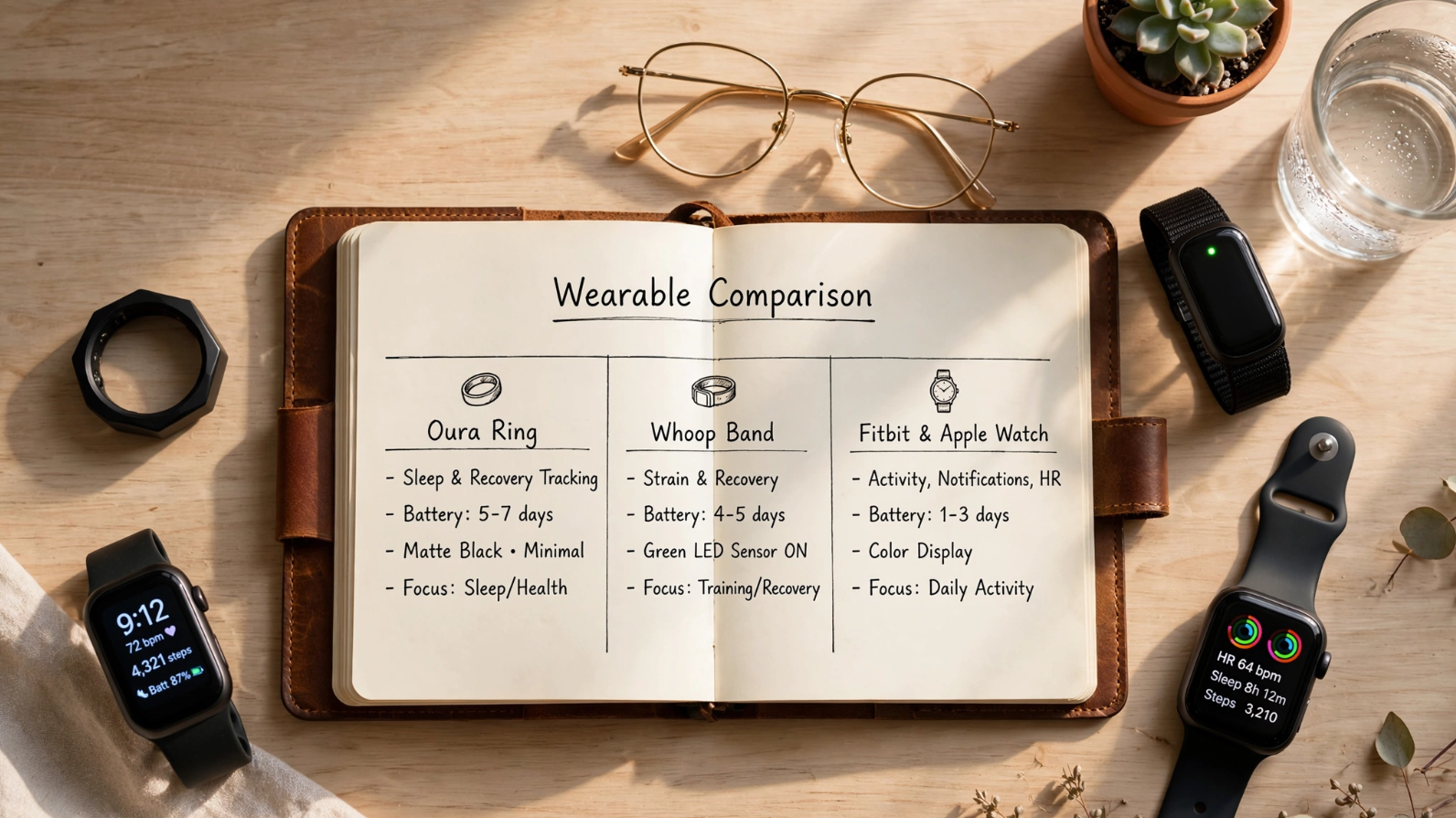
| Feature | Oura Ring Gen3 | Whoop 4.0 | Fitbit (e.g., Charge 6) | Apple Watch Series 9 |
|---|---|---|---|---|
| Form Factor | Ring | Wrist/Biceps Band | Wristband / Watch | Watch |
| Screen | None | None | Color touchscreen | Color touchscreen |
| Battery Life | 4–7 days | 4–5 days | 5–7 days (Charge) / 1–2 days (Versa/Sense) | ~18 hours |
| Sleep Tracking | Excellent, validated | Excellent, with coach | Very good, with score | Good (improved), third-party apps available |
| HRV | Overnight average, very reliable | Overnight average, core metric | Nightly average, basic | Sporadic; overnight average in Health app |
| RHR & SpO2 | Yes, both | Yes, SpO2 pending | Yes, both | Yes, both (SpO2 app may not be available in US due to patent issue) |
| Activity Tracking | Steps, basic workout HR | Strain-based, no steps | Steps, GPS, full workout | Steps, GPS, full workout |
| Subscription Required | $5.99/mo for full features | Yes, $30/mo or $239/yr | No (Premium optional $9.99/mo) | No (third-party apps may charge) |
| Best For | Sleep & recovery only | Training load optimization | All-around daily tracking | Smartwatch + health hybrid |
Section 4: Which Tracker Fits Your American Lifestyle?
Choose the device that matches how you actually live, not how you aspire to live.
Scenario 1: “I Just Want to Sleep Better and Know If I’m Recovered.”
You’re a busy professional or parent. Exercise is moderate—daily walks, occasional weekend bike rides. You hate wristbands at night and don’t want another screen. You want to check a readiness score in the morning and move on.
Best Pick: Oura Ring. Its form factor and sleep-first focus are unmatched for this profile.
Scenario 2: “I’m Training for Something—or I Want to Know Exactly How Hard to Push.”
You regularly exercise with intensity: HIIT, cycling, running, weightlifting. You want to quantify your cardiovascular strain and learn how sleep, alcohol, and stress affect your performance and recovery. You’re willing to wear a band 24/7 and pay a subscription.
Best Pick: Whoop. The Strain and Recovery ecosystem is purpose-built for this.
Scenario 3: “I Want One Device for Steps, Sleep, and Notifications—Keep It Simple.”
You want to count steps, see your sleep score, get text notifications, and maybe track a weekend hike with GPS. You don’t want to pay a monthly fee for basic data. You like a screen.
Best Pick: Fitbit Charge 6 (or Versa 4 if you want more smartwatch features). The most accessible, no-fuss option.
Scenario 4: “I’m an iPhone User and Want It All—Even If I Have to Charge It Daily.”
You value the ECG, fall detection, seamless Apple integration, and the ability to leave your phone behind on runs with cellular. You’re okay with charging during your morning routine.
Best Pick: Apple Watch. Pair it with a sleep-tracking app like AutoSleep if you want deeper sleep insights, and an HRV app for recovery.
Scenario 5: “I’m on a Tight Budget and Just Want the Essentials.”
Best Pick: Fitbit Inspire 3. Around $99, no subscription needed for sleep score and RHR, long battery life. It does 80% of what the expensive trackers do for the metrics that matter most.
Section 5: How Your Tracker Fits the VigorForty System
Whatever device you choose, the data it provides feeds directly into the VigorForty health dashboard.
Morning Habit Stack Integration:
- Oura: Check your Readiness and Sleep scores while you drink your morning water. If readiness is low, prioritize a gentle movement snack and an earlier bedtime.
- Whoop: Review your Recovery score and suggested Strain target. If in the red, adjust your exercise snack intensity downward—replace a brisk climb with a slow walk.
- Fitbit/Apple Watch: Glance at your sleeping heart rate and HRV trend in the app. Note your subjective feel. Record it in your health journal alongside blood pressure.
Supplement Feedback Loop:
- As you add magnesium glycinate at night, watch your overnight HRV and resting heart rate improve over 4–6 weeks. This data reinforces the supplement habit.
- With consistent omega-3s and CoQ10, you may see a downward trend in resting heart rate and an upward trend in HRV, confirming the cardiovascular benefits.
Never Miss Twice for Wearables:
- If you forget to wear your device one night, treat it like a missed habit: charge it the next day, put it on before bed, and don’t let two nights go unrecorded. The data chain is valuable.
Section 6: FAQ—Your Tracker Questions
Q: Can I use two devices—like an Apple Watch during the day and an Oura Ring at night?
A: Yes, many people do this. The Apple Watch handles daytime activity and smart features; the Oura handles sleep and recovery. Data can coexist in Apple Health, but you’ll have two HRV baselines. Treat them as separate data streams. This is the “hybrid” approach for those who want the best of both worlds but adds cost.
Q: Which tracker has the most accurate sleep tracking?
A: Oura Ring and Whoop both perform very well against sleep lab polysomnography, with Oura having a slight edge in independent validation for sleep staging. Fitbit is close behind and still excellent for consumer purposes. Apple Watch has improved significantly and is now quite good. For detecting sleep duration and general patterns, all four are reliable enough. For exact minute counts of deep sleep, none are perfect.
Q: I’m not an athlete. Is Whoop overkill?
A: If you don’t exercise regularly, Whoop’s Strain and Recovery metrics may feel irrelevant. However, its sleep coach and journal feature are genuinely useful for anyone. The monthly cost is steep if you’re not using the strain guidance. Oura or Fitbit likely offer better value for the non-exerciser.
Q: How does Fitbit’s stress management compare?
A: Fitbit’s body response sensor (cEDA) on the Sense 2 and Charge 6 tracks electrodermal activity to detect stress. It can prompt you to log your mood and do breathing exercises. It’s a nice feature but not as central to the experience as Whoop’s recovery or Oura’s readiness. For stress management, Oura’s daytime stress tracking (newer feature) is becoming competitive.
Q: My SpO2 levels sometimes dip to 88% on my tracker. Should I panic?
A: No single reading is a diagnosis. Artifacts like a loose band, cold fingers, or sleeping position can cause false low readings. If you consistently see repeated drops below 90% and you have symptoms (snoring, gasping, daytime sleepiness), bring the data to your doctor. The tracker is a screening tool, not a medical device.
The VigorForty Take
The sea of wearable technology can feel overwhelming, but after 40, the choice simplifies around a few honest questions: Will I wear it every night? Does it measure sleep, resting heart rate, and HRV reliably? Does the data help me make better decisions today, not just fill a dashboard? And does the cost—upfront and subscription—fit my budget for the long haul?
Oura wins for the sleep-focused minimalist. Whoop wins for the active self-optimizer. Fitbit wins for the all-rounder who wants a screen and simplicity. Apple Watch wins for the iPhone lover who wants a smartwatch and health lab in one. There is no universal best, only the best fit for your life.
Choose one. Wear it consistently for 90 days. Watch the trends, not the daily noise. Let the data reinforce your supplement habits, your sleep hygiene, and your exercise snacks. A tracker is a mirror, not a judge. The reflection it shows—of better sleep, a calmer heart rate, a rising HRV—is the story of your health, quietly improving one night and one day at a time.
Read All Related Articles
- The Complete Guide to Heart Health: Beyond Omega-3s—CoQ10, Magnesium, Potassium, and Nitric Oxide Support After 40
- The Complete Guide to Habit Design After 40: Building Sustainable Health Routines and Tracking What Matters
- The 8 Health Metrics Every American Over 40 Should Track (And How to Do It Without Obsession)
- Habit Stacking for Busy Americans: A 10-Minute Morning Routine That Actually Sticks
- Sleep Tracking Demystified: How to Use Your Apple Watch/Oura Ring to Wake Up Refreshed
- Habit Design 101: Why You Fail (And the Tiny Fix That Changes Everything)
- From Couch to Consistent: The 30-Day ‘Exercise Snack’ Habit Plan
- The Mediterranean Diet Habit Blueprint (For Americans Who Hate Meal Prep)
- HRV Explained: Why It Matters and How to Improve It Without Chasing Numbers
- Whoop vs. Oura vs. Fitbit: Which Health Tracker Fits Your Lifestyle?
- How to Keep Your Health Habits Alive During BBQ & Travel Season
- 5-Minute Poolside/Patio Workouts (No Equipment, No Sweat)
- Half-Year Habit Audit: A Simple Framework to Review What’s Working
- Reader Stories: 3 Americans Who Transformed Their Health with One Tiny Habit