
Author: Vigor Forty Editorial Team
Medically Reviewed By: Editorial Review Board
Disclaimer: This article is for informational purposes only and is not a substitute for professional medical advice. Read our full Medical Disclaimer.
📌 Key Takeaways
- Sleep Trackers Are Tools, Not Judges: An Apple Watch, Oura Ring, or Fitbit estimates your sleep stages, duration, and quality. These are useful trend indicators but not clinical sleep studies. Use them to spot patterns, not to obsess over a single night’s “sleep score.”
- After 40, Sleep Architecture Changes—and Tracking Makes That Visible: Deep sleep naturally declines, and awakenings increase. A tracker helps you connect lifestyle factors (alcohol, late meals, screen time, inconsistent bedtimes) to the objective data, empowering you to experiment and optimize.
- The Most Actionable Metrics Are Total Sleep Time, Resting Heart Rate Drop, and Nighttime Movement: These three data points are highly reliable across devices and directly reflect your recovery status. HRV, sleep stages, and REM percentages offer deeper insight for those who want it, but they’re secondary.
- A Morning Review Ritual Turns Data into Behavior Change: Spend 60 seconds each morning noting your sleep duration, how you feel, and one factor that may have impacted sleep. Over weeks, this feedback loop—not the raw numbers—improves your sleep hygiene.
- If Your Tracker Suggests Severe Sleep Apnea (Persistent Low Oxygen, High Restlessness), See a Doctor: Wearables can flag potential problems but cannot diagnose. Loud snoring, witnessed breathing pauses, and excessive daytime sleepiness combined with concerning tracker data warrant a sleep study.
Introduction: Your Wrist Knows How You Slept—But Do You Know What to Do With That Data?
Fifty million Americans now wear a device that tracks their sleep. Every morning, they’re handed a sleep score, a breakdown of light, deep, and REM sleep, and a readiness rating that tells them how to feel. For the 40-something American who already tracks steps, blood pressure, and supplements, sleep data can feel like the missing piece of the health puzzle—or it can feel like a daily report card they never quite ace.
The problem is that most people don’t know how to interpret what their wearable is telling them. A sleep score of 78 triggers anxiety, but a score of 92 feels like a victory—even though both are based on algorithms that estimate, not measure, brainwave activity. Worse, the pursuit of a perfect score can lead to “orthosomnia,” an obsessive fixation on sleep data that ironically makes sleep worse.
This article demystifies sleep tracking for the busy American over 40. You’ll learn exactly what your Apple Watch, Oura Ring, Fitbit, or Whoop actually measures, which metrics deserve your attention, how to create a 60-second morning review ritual that improves sleep without obsession, and how to spot patterns that might signal a genuine problem like sleep apnea. Sleep is the foundation of every habit, every supplement, and every workout you invest in. Mastering your sleep data—not obsessing over it—pays compound interest on everything else.
Section 1: What Your Wearable Actually Measures—and What It Estimates
Understanding the limitations of your device prevents you from over-indexing on a single number.
What Is Directly Measured:
- Movement: Via an accelerometer, the device detects how much you move. Less movement generally indicates deeper, more restful sleep.
- Heart Rate: Optical heart rate sensors track your pulse throughout the night. A dropping heart rate signals parasympathetic activation and recovery.
- Heart Rate Variability (HRV): Calculated from the tiny variations between heartbeats, used as a proxy for autonomic nervous system balance.
- Respiratory Rate: Some devices estimate breaths per minute from subtle chest movements or heart rate patterns.
- Blood Oxygen (SpO2): Selected devices (Apple Watch Series 6+, Oura Ring Gen3, Fitbit) measure overnight oxygen saturation, which can flag potential breathing disturbances.
What Is Estimated (Inferred from the Above):
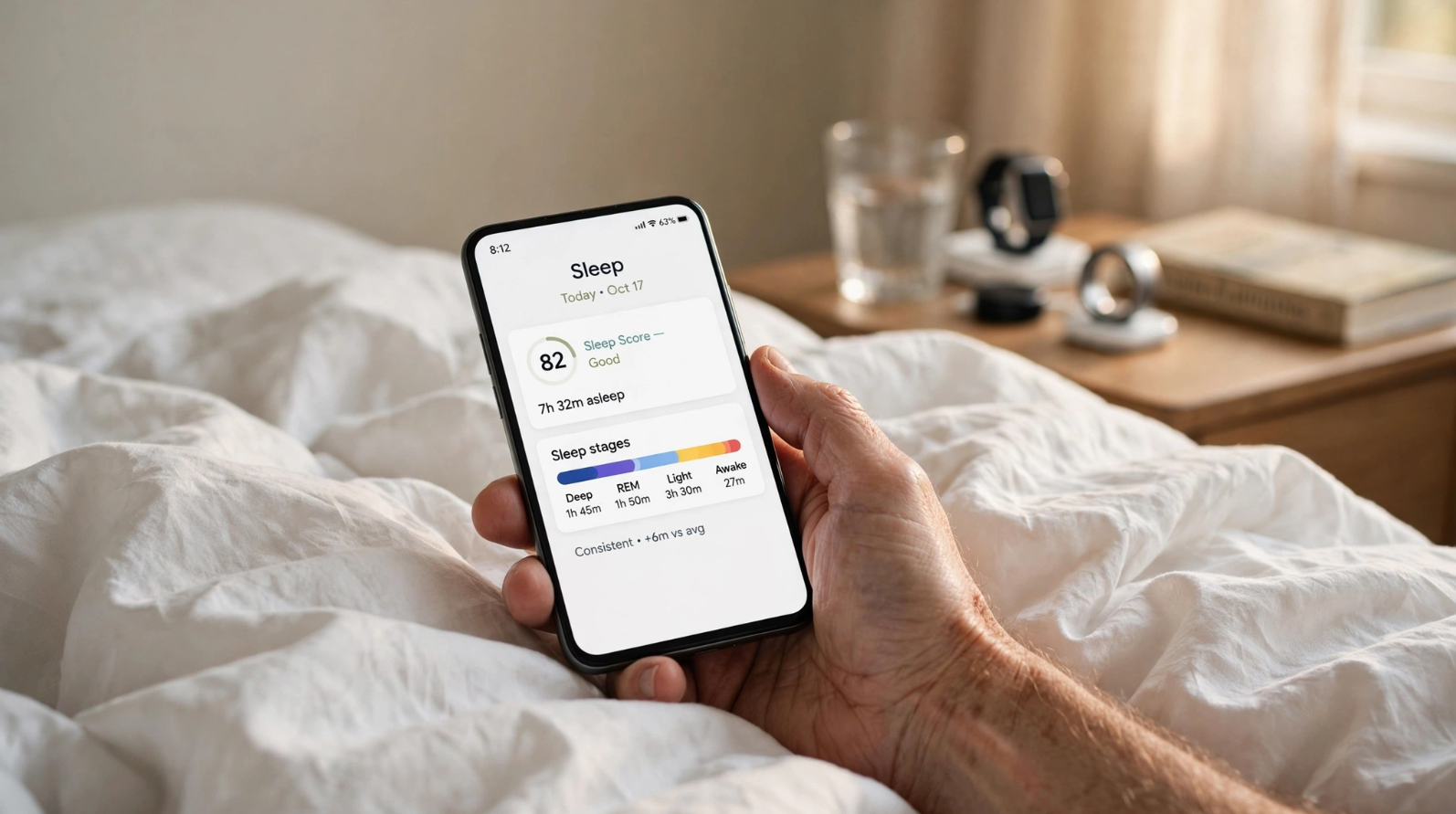
- Sleep Stages: Light, deep, and REM sleep are estimated by algorithms that analyze movement, heart rate, and heart rate variability patterns. A lab-based polysomnogram measures brain waves directly via EEG; your watch guesses. Accuracy for deep sleep is roughly 60–70% compared to a sleep lab, meaning it’s directionally useful but not precise.
- Sleep Score / Readiness Score: A proprietary composite number created by the company. It’s a convenient summary, but it’s an interpretation, not a measurement. Two devices on the same wrist may give different scores.
The Takeaway: Treat sleep stage data as a rough sketch, not a blueprint. A night labeled “20 minutes of deep sleep” might have been 30 or 40. But if your deep sleep trend is consistently declining over three months while your alcohol intake increases, that’s a valid pattern to act on. The trend matters; the absolute minute count does not.
Section 2: The Only Three Sleep Metrics That Matter (Start Here)
You can ignore most of the dashboard. Focus on these three high-yield metrics, which are reliably tracked across all major devices.
Metric 1: Total Sleep Time (TST)
Why It Matters:
This is the simplest and most important metric. After 40, chronic sleep deprivation accelerates cardiovascular aging, impairs glucose metabolism, reduces testosterone and growth hormone secretion, and destroys the willpower reserves you need for healthy habits. Every major health organization recommends 7–9 hours for adults, but the actual number you need is the one that leaves you feeling rested and functional without caffeine.
How to Track It:
All devices provide a total sleep time number. Compare it to your time-in-bed. If you spend 9 hours in bed but only sleep 6.5 hours, you have a sleep efficiency problem (frequent awakenings, long latency). The goal is efficiency above 85% (time asleep divided by time in bed).
Actionable Goal:
First, lock in 7 hours of actual sleep consistently for two weeks. If you still wake tired, add 30 minutes per night until you find your personal requirement.
Metric 2: Resting Heart Rate Drop (Sleeping Heart Rate)
Why It Matters:
A healthy cardiovascular system drops heart rate by 10–20 beats per minute during sleep as parasympathetic tone dominates. A smaller drop, or an elevated sleeping heart rate, can indicate overtraining, stress, alcohol consumption, or illness. Watching this number helps you gauge recovery. For example, a sleeping heart rate 8–10 bpm higher than your normal baseline is a strong signal to prioritize rest that day.
How to Track It:
Your wearable gives you an overnight average or a lowest sleeping heart rate. Track your 7-day average and note large deviations. Most devices will display a resting heart rate trend in the app.
Actionable Goal:
If your sleeping heart rate is chronically elevated (above 65–70 for a relatively fit 45-year-old), prioritize aerobic base training, eliminate alcohol for a month, and improve hydration. A gradual decline over months reflects improving fitness and recovery.
Metric 3: Nighttime Movement (Restlessness)
Why It Matters:
Excessive tossing and turning fragments sleep, preventing the sustained deep and REM cycles that restore your brain and body. Restlessness can be caused by a too-warm bedroom, caffeine too late in the day, alcohol (which sedates but then causes rebound wakefulness), stress, or a partner’s movements.
How to Track It:
Devices show a movement plot or a “restless” percentage. More than 15–20% of the night spent in restless sleep is a flag.
Actionable Goal:
Keep the bedroom at 65°F (18°C), avoid alcohol within 3 hours of bed, and stop caffeine by noon. If restlessness persists, check for environmental noise, an uncomfortable mattress, or consider if a partner’s sleep disorder is affecting you.
Section 3: For Those Who Want More—Secondary Metrics Explained
Once you’ve mastered the big three, you can optionally look at these. They offer nuance but are more prone to estimation error.
Deep Sleep (Slow-Wave Sleep):
Declines with age, but resistance exercise, sauna use, and avoiding late meals can boost it. A tracker showing consistently low deep sleep (<30 minutes) alongside feeling unrefreshed suggests a need for earlier bedtimes and reduced alcohol. However, do not chase a specific minute count.
REM Sleep:
Important for emotional processing and memory consolidation. REM occurs predominantly in the second half of the night. If you wake up early, you lose REM. A consistent REM percentage below 15% may mean you need a longer sleep window or that stress is causing REM suppression.
Heart Rate Variability (HRV) Overnight:
Higher is generally better, but it’s highly individual. A single low HRV night after a stressful day is normal. A week-long decline often indicates accumulating fatigue or illness. Use it as a recovery check.
Blood Oxygen (SpO2):
Occasional dips to 90% are common, but repeated drops below 90% during sleep are concerning for sleep apnea. If your device frequently flags low oxygen, discuss it with your doctor. This feature is a powerful screening tool, particularly for the 40+ population with a neck circumference over 17 inches (men) or 16 inches (women) or a history of snoring.
Section 4: The 60-Second Morning Review Ritual
Instead of staring at a complicated sleep dashboard, build a one-minute habit that feeds directly into better decisions.
The Script (Do This While Still in Bed or with Your Morning Coffee):
- Check Duration: “How many hours did I actually sleep?” (Goal: 7+ hours)
- Subjective Rating: “On a scale of 1–5, how rested do I feel right now?” (1 = exhausted, 5 = fully refreshed)
- Heart Rate Check: “Is my sleeping heart rate near my normal baseline, or elevated?”
- One Factor Note: “What’s one thing that may have affected my sleep last night?” (Example: late meal, argument, alcohol, good workout, early bedtime)
Where to Record It:
Use a simple notes app, the journal you already keep for habit tracking, or the notes section in your wearable’s app. Keep it to one line.
Example entry:
Wed: 7h 10m, feel 4/5, HR 58 (normal), late meal at 9 PM maybe caused initial restlessness.
Why This Works:
Over two to three weeks, you’ll see clear correlations: “Every time I have two glasses of wine, my resting heart rate is 8 bpm higher and I feel a 2/5.” That insight is far more powerful than a generic sleep score, and it leads to natural behavior change without strict rules. You’ll simply start wanting the better morning feeling.
Section 5: When to Consider a Sleep Study (Not Just Your Watch)
Wearables are screening tools, not diagnostic devices. Certain patterns warrant medical evaluation.
Red Flags Your Wearable Might Show:
- Frequent, significant oxygen desaturation: Repeated drops below 90%, especially if accompanied by spikes in heart rate.
- Extremely high restlessness: A movement graph that looks like a seismograph all night, combined with loud snoring (ask your partner).
- Very high sleeping heart rate: Consistently above 80 bpm without an obvious cause like illness or extreme stress.
- Very low deep/REM despite 8+ hours of sleep and feeling unrefreshed.
Symptoms That Should Prompt a Doctor Visit Regardless of Tracker Data:
- Loud, habitual snoring.
- Witnessed pauses in breathing during sleep.
- Gasping or choking awakenings.
- Morning headaches.
- Excessive daytime sleepiness (falling asleep at red lights, in meetings, while watching TV).
- Difficulty concentrating or severe brain fog.
If these are present, an in-lab polysomnogram or home sleep apnea test (HSAT) ordered by a physician is necessary. The cost is often covered by insurance when indicated. Untreated sleep apnea increases the risk of hypertension, atrial fibrillation, heart attack, stroke, and dementia—making this arguably the most important diagnostic pursuit after 40.
Section 6: FAQ—Your Sleep Tracking Questions
Q: My sleep score is often “fair” or “poor,” but I feel fine. Should I worry?
A: No. How you subjectively feel and function during the day overrules a sleep score. If you feel alert, can concentrate, aren’t reliant on caffeine to survive, and your mood is stable, your sleep is likely sufficient. Your device may be misinterpreting your data, or you may simply need less sleep than the algorithm expects. Trust your body first; the device is a consultant, not the CEO.
Q: Which device is better for sleep tracking—Apple Watch or Oura Ring?
A: Both are excellent for the core metrics (total sleep time, resting heart rate, movement). The Oura Ring is more comfortable to wear overnight and has a longer battery life, but requires a subscription for full data. The Apple Watch offers SpO2, a vibrant app ecosystem, and no mandatory subscription for basic sleep tracking, but needs daily charging. For sleep-only purposes, Oura is slightly preferred by sleep researchers. If you want an all-in-one fitness and health tracker, Apple Watch is the better overall value. Either is more than adequate.
Q: I use a CPAP machine. Can I still use a sleep tracker?
A: Yes, but interpret with caution. Your CPAP treats apnea, but your wearable will still track your sleep architecture. It can be useful to see if your sleep is more restful with therapy. However, a CPAP machine itself tracks detailed breathing data (AHI, mask leak) that is far more clinically relevant; that data, accessible through your CPAP’s app or your doctor, is more important than the wearable’s estimates.
Q: Is it harmful to track sleep every night?
A: Only if it causes anxiety. If checking your sleep score in the morning reliably prompts you to prioritize an earlier bedtime or skip that second glass of wine, it’s a healthy feedback loop. If you feel dread when opening the app, or you lie in bed worrying that tossing will hurt your score, take a break. Remove the device for two weeks, focus on the subjective 1–5 rating, and reintroduce the tracker only when it feels emotionally neutral. Sleep tracking should reduce suffering, not create it.
Q: My deep sleep is always low no matter what I do. Is that just age?
A: Age is a factor, but don’t accept it as fixed. Chronic low deep sleep can also be caused by chronic stress (high nighttime cortisol), alcohol, sleep environment (too warm, too noisy), or poorly timed exercise. Experiment with an earlier bedtime, a cooler room, magnesium glycinate before bed, and no alcohol for 30 days. Even modest improvements in deep sleep have a meaningful impact on cognitive function, growth hormone secretion, and physical recovery. If nothing helps and you feel unrefreshed, a sleep study is warranted.
The VigorForty Take
Sleep tracking technology is a gift—but only if you use it as a mirror, not a master. Your Apple Watch or Oura Ring gives you a window into a third of your life that was once completely invisible. It shows you the impact of that late cocktail, that stressful meeting, that perfect, cool, dark bedroom you finally set up. It can alert you to patterns that merit a doctor’s visit. But it cannot tell you how to feel, and it should never replace the quiet, simple wisdom of going to bed when you’re tired and waking up without an alarm when life allows.
Take the one-minute morning review ritual. Watch the trends over weeks. Let the data guide you, gently, toward the habits that produce a 5/5 morning. And if the numbers ever make you anxious, take the device off. Your sleep exists to restore you, not to be graded. After 40, the goal is not a perfect sleep score. The goal is waking up with enough energy to embrace the day, crush your walk, take your supplements, and feel fully alive for the people and passions that matter. Your tracker is a tool on that journey. Use it wisely, and sleep deeply.
Read All Related Articles
- The Complete Guide to Heart Health: Beyond Omega-3s—CoQ10, Magnesium, Potassium, and Nitric Oxide Support After 40
- The Complete Guide to Habit Design After 40: Building Sustainable Health Routines and Tracking What Matters
- The 8 Health Metrics Every American Over 40 Should Track (And How to Do It Without Obsession)
- Habit Stacking for Busy Americans: A 10-Minute Morning Routine That Actually Sticks
- Sleep Tracking Demystified: How to Use Your Apple Watch/Oura Ring to Wake Up Refreshed
- Habit Design 101: Why You Fail (And the Tiny Fix That Changes Everything)
- From Couch to Consistent: The 30-Day ‘Exercise Snack’ Habit Plan
- The Mediterranean Diet Habit Blueprint (For Americans Who Hate Meal Prep)
- HRV Explained: Why It Matters and How to Improve It Without Chasing Numbers
- Whoop vs. Oura vs. Fitbit: Which Health Tracker Fits Your Lifestyle?
- How to Keep Your Health Habits Alive During BBQ & Travel Season
- 5-Minute Poolside/Patio Workouts (No Equipment, No Sweat)
- Half-Year Habit Audit: A Simple Framework to Review What’s Working
- Reader Stories: 3 Americans Who Transformed Their Health with One Tiny Habit