
Author: Vigor Forty Editorial Team
Medically Reviewed By: Editorial Review Board
Disclaimer: This article is for informational purposes only and is not a substitute for professional medical advice. Read our full Medical Disclaimer.
📌 Key Takeaways
- Chronological Age Is Fixed; Biological Age Is Malleable: You’ve had 45 birthdays, but your cells might function like a 35-year-old’s—or a 55-year-old’s. Biological age reflects how fast your body is aging internally, and it responds powerfully to lifestyle, nutrition, and targeted interventions.
- Nine Hallmarks of Aging Drive the Decline: Scientists have identified core cellular processes that go awry with time: genomic instability, telomere shortening, epigenetic drift, loss of protein quality control, mitochondrial dysfunction, cellular senescence, stem cell exhaustion, altered nutrient sensing, and chronic inflammation. Understanding these hallmarks makes the aging process visible and actionable.
- After 40, the Pace of Biological Aging Accelerates: Hormonal shifts, accumulated oxidative damage, and declining repair mechanisms create a “tipping point” around midlife. The habits you start now have an outsized effect on how you age in your 50s, 60s, and beyond.
- You Already Have Many of the Tools: Exercise, quality sleep, the Mediterranean diet, stress management, and the VigorForty supplement protocols directly target the hallmarks of aging. They aren’t just heart-healthy or mood-boosting—they are geroprotective, meaning they slow the fundamental processes of aging.
- The Goal Is Healthspan, Not Just Lifespan: Living to 95 is irrelevant if the last 20 years are spent in frailty and disease. Biological aging interventions aim to compress morbidity—keeping you strong, sharp, and independent until the very end. This is the core mission of VigorForty.
Introduction: You Are Not Just Getting Older—Your Cells Are Changing
Look in the mirror. The face staring back is undeniably yours, but it’s changed. The skin is a little thinner, the lines a little deeper. You feel it, too: recovery from a workout takes an extra day; a late night leaves you foggy for two. On your birthday, you add another candle. Chronologically, you’re 45, 52, 60. But under the microscope, something far more interesting is happening.
Your cells are aging at their own pace. Some are accumulating tiny errors in their DNA. Others are losing the protective caps on their chromosomes. Mitochondria, the power plants inside every cell, are sputtering. A few cells have stopped dividing entirely, becoming “zombie cells” that leak inflammation and poison their neighbors. This isn’t a metaphor; it’s the biology of aging, and it’s happening inside you right now.
The good news—the extraordinary, actionable news—is that this cellular clock is not fixed. The emerging science of biological aging reveals that the rate at which your cells decline is heavily influenced by what you eat, how you move, how you sleep, and which supplements you take. You can’t turn the chronological clock back to 25. But you can dramatically slow the cellular clock, and in some cases, even reverse aspects of it. You can be 50 with the internal biology of a 35-year-old.
This article is your roadmap. You’ll learn the nine hallmarks of aging in plain language, why the period after 40 represents a critical window, and exactly which tools—from fasting and exercise to targeted supplements—slow each hallmark. We’ll end with the VigorForty Biological Aging Protocol, a simple, integrated plan that works with your existing habits. This is not about chasing immortality. It’s about ensuring that the decades ahead feel vibrant, not frail.
Section 1: Chronological vs. Biological Age—Why the Difference Matters
Chronological age is the number of years since your birth. It’s a useful frame for life stages, but it tells you nothing about the internal state of your cells. Biological age is an estimate of how old your body actually functions based on molecular and cellular markers. Two 50-year-olds can have biological ages 10 years apart—one on a trajectory for early disease, the other on a path to robust longevity.
How Biological Age Is Measured:
- Epigenetic Clocks (DNA Methylation): The most validated method. Chemical tags called methyl groups attach to your DNA and change over time in predictable patterns. Algorithms like the Horvath clock, PhenoAge, and GrimAge analyze these patterns to estimate biological age. They can predict mortality and disease risk better than chronological age alone.
- Telomere Length: Telomeres are protective caps on chromosome ends that shorten with each cell division. Shorter telomeres correlate with aging and disease, but telomere length is a less precise marker than epigenetics. It’s highly variable and influenced by genetics.
- Composite Biomarker Panels: Tests that measure blood markers like HbA1c, CRP, albumin, creatinine, and white blood cell count to estimate biological age. These are less direct than epigenetic clocks but still informative.
- Physical Function Tests: Grip strength, gait speed, and VO2 max are functional proxies for biological age. A 60-year-old with the gait speed of a 40-year-old is biologically younger in meaningful ways.
The Key Insight: Biological age is modifiable. A landmark 2019 study showed that a protocol including diet, exercise, sleep, and supplements reduced the biological age of participants by an average of 3.2 years in just 8 weeks, as measured by the Horvath clock. That’s the power of the approach you’re about to learn.
Section 2: The Nine Hallmarks of Aging—What’s Going Wrong in Your Cells
In 2013, scientists published a framework that organized the chaos of aging research into nine distinct but interconnected hallmarks. Understanding them turns aging from a vague, inevitable decline into a set of specific cellular processes that can be targeted.
Hallmark 1: Genomic Instability (DNA Damage Accumulates)
Every day, your DNA is bombarded by oxidative stress, toxins, UV radiation, and replication errors. Cells have repair machinery, but it becomes less efficient with age. Unrepaired DNA damage leads to mutations, cellular dysfunction, and cancer.
What Accelerates It: Oxidative stress (from smoking, pollution, poor diet), inflammation, and chronic high blood sugar.
What Slows It: Antioxidant-rich diet (polyphenols from berries, dark chocolate, green tea), reducing oxidative stress via exercise and stress management, and supporting DNA repair with nutrients like NAD+ precursors.
Hallmark 2: Telomere Attrition (The Protective Caps Wear Down)
Telomeres are the plastic tips on the ends of shoelaces—your chromosomes. With each cell division, they shorten. When they become critically short, the cell stops dividing (senescence) or dies.
What Accelerates It: Chronic stress (cortisol accelerates telomere shortening), poor sleep, inflammation, smoking, and a sedentary lifestyle.
What Slows It: Aerobic exercise, mindfulness meditation (shown to increase telomerase, the enzyme that rebuilds telomeres), omega-3 fatty acids, and a diet rich in fiber and antioxidants. The VigorForty supplement stack directly supports this.
Hallmark 3: Epigenetic Alterations (The Instruction Manual Gets Scrambled)
Your DNA is a fixed code, but which genes are turned on or off is controlled by the epigenome. With age, the epigenetic pattern drifts—genes that should be silent become active, and vice versa. This is the primary driver of the epigenetic clock mentioned earlier.
What Accelerates It: Poor diet, lack of exercise, exposure to toxins, and chronic inflammation.
What Slows/Reverses It: Caloric restriction, intermittent fasting, exercise, and compounds like resveratrol, which activate sirtuins—proteins that regulate epigenetic stability. The field of epigenetic reprogramming is advancing rapidly, with early human trials showing promise.
Hallmark 4: Loss of Proteostasis (Protein Garbage Builds Up)
Proteins are the workhorses of the cell, but they must be folded into precise shapes to function. With age, misfolded proteins accumulate, forming toxic clumps. Cells have a cleanup system—the ubiquitin-proteasome pathway and autophagy—that becomes sluggish with age. Alzheimer’s (amyloid plaques) and Parkinson’s are diseases of proteostasis failure.
What Accelerates It: Insulin resistance, chronic inflammation, and mitochondrial dysfunction.
What Restores It: Autophagy (triggered by fasting and exercise), heat shock proteins (activated by sauna use), and compounds like spermidine (found in wheat germ, soybeans, and aged cheese).
Hallmark 5: Mitochondrial Dysfunction (The Power Plants Sputter)
This is one of the most impactful hallmarks for energy, cognitive function, and metabolic health. Mitochondria convert food into ATP, the energy currency of the cell. With age, mitochondrial DNA mutates, electron transport chain efficiency drops, and reactive oxygen species leak out, damaging the cell. The result: fatigue, brain fog, muscle weakness, and metabolic slowing.
What Accelerates It: Sedentary lifestyle, high-sugar diet, chronic stress, and environmental toxins.
What Restores It: Zone 2 aerobic exercise (mitochondrial biogenesis), resistance training, CoQ10, PQQ, creatine, NAD+ precursors (NMN, NR), and a low-glycemic Mediterranean diet. This is why the VigorForty heart protocol, with its CoQ10 and magnesium, is also a mitochondrial protocol.
Hallmark 6: Cellular Senescence (Zombie Cells Accumulate)
When cells experience irreparable damage, they normally undergo apoptosis (programmed cell death). But some cells enter a state called senescence—they stop dividing but don’t die. They sit in tissues, secreting inflammatory signals (SASP: senescence-associated secretory phenotype) that damage neighboring cells and drive systemic aging.
What Accelerates It: DNA damage, oxidative stress, short telomeres, and obesity.
What Clears Them: Exercise (which boosts the immune system’s clearance of senescent cells), fasting, and natural senolytic compounds like fisetin (found in strawberries) and quercetin (found in apples, onions, and capers). A future article in this series will dive deep into senolytics.
Hallmark 7: Stem Cell Exhaustion (The Repair Crew Depletes)
Stem cells are your body’s reserve repair system. With age, stem cell pools in bone marrow, muscle, brain, and skin diminish and lose their ability to divide. This manifests as poor wound healing, muscle loss (sarcopenia), and a weakened immune system.
What Accelerates It: Chronic inflammation, metabolic disease, and cellular senescence.
What Supports It: Fasting and caloric restriction (which preserve stem cell function), exercise (which activates muscle stem cells), and adequate protein intake. The VigorForty emphasis on protein (1.6–2.0 g/kg) and resistance training directly combats stem cell exhaustion in muscle.
Hallmark 8: Altered Intercellular Communication (Hormones and Signals Go Haywire)
Cells communicate via hormones, neurotransmitters, and cytokines. With age, this communication network degrades. Insulin signaling becomes dysregulated, leading to insulin resistance. The renin-angiotensin system overactivates, driving hypertension. Inflammaging—chronic, low-grade inflammation—spreads through the body like static on a radio line.
What Accelerates It: Visceral fat (which secretes inflammatory cytokines), poor sleep, chronic stress (elevated cortisol), and a Western diet.
What Restores It: The Mediterranean diet (anti-inflammatory), consistent sleep, stress management, omega-3s, and maintaining a healthy waist circumference.
Hallmark 9: Dysregulated Nutrient Sensing (The Cellular Fuel Gauge Fails)
Cells have sensors that detect glucose, amino acids, and energy status. The most famous is mTOR (mechanistic target of rapamycin), which promotes growth and anabolism. Another is AMPK (AMP-activated protein kinase), which promotes energy conservation and repair. With age, mTOR is chronically overactive (driving inflammation and blocking autophagy), while AMPK is underactive. The sirtuin family, which responds to NAD+ levels, also declines.
What Accelerates It: Constant eating (grazing), high sugar intake, excess protein in the context of inactivity.
What Restores It: Intermittent fasting and caloric restriction (which inhibit mTOR and activate AMPK), exercise (activates AMPK), and NAD+ boosters like NMN/NR (which activate sirtuins). The popular “longevity diet” patterns work primarily through this hallmark.
Section 3: Why After 40 Is the Critical Window
The hallmarks of aging don’t start at 40—they’ve been progressing silently for decades. But around midlife, several factors converge to create an acceleration phase:
- Hormonal Transitions: Perimenopause and andropause (declining testosterone) amplify inflammation, reduce mitochondrial efficiency, and increase visceral fat deposition. Estrogen is a powerful mitochondrial protectant and anti-inflammatory; its loss accelerates multiple hallmarks.
- Accumulated Damage Threshold: By 40, the cumulative burden of oxidative stress, DNA damage, and senescent cells reaches a tipping point where the repair systems start to become overwhelmed.
- Metabolic Inflection: Insulin resistance spikes, fasting glucose creeps up, and NAFLD (non-alcoholic fatty liver disease) prevalence rises sharply. These metabolic shifts fuel inflammaging and epigenetic drift.
- Vascular Aging Acceleration: Arterial stiffness, endothelial dysfunction, and hypertension prevalence jump. The heart and vasculature age biologically faster than other organs in many Americans.
The good news is that the same inflection point makes the body exquisitely responsive to intervention. Studies consistently show that lifestyle changes and targeted supplementation in the 40–60 age range produce the largest relative reductions in biological age and disease risk. This is the window to act.
Section 4: The VigorForty Biological Aging Protocol
This protocol integrates anti-aging interventions into the systems you’re already using. Nothing here is drastic; everything is evidence-based.
1. Exercise as Geroprotection (Non-Negotiable)
- Aerobic (Zone 2): 3–4 sessions of 30–45 minutes per week at a conversational pace. This stimulates mitochondrial biogenesis, improves NAD+ levels, enhances endothelial function, and reduces inflammation.
- Resistance Training: 2–3 sessions per week. Prevents sarcopenia, maintains bone density, improves insulin sensitivity, and activates muscle stem cells.
- High-Intensity Bursts (Exercise Snacks): Your daily exercise snacks—brief, vigorous bursts—improve VO2 max, a powerful predictor of biological age and all-cause mortality.
- Daily Movement: 7,000–10,000 steps per day, as you’ve been tracking. This keeps AMPK active and inflammation low.
2. Nutrition for Longevity
- Mediterranean Pattern: As outlined in your blueprint, this diet is anti-inflammatory, rich in polyphenols that support the epigenome and sirtuins, and naturally restricts processed foods and sugar.
- Time-Restricted Eating (Optional Foundation): Eating within a 10–12 hour window (e.g., 8 AM to 6 PM) improves insulin sensitivity, activates autophagy, and supports circadian rhythm. This is not a rigid fast; it’s a gentle pattern that aligns with your natural biology. You can still enjoy a late dinner occasionally.
- Nutrient-Dense Foods for Specific Hallmarks: Emphasize cruciferous vegetables (sulforaphane for Nrf2 activation), berries (polyphenols for autophagy and epigenetics), fatty fish (omega-3s for inflammation and telomeres), nuts (magnesium and healthy fats), and green tea (EGCG for AMPK and sirtuins).
3. Supplements for Biological Aging (Add to Your VigorFive Stack)
- Omega-3s (EPA/DHA): Already in your stack. Anti-inflammatory, supports telomerase, improves endothelial function.
- CoQ10 (Ubiquinol): Already in your heart protocol. Directly supports mitochondrial electron transport and protects mitochondrial DNA.
- Magnesium Glycinate: Already in your stack. Required for DNA repair enzymes, mitochondrial function, and stress resilience.
- Vitamin D3 + K2: Already in your stack. D3 regulates over 200 genes, including those involved in aging and inflammation. K2 prevents arterial calcification.
- Creatine Monohydrate: Already in your VigorFive. Supports mitochondrial energy, muscle mass preservation, and even cognitive function.
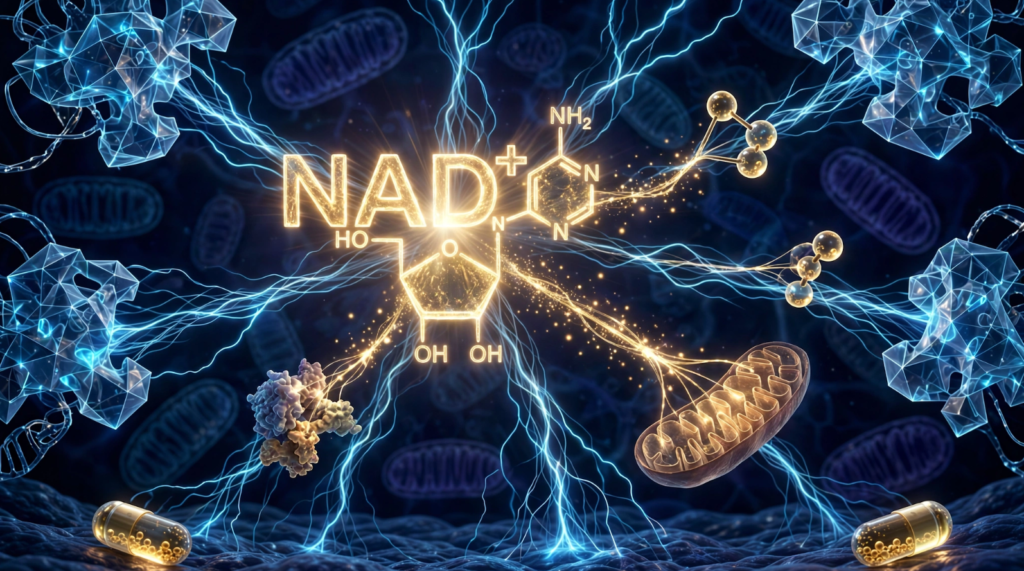
- NAD+ Precursor (NMN or NR—Optional Add-On): NAD+ levels decline by up to 50% between ages 40 and 60. Supplementing with nicotinamide mononucleotide (NMN) or nicotinamide riboside (NR) can raise NAD+ levels, supporting sirtuins, mitochondrial function, and DNA repair. This is an advanced, optional addition. Start with 250–500 mg NMN or NR in the morning, and discuss with your physician.
- Fisetin or Quercetin (Optional, Under Guidance): Natural senolytics that may help clear senescent cells. Fisetin is being studied in clinical trials. A small dose from strawberries is safe; concentrated supplements should be used with physician oversight. We’ll cover these in a future deep-dive.
4. Lifestyle Biohacks That Target Aging Directly
- Sauna Use (If Accessible): Frequent sauna bathing (4–7 sessions per week, 20 minutes at 175°F) is associated with a 40–50% reduction in all-cause mortality, cardiovascular death, and even dementia in Finnish studies. Heat stress activates heat shock proteins, which repair misfolded proteins and improve proteostasis. If you don’t have a sauna, even a hot bath that raises your body temperature can provide some benefit.
- Cold Exposure (Optional, for Autophagy and Inflammation): Brief cold showers or cold plunges activate AMPK, reduce inflammation, and may stimulate autophagy. Start with 30 seconds of cold water at the end of your shower. Not a requirement, but a powerful tool for those who enjoy it.
- Circadian Rhythm Optimization: Consistent sleep/wake times, morning sunlight, and reduced blue light at night—all covered in your habit-stacking and sleep articles—regulate the epigenetic clock and support mitochondrial repair during sleep.
- Breathwork and Meditation: The 5-minute breathwork sessions from your summer article train the vagus nerve, reduce cortisol, and have been shown to slow telomere shortening and improve epigenetic age. Stress accelerates biological aging dramatically; managing it is geroprotective.
Section 5: The VigorForty Biological Age Tracking Dashboard
In addition to the eight health metrics you track, consider adding these biological age proxies once or twice a year.
| Metric | How to Track | Relevance |
|---|---|---|
| Epigenetic Age Test | Consumer kits (e.g., TruDiagnostic, Elysium Index, myDNAge) use a saliva or blood sample. Cost: $200–$500. | Directly measures DNA methylation age. A declining or stable biological age relative to chronological age is the ultimate feedback. |
| Grip Strength | Handgrip dynamometer ($20–$30 online). | Correlated with all-cause mortality, cognitive decline, and frailty. A simple, powerful biomarker. |
| Gait Speed | Time yourself walking a 4-meter course at normal pace. | A “walking speed” below 0.8 m/s is a frailty indicator. Improving it indicates biological rejuvenation. |
| VO2 Max (Estimated) | Wearables (Apple Watch, Garmin) estimate VO2 max from heart rate and pace data. | One of the strongest predictors of longevity. Even modest increases yield significant benefits. |
| Inflammatory Markers (annual bloodwork) | hs-CRP, IL-6, and fasting insulin. | Direct markers of inflammaging and metabolic aging. |
Section 6: FAQ—Your Biological Aging Questions
Q: Can I really reverse my biological age, or just slow it down?
A: Both are possible. The 2019 TRIIM trial showed a 2.5-year epigenetic age reversal in a small group using a protocol of growth hormone, DHEA, and metformin. Less intensive interventions—diet, exercise, supplements—have shown reversal of 1–3 years in some studies. Even if you only slow the rate of aging by 20%, that’s decades of added healthspan. Aim for slowing first; reversal is a bonus.
Q: Is taking NAD+ precursors safe?
A: NMN and NR have been studied in numerous human trials with a good safety profile. Mild side effects like nausea or flushing are rare. Long-term safety data is still accumulating because these are relatively new supplements. If you’re on medication or have a history of cancer, discuss with your physician. There’s a theoretical concern that boosting NAD+ could fuel existing cancer growth, though no human evidence confirms this.
Q: I’m already on your supplement stack. Is adding an NAD+ precursor overkill?
A: Not necessarily. Your existing stack supports mitochondrial health and reduces oxidative stress, but it doesn’t directly raise NAD+ levels. NAD+ decline is a central aging hallmark that your stack doesn’t fully address. If you want to add one extra supplement for biological aging, an NAD+ precursor is the highest-evidence choice.
Q: How often should I test my biological age?
A: Annually, at most. Epigenetic age changes slowly. Test once, implement a protocol for 6–12 months, then retest. Don’t test more frequently; it will cause unnecessary anxiety and noise. Grip strength, gait speed, and VO2 max can be tracked quarterly.
Q: I’m overwhelmed by all nine hallmarks. Where do I start?
A: Start with the three levers you already control: exercise (both aerobic and resistance), a Mediterranean eating pattern, and your VigorFive supplement stack. Those three interventions address every single hallmark simultaneously. The rest—sauna, NAD+ precursors, senolytics—are amplifiers. You don’t need to add them all at once. Master the foundation first, which you are already doing.
The VigorForty Take
Aging is not a light switch that flips at 65. It’s a slow, cellular burn that has been smoldering since your 20s and begins to accelerate after 40. But here’s what the science makes crystal clear: that fire is not out of your control. Every walk you take, every night of quality sleep, every dose of omega-3s and CoQ10, every handful of greens on your plate—these are not just healthy choices. They are direct, targeted interventions into the fundamental biology of aging.
You don’t need to micro-dose a dozen experimental compounds or freeze yourself in a cryo-chamber. The most powerful geroprotectors are sitting in your kitchen, your supplement organizer, and your walking shoes. Exercise, the Mediterranean diet, magnesium, vitamin D, omega-3s, and a consistent sleep schedule slow genomic instability, protect telomeres, restore mitochondrial function, clear senescent cells, and recalibrate your epigenetic clock. They extend healthspan, not just lifespan.
The biological aging series you’re beginning today will take you deeper into each of these tools: autophagy, mitochondria, NAD+, and the frontier of senolytics. But for now, take a moment to appreciate what you’ve already built. You’re not just managing midlife symptoms. You’re altering the trajectory of your cellular destiny. Your future self—sharp, strong, mobile, and independent at 85—is being built right now, one tiny habit, one supplement, one walk, one deep breath at a time. That’s the science. That’s the power. And it’s in your hands.