
Author: Vigor Forty Editorial Team
Medically Reviewed By: Editorial Review Board
Disclaimer: This article is for informational purposes only and is not a substitute for professional medical or psychological advice. Read our full Medical Disclaimer.
📌 Key Takeaways
- Willpower Is a Finite Resource, Especially After 40: Relying on motivation to power health changes is a losing strategy. The brain’s executive function fatigues with stress, sleep deprivation, and the sheer volume of midlife decisions. Habit design removes the need for willpower by making healthy behaviors automatic.
- The Fogg Behavior Model (B = MAP) Reveals Why You Fail: A behavior happens only when Motivation, Ability, and a Prompt converge in the same moment. Most failed attempts at exercise or nutrition are failures of Ability (the behavior was too hard) or Prompt (no reliable trigger was set), not failures of character.
- The Tiny Fix Is to Make the Behavior So Small You Can’t Say No: Instead of “exercise 45 minutes daily,” start with “one push-up after using the bathroom.” Tiny behaviors bypass the brain’s resistance, build self-efficacy, and reliably wire new neural pathways through repetition. This is the single most important concept in habit design.
- Shifting Your Identity Is the Ultimate Long-Term Strategy: Instead of focusing on outcomes (“lose 20 pounds”), focus on identity (“become a person who moves every day”). Every tiny action you complete casts a vote for this new identity, making the behavior stick permanently.
- Environment Design Outperforms Discipline: Willpower is no match for a visible bag of chips. Redesigning your surroundings—placing fruit on the counter, hiding snacks, sleeping in workout clothes—makes the healthy choice the path of least resistance, automating good decisions before you even make them.
Introduction: The 80% Failure Rate Is Not Your Fault
Every January, millions of Americans set health resolutions with fierce determination. By Valentine’s Day, roughly 80% have abandoned them. If you’ve cycled through this pattern for years—starting a gym membership, buying a juicer, swearing off sugar—you might believe you lack discipline or that something is fundamentally wrong with you. Neither is true.
The problem is not your character. The problem is that nobody ever taught you how to design a habit. You were told to “try harder” and “want it more,” as if the sheer force of desire could overcome a brain evolved to conserve energy, seek comfort, and automate repetitive behaviors. After 40, this disconnect becomes even more pronounced. Stress is higher, recovery is slower, and the “just push through” mentality that worked in your 20s now leads to burnout and injury.
The science of habit design—drawn from behavioral psychology, neuroscience, and real-world application—offers a different path. It doesn’t ask you to be stronger. It asks you to be smarter. This article is your introduction to the core principles: the Fogg Behavior Model, the Tiny Habits method, identity-based change, and environmental design. By the end, you’ll understand why you’ve struggled in the past and, more importantly, you’ll have a single, immediate, embarrassingly easy fix that changes everything. This is not another motivational speech. This is a user manual for your brain.
Section 1: The Fogg Behavior Model—Why You Fail, Explained in Three Letters
Dr. BJ Fogg, a behavior scientist at Stanford, spent decades studying why people do what they do. His conclusion is elegantly simple and devastatingly accurate. A behavior happens when three elements converge in the same instant: Motivation, Ability, and a Prompt. The formula is B = MAP.
If a behavior didn’t happen, at least one of those three elements was missing. This framework removes the guilt and shame from failed attempts and replaces them with a diagnostic tool.
Motivation (M):
Motivation is your desire to do the behavior at a given moment. It fluctuates wildly based on sleep, stress, mood, blood sugar, and external events. You cannot rely on high motivation, because it will inevitably be low—on a Tuesday after a 10-hour workday, when your kid is sick, or when you’re simply tired. After 40, motivation is even less stable due to hormonal shifts and accumulated life stress.
Ability (A):
Ability is how easy or hard the behavior is to perform. This includes time, money, physical effort, mental effort, and how much the behavior disrupts your existing routine. The harder something is, the higher the motivation required. Most health goals fail here: the behavior was simply too difficult. A 60-minute gym session requires massive ability and massive motivation. A single push-up requires almost none.
Prompt (P):
A prompt is a trigger—something that says “do this now.” It can be external (an alarm, a visual cue) or internal (a feeling, a memory). The most common point of failure is not a lack of motivation or ability; it’s simply forgetting. The prompt was missing, so the behavior never crossed the mind.
The Diagnosis Tool:
Next time a health behavior doesn’t happen, instead of berating yourself, ask: “Was motivation low? Was the behavior too hard? Or did I simply forget because there was no prompt?” The fix becomes obvious. Low motivation is normal—redesign for higher ability and a stronger prompt. The behavior is too hard—make it smaller. You forgot—create a reliable cue. This simple diagnostic shift ends the cycle of self-blame and begins the cycle of intelligent iteration.
Section 2: The Tiny Fix—Start So Small You Can’t Fail
The most important concept in habit design is this: start with a tiny behavior that requires almost no motivation and is impossible to do wrong. This is not a trick; it’s a direct application of the Fogg Model. When you make the behavior so easy that ability is sky-high, it will happen even on your worst days. And when it happens, you get a micro-dose of success and dopamine, which builds the neural pathway and the self-belief to grow the behavior naturally.
What Tiny Looks Like:
- Not “meditate 20 minutes” but “sit on the meditation cushion for 30 seconds.”
- Not “meal prep for the week” but “put one bag of frozen vegetables in the shopping cart.”
- Not “drink a gallon of water” but “drink one sip of water after flushing the toilet.”
- Not “go to the gym” but “put on walking shoes after pouring coffee.”
These sound absurdly small. That’s the point. The size of the behavior is inversely proportional to the motivation required. A huge behavior demands high motivation that collapses quickly. A tiny behavior sidesteps motivation entirely and installs the habit loop through sheer repetition. Over time, you’ll naturally do more—two minutes of meditation, five push-ups, a full glass of water—not because you forced yourself, but because the tiny seed grew.
Why This Works for the Skeptical American Over 40:
You’ve been conditioned by decades of “go big or go home” culture. It feels wrong to do one push-up and call it success. But that cultural programming is exactly why you’ve failed repeatedly. After 40, the body and brain respond better to gradual, consistent inputs. The tiny habit respects your reality: you are tired, stressed, and time-poor. It meets you exactly where you are and builds from there. In six months, you’ll be doing 20 push-ups daily without having forced a single one.
Section 3: Identity—The Deepest Habit Lever
The most resilient habits are not driven by outcomes (“I want to lose 10 pounds”) but by identity (“I am a person who nourishes my body”). When a behavior becomes an expression of who you believe you are, it persists through motivation droughts and life chaos.
The Two-Phase Shift:
- Decide the identity: State clearly the kind of person you want to be. “I am the type of person who moves every day.” “I am someone who prioritizes sleep.” “I am a person who takes my supplements.” This is not a wish; it’s a decision.
- Accumulate evidence: Every tiny action you take provides proof for this identity. One push-up is a vote for “I move daily.” One early bedtime is a vote for “I prioritize sleep.” Over weeks and months, your brain updates its self-model to match the accumulated evidence. You stop needing willpower because the behavior flows from who you are.
The Midlife Identity Trap:
After 40, many people are unconsciously wedded to a fixed identity: “I’m not athletic,” “I’ve never been a morning person,” “I come from a big family, it’s genetics.” These statements are not facts; they are habits of thought that block behavior change. The tiny fix undermines them quietly. A person who does one push-up every day is, by definition, someone who exercises. The evidence dismantles the old story and builds a new one, one tiny action at a time. You don’t have to believe you’re athletic at the start. You just have to act like it, in miniature, and let the identity catch up.
Section 4: Environment Design—The Willpower Alternative
Willpower is a muscle that fatigues. Your environment, however, is an ever-present force that shapes your behavior without you noticing. After 40, when decision fatigue is real, shaping your surroundings is the highest-leverage move you can make.
Fogg’s Maxim: “Design for laziness.”
Make the healthy behavior the easiest, most obvious path, and make the unhealthy behavior invisible or inconvenient.
In the Kitchen:
- Place a fruit bowl on the counter. Move chips, cookies, and crackers to a high, closed cabinet. You eat what you see first.
- Use a smaller dinner plate. Americans serve themselves up to 30% more food on a 12-inch plate compared to a 9-inch plate. The plate does the portion control for you.
- Prep one healthy component the night before: a container of overnight oats, a washed apple, a pre-filled water bottle. Friction removed, the behavior happens.
For Movement:
- Sleep in your workout clothes. At 6:00 AM, the barrier to getting out the door is zero. You are already dressed to move.
- Keep a yoga mat and a resistance band visible in the living room, not rolled up in a closet. A visible mat is a prompt to stretch for two minutes.
- Park at the far end of every parking lot. This single, tiny decision adds 500–1,000 steps per day without a single minute of scheduled exercise.
For Sleep:
- Install a lamp with a warm, dim bulb on a timer set to turn on at 9:30 PM. The shift in light quality is a non-verbal prompt to wind down.
- Place your phone charger outside the bedroom. The phone does not enter the sleep sanctuary. An old-fashioned alarm clock wakes you. This removes the single biggest sleep disruptor in American homes.
For Supplements:
- Put your daily pill organizer next to the coffee maker or toothbrush—whatever you use without fail every morning. The anchor does the prompting. You will not forget.
Environment design is not a character test. It is a recognition that you live in a world engineered to make you sedentary and overfed, and you have the power to re-engineer your immediate surroundings to support your health. This is not cheating; it’s wisdom.
Section 5: The 7-Day Tiny Habit Jumpstart
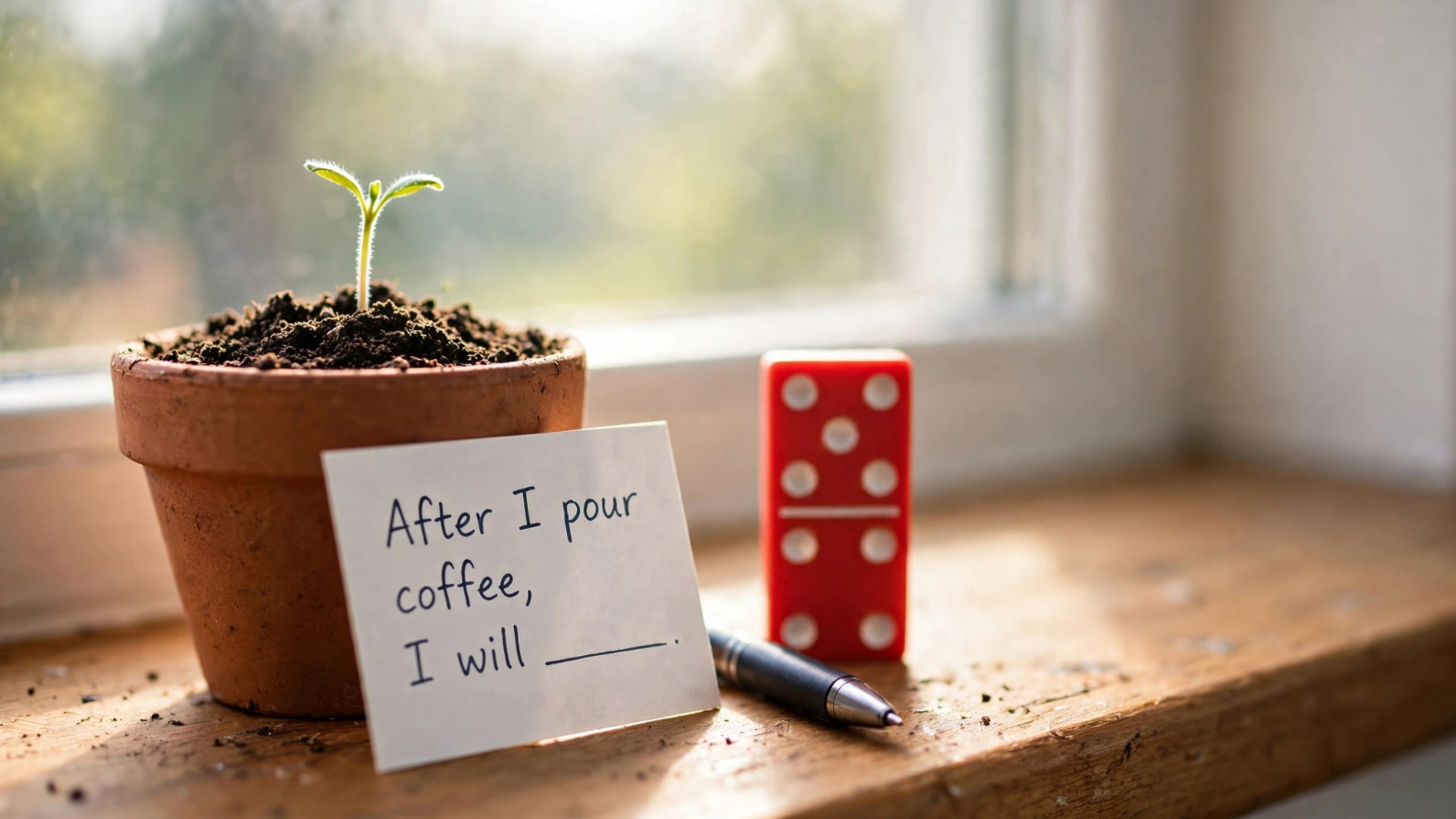
This is your immediate, no-equipment, no-cost protocol for the next week. Pick one tiny habit from the list below, or create your own using the “After [existing habit], I will [tiny new behavior]” format. Perform it daily for seven days.
Options:
- Hydration: After I flush the toilet in the morning, I will drink a small glass of water.
- Movement: After I pour my coffee, I will do 2 air squats.
- Nutrition: After I open the fridge for dinner, I will put one handful of greens on my plate.
- Sleep: After I plug in my phone for the night, I will read one page of a physical book.
- Stress: After I sit in my car after work, I will take 3 slow deep breaths before starting the engine.
Tracking:
Use a sticky note on the bathroom mirror. Each day you do the tiny habit, draw a bold X. After seven days, look at the chain. That chain is evidence that you are capable of consistent action. That chain is the beginning of a new identity.
At the End of 7 Days:
Ask yourself: “Do I want to continue this habit? Has it grown naturally? Do I feel a tiny bit more like the person I want to be?” If the answer is yes, keep the habit and consider adding another tiny one next week. If the answer is no, adjust the behavior to be even smaller or attach it to a different anchor. There is no failure, only data. This is the habit designer’s mindset.
Section 6: FAQ—Your Habit Design 101 Questions
Q: I understand the logic, but one push-up feels pointless. Can’t I just start with 20?
A: You can try, and if you succeed consistently for three months without missing, that’s wonderful. But if you’re reading this because you’ve tried and failed before, respect the evidence. The tiny start is a psychological Trojan horse. It gets the behavior installed without triggering the brain’s resistance. After a month of doing one push-up, you will almost certainly be doing 5 or 10 without any additional forcing. The seed must be planted before the tree can grow. Trust the process even when your “go big” ego resists it.
Q: How long until this becomes automatic?
A: The myth is 21 days; the reality is that it depends on the complexity of the behavior. A simple habit anchored to a reliable prompt (like “drink water after flushing the toilet”) can feel automatic in 10 days. A more complex habit might take 60 days or more. However, with a tiny habit, the internal resistance drops dramatically within the first week because the behavior is so easy. You’ll notice that by Day 5, you’re not debating whether to do it; you just do it. That’s the beginning of automaticity.
Q: What if I miss a day?
A: You will miss a day. Everyone does. The danger is not missing one day; it’s missing two in a row, which begins to establish a new pattern. The rule is “Never Miss Twice.” When you miss, do not double up the next day. Do not feel guilt. Simply do the tiny habit the next day as if nothing happened. Missing one day has a 0% long-term effect if you re-engage immediately. Missing two starts a slide. Protect the chain, but forgive the blip.
Q: I already have a good exercise habit, but my nutrition is terrible. Can I redesign that using tiny habits?
A: Absolutely. Nutrition is where tiny habits shine because food choices are made dozens of times per day, often automatically. Start with the smallest possible change at the point of decision: “After I order my lunch, I will ask for the dressing on the side.” “After I get gas, I will buy one piece of fruit at the station.” “After I plate dinner, I will put the remaining food in a container for tomorrow before sitting down.” Each tiny tweak to the food environment and your response to it compounds into a vastly better dietary pattern over time.
Q: How does this connect to the supplements VigorForty recommends?
A: The habit design principles in this article are the delivery mechanism for your supplement protocol. Taking supplements daily is a behavior. It requires a prompt (pill organizer next to coffee maker), high ability (pre-organized, no thinking), and motivation (understanding of heart health benefits). When you apply the Fogg Model, you turn supplement adherence from a chore into an automatic part of your morning stack. The same principles apply to blood pressure tracking, daily walks, and sleep hygiene. Habits are the engine; supplements, movement, and sleep are the fuel.
The VigorForty Take
The wellness industry sells transformation through willpower, intensity, and radical overnight change. That approach has failed you not because you are weak, but because it defies human biology. You are a middle-aged human being with a full life, a stressed nervous system, and a brain that is exquisitely designed to automate repetition into unconscious patterns. The path to lasting health after 40 is to work with that design, not against it.
Start tiny. Anchor to something you already do. Make it so easy that even on your worst day, you can still do it. Celebrate the tiny win—that small celebration rewires your brain more effectively than any external reward. Over weeks and months, these micro-behaviors compound into a new identity, a new body, and a new trajectory. The tiny fix is not a shortcut; it is the only scientifically validated route to sustainable change. It is generous, patient, and deeply respectful of the human you are right now.
You don’t need more motivation. You don’t need more discipline. You need a smaller behavior and a reliable prompt. You can design that right now. Pick one tiny habit from this article. Do it tomorrow. Mark the X. Your future self—the one with strong bones, stable blood pressure, restful sleep, and quiet confidence—will trace its origin back to that single, tiny, powerful action. Start small. Start now. The rest is compounding.
Read All Related Articles
- The Complete Guide to Heart Health: Beyond Omega-3s—CoQ10, Magnesium, Potassium, and Nitric Oxide Support After 40
- The Complete Guide to Habit Design After 40: Building Sustainable Health Routines and Tracking What Matters
- The 8 Health Metrics Every American Over 40 Should Track (And How to Do It Without Obsession)
- Habit Stacking for Busy Americans: A 10-Minute Morning Routine That Actually Sticks
- Sleep Tracking Demystified: How to Use Your Apple Watch/Oura Ring to Wake Up Refreshed
- Habit Design 101: Why You Fail (And the Tiny Fix That Changes Everything)
- From Couch to Consistent: The 30-Day ‘Exercise Snack’ Habit Plan
- The Mediterranean Diet Habit Blueprint (For Americans Who Hate Meal Prep)
- HRV Explained: Why It Matters and How to Improve It Without Chasing Numbers
- Whoop vs. Oura vs. Fitbit: Which Health Tracker Fits Your Lifestyle?
- How to Keep Your Health Habits Alive During BBQ & Travel Season
- 5-Minute Poolside/Patio Workouts (No Equipment, No Sweat)
- Half-Year Habit Audit: A Simple Framework to Review What’s Working
- Reader Stories: 3 Americans Who Transformed Their Health with One Tiny Habit