

Author: Vigor Forty Editorial Team
Medically Reviewed By: Editorial Review Board
Disclaimer: This article is for informational purposes only and is not a substitute for professional medical or psychological advice. Read our full Medical Disclaimer.
📌 Key Takeaways
- The “Miracle Morning” Is a Myth for Most Americans Over 40: Waking at 5 AM to meditate, journal, exercise, and read is not sustainable for parents, shift workers, or those simply exhausted from midlife demands. A 10-minute habit-stacked routine is both achievable and transformative.
- Habit Stacking Converts Existing Autopilot Behaviors into Triggers for New Health Habits: By anchoring a tiny new behavior to something you already do—pouring coffee, flushing the toilet, putting on shoes—you bypass the need for willpower and create a seamless chain of automatic health actions.
- A 10-Minute Morning Stack Can Improve Hydration, Circulation, Circadian Rhythm, and Mental Clarity: Each micro-habit targets a specific physiological need: rehydration after sleep, morning sunlight for cortisol regulation, brief movement to pump blood and lymph, and a mindful moment to set intention.
- The Routine Must Be Flexible, Not Rigid: The stack can shrink to 5 minutes on chaotic mornings, travel easily with simple substitutions, and expand naturally when time allows. Perfection is never the goal; consistency is.
- Tracking Your Stack with a Simple “Done” Check-In Reinforces the Habit Loop: A single checkmark on a calendar or a tap in a notes app provides the dopamine reward that wires the routine into your basal ganglia. After 30 days, the stack feels automatic.
Introduction: Stop Trying to Be a Morning Person—Just Stack These 10 Minutes
Open any productivity book or scroll social media, and you’ll be told that the key to health and success is a 90-minute morning routine that begins at 4:45 AM with ice plunges and gratitude journaling. For the average 45-year-old American who went to bed at midnight after helping a teenager with homework, cleaning the kitchen, and worrying about a parent’s medical bills, that advice is not just unrealistic—it’s discouraging.
What actually works after 40 is not a monumental morning overhaul. It’s a tiny, stackable sequence of micro-habits that takes just ten minutes and requires zero motivation. You don’t need to become a different person. You just need to attach a few new, health-forward behaviors to the things you’re already doing on autopilot every morning.
This article walks you through the science and practice of habit stacking, then gives you a fully customizable 10-minute morning stack. We’ll cover the exact steps, why each one matters physiologically, how to adapt the stack for chaotic American life (kids, travel, shift work, small apartments), and how to track it so it becomes as automatic as brushing your teeth. Wake up at your normal time. Keep your coffee. Just stack these ten minutes, and watch your energy, mood, and health trajectory shift.
Section 1: The Science of Habit Stacking—Why It’s Different from “Building a Routine”
Traditional routine-building demands that you carve out a new block of time and force a new behavior into it. That approach collapses the moment life gets busy. Habit stacking, popularized by James Clear in Atomic Habits and grounded in BJ Fogg’s behavior model, works with your existing neural wiring.
The Formula:
“After [CURRENT HABIT], I will [NEW TINY BEHAVIOR].”
You already have dozens of automatic morning behaviors: turning off the alarm, using the bathroom, starting the coffee maker, checking your phone, brushing your teeth. Each of these is a deeply grooved neural pathway. By inserting a new, short action immediately after one of these anchors, you give the new behavior a reliable trigger. The brain doesn’t need to remember to do it; the anchor drags the new behavior along with it.
Why This Matters After 40:
Executive function—the mental capacity to remember, plan, and self-regulate—declines under chronic stress and sleep deprivation, both common in midlife American life. A habit stack removes the executive function burden. You don’t decide to do the new behavior; you simply ride the wave of an existing one. The stack becomes a single fluid sequence, not a checklist of separate chores.
The Neurochemistry of Success:
Each completed micro-habit delivers a small hit of dopamine. This reinforces the loop and accelerates myelination (the insulation of the neural pathway), making the behavior faster and more automatic over time. A 10-minute stack completed in full delivers five to seven tiny wins before 8:00 AM. That sense of accomplishment cascades into better food choices, more patience, and higher productivity all day.
Section 2: The VigorForty 10-Minute Morning Stack
This stack is designed to be performed in the order listed, with each behavior anchored to the one before it or to a universal morning trigger. The total time is ten minutes, but each component can be as short as 30 seconds on a rushed morning and expand on weekends.
Step 1: Rehydrate (1 minute)
Anchor: After I turn off my alarm / After my feet hit the floor.
Tiny Behavior: Drink a full glass of water (8–16 oz).
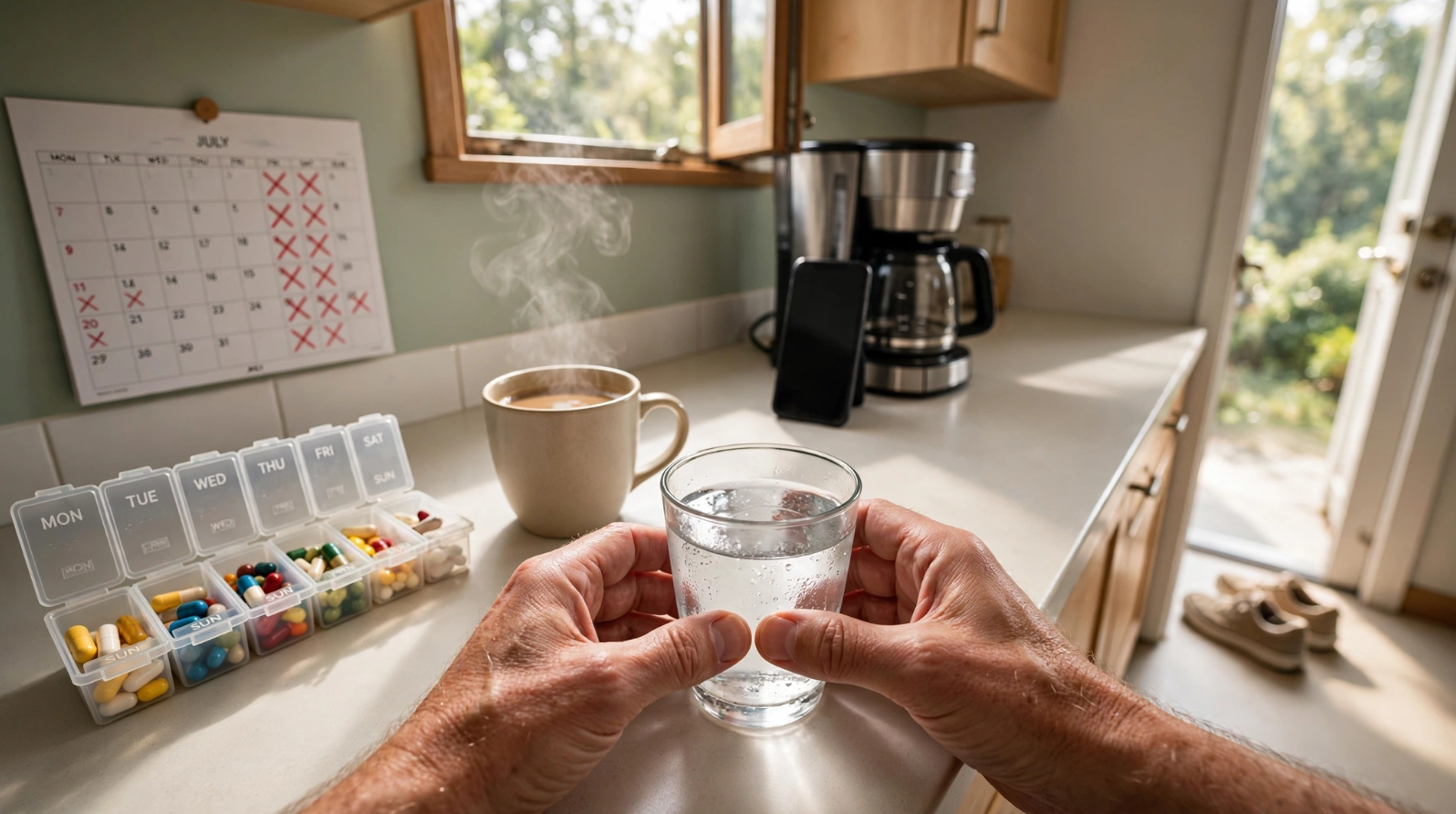
Why It Matters: You just spent 7–8 hours exhaling water vapor. Mild dehydration upon waking thickens the blood slightly, impairs cognitive function, and triggers a cortisol spike. A glass of water within minutes of waking re-establishes blood volume, kickstarts metabolism, and signals your organs it’s time to shift into daytime mode. Keep a water glass or bottle on the nightstand so the cue is visual and frictionless. Add a squeeze of lemon or a pinch of electrolyte powder if it makes the habit more appealing—the key is doing it, not optimizing it.
Step 2: Morning Light (2 minutes)
Anchor: After I drink the water.
Tiny Behavior: Step outside, or stand by an open window, facing natural light for 2 minutes.
Why It Matters: Morning sunlight is the single most powerful circadian rhythm regulator. Photoreceptors in your retina signal the suprachiasmatic nucleus in your brain to suppress melatonin, boost cortisol in a healthy, timed spike, and set a timer for melatonin release 14–16 hours later. This improves sleep onset at night, elevates mood, and sharpens daytime alertness. On a cloudy day or in a dark winter climate, 5–10 minutes of indirect outdoor light still works. If stepping outside isn’t possible (apartment building, extreme cold), sit by the brightest window you have and simply face the sky for two minutes while breathing slowly. No phone. No coffee yet. Just light.
Step 3: Brief Movement (3 minutes)
Anchor: After the 2 minutes of daylight.
Tiny Behavior: Perform a simple, full-body movement sequence: 5 air squats, 5 wall push-ups, 5 standing torso twists, and a 30-second downward dog stretch.
Why It Matters: Overnight, your intervertebral discs rehydrate and your body temperature is at its lowest. Gentle, dynamic movement pumps synovial fluid into joints, warms muscles, increases heart rate slightly, and mobilizes the spine. The air squats and push-ups activate large muscle groups, signaling glucose uptake pathways and improving insulin sensitivity for the day ahead. The twisting motion wakes up the digestive system and loosens the fascia around the ribcage, making breathing deeper and easier. This is not a workout; it’s a physical “on” switch. You should not be sweaty or breathless, just awake and mobile.
Step 4: Set One Intention (1 minute)
Anchor: After the movement sequence, while still standing or sitting quietly.
Tiny Behavior: Close your eyes and ask yourself: “What is the one thing that would make today feel successful?” Silently state that intention, then take one deep breath (4 seconds in, 6 seconds out).
Why It Matters: This micro-practice counteracts the reactive, email-driven start that defines the American work morning. By defining your own metric for success—whether it’s “patience with my kids,” “finishing the project proposal,” or “taking my lunchtime walk”—you prime your prefrontal cortex for focused action instead of scattered distraction. The single deep breath after stating the intention activates the parasympathetic nervous system, dialing down cortisol and bringing your heart rate to a calm baseline before you engage with the day. It’s meditation for people who think they can’t meditate.
Step 5: Supplements with Coffee (1 minute)
Anchor: After I pour my coffee / tea.
Tiny Behavior: Take your morning supplements (Vitamin D3+K2, Omega-3s, CoQ10 if applicable) with that first sip of coffee.
Why It Matters: Many supplements are fat-soluble and absorb better with some dietary fat. The morning coffee ritual is already deeply ingrained; attaching supplement intake to it removes forgetting. If you use a pill organizer set next to the coffee maker, the visual cue prompts the action without thought. For those who don’t drink coffee, anchor it to any breakfast activity: after you pour your milk, after the toaster pops, after you open the fridge. The supplement routine becomes a seamless part of the morning kitchen flow.
Step 6: The “One-Minute Tidy” (2 minutes)
Anchor: After I finish my supplements / before I leave the kitchen.
Tiny Behavior: Spend two minutes tidying one small area: make the bed, clear the coffee table, wipe down the bathroom counter, or lay out clothes for the day.
Why It Matters: A small environmental win reduces ambient stress. External clutter competes for your brain’s attentional resources; a tidy space signals safety and order to the limbic system. The “one-minute tidy” also reinforces the identity of “someone who takes care of their environment,” which generalizes to taking care of your body. Start with making the bed if you do nothing else—that single act is correlated with better sleep and higher productivity in multiple studies.
Section 3: Customizing the Stack for Real American Life
The stack above is a template, not a straitjacket. Life is messy, and the stack must flex.
The 5-Minute “Sprint” Version (For chaotic mornings):
- Drink water while the coffee brews.
- Stand by the window for 60 seconds while holding the warm mug.
- Do 5 air squats and one big overhead stretch.
- Take your supplements in one gulp.
- State your intention while walking to the car.
Total time: under 5 minutes. You still hit hydration, light, movement, intention, and supplements—just faster.
The Parent with Young Kids Version:
- Anchor water drinking to “after I pour the first sippy cup.”
- Morning light: step onto the porch while holding the baby or with a toddler in a stroller for 2 minutes.
- Movement: do 5 squats while holding the child (they’ll love it) and a few shoulder rolls.
- Intention: whisper it to yourself while buckling car seats.
- Supplements: keep your organizer next to the breakfast cereal; take them while the kids eat.
The Business Traveler Version:
- Water: fill a hotel glass the night before and put it by the bathroom sink. Drink after using the toilet.
- Light: open the hotel curtains wide, stand by the window for 2 minutes.
- Movement: 5 squats, 5 push-ups against the desk, 30-second forward fold. No equipment needed.
- Intention: say it while the shower warms up.
- Supplements: pack a daily pill bag in your carry-on; take with the in-room coffee.
The Night Shift Worker Version:
Your “morning” might be 5:00 PM. The stack still works, but substitute light with a 10,000-lux light therapy lamp for 10 minutes if natural daylight isn’t available. The sequence of hydration, movement, intention, and supplements remains identical. The anchor is always your waking moment, regardless of the clock.
Section 4: How to Track and Lock In the Stack
Tracking transforms a sequence of actions into a firmly wired habit.
The Seinfeld Calendar Method (Low Tech, High Power):
Print a one-page monthly calendar. Hang it on the fridge or bathroom mirror. Every day you complete the stack (even the 5-minute version), draw a large red “X” on that day. The goal is not to break the chain. Seeing a streak of 15 red X’s makes skipping feel like a loss; the visual momentum is incredibly motivating.
Digital Tracking (For App Lovers):
Use a simple notes app (Google Keep, Apple Notes) or a dedicated habit tracker (Streaks, Habitica, Loop). Log a single checkmark for “Morning Stack Complete.” Do not track each component separately—that creates complexity that kills the habit. One box, one tap, done.
The “Never Miss Twice” Rule Applied to the Stack:
If you miss a day—slept through the alarm, rushed to a flight, got hit with a stomach bug—do not attempt to make it up or spiral into guilt. Simply execute the stack the next day. The only danger is missing two consecutive days, which begins to erode the neural pathway. One missed day is a blip; two missed days is the start of a new habit of skipping.
Section 5: FAQ—Your Morning Stack Questions
Q: I’m not a morning person. Can I do this stack later in the day?
A: The stack is designed to capitalize on the morning’s unique biology (cortisol awakening response, circadian light sensitivity), but the habit-stacking method works at any hour. If you are a dedicated night owl, perform the stack immediately after your wake-up, whatever time that is. The key is consistency of anchor, not the time on the clock. A 10:00 AM wake-up still benefits from hydration, light, and movement.
Q: Do I really need to go outside if my kitchen is sunny?
A: Indoor light, even through a window, is significantly weaker than direct or indirect outdoor light. The lux level inside a bright kitchen might be 500–1,000 lux, while outside on a cloudy day it’s 5,000–10,000 lux, and on a sunny day over 50,000 lux. That intensity difference is what properly resets your circadian clock. If you cannot go outside, sit as close to an open window as possible and face the sky; it’s better than nothing, but outdoor exposure is ideal.
Q: Can I add my own steps to the stack?
A: Absolutely. The stack is a skeleton. Once the core sequence is automatic, you can add micro-habits like “After I state my intention, I will write one sentence in a gratitude journal” or “After my squats, I will foam roll my back for 1 minute.” Just keep any addition under 2 minutes initially, and only add one new item at a time, waiting until the previous stack is rock-solid.
Q: What if my spouse/kids interrupt the stack?
A: Interruption is normal. The stack is not a sacred ritual that requires silence and solitude; it’s a flexible set of behaviors that can be done in pieces. If a child cries during your light step, attend to them, then return to the next step in the stack as soon as possible. The anchor will still be there. Over time, family members may even join you. A 2-minute outdoor moment with a child in your arms still delivers light and a bonding moment.
Q: How soon until I feel the effects?
A: Many people report better energy and mood within 3–5 days of consistent morning light and hydration. The deeper benefits—lower resting heart rate, improved sleep quality, more stable blood pressure—accrue over 4–8 weeks as the circadian rhythm and autonomic nervous system re-regulate. Track your sleep quality rating and morning energy level to see the trend.
The VigorForty Take
The American morning is often a rushed, cortisol-soaked scramble of alarms, screens, and caffeine. It doesn’t have to be. By stacking just ten minutes of tiny, science-backed behaviors onto your existing autopilot, you reclaim the start of your day as a foundation for health rather than a source of stress.
You don’t need to wake up earlier. You don’t need to become a different person. You simply need to use the habit-stacking formula to chain together hydration, light, movement, intention, and supplements. On good mornings, the full ten minutes will feel like a gift; on hard mornings, the five-minute sprint version will keep the streak alive. Either way, you’re building a morning identity that compounds into better sleep, lower blood pressure, improved metabolic health, and a calmer, more focused mind.
Set out your water glass tonight. Place your pill organizer next to the coffee maker. Tomorrow morning, after you turn off the alarm, take one sip, take one step outside, and take one deep breath. That’s it. The habit stack has begun. Your future mornings—and the years they build toward—will never be the same.
Read All Related Articles
- The Complete Guide to Heart Health: Beyond Omega-3s—CoQ10, Magnesium, Potassium, and Nitric Oxide Support After 40
- The Complete Guide to Habit Design After 40: Building Sustainable Health Routines and Tracking What Matters
- The 8 Health Metrics Every American Over 40 Should Track (And How to Do It Without Obsession)
- Habit Stacking for Busy Americans: A 10-Minute Morning Routine That Actually Sticks
- Sleep Tracking Demystified: How to Use Your Apple Watch/Oura Ring to Wake Up Refreshed
- Habit Design 101: Why You Fail (And the Tiny Fix That Changes Everything)
- From Couch to Consistent: The 30-Day ‘Exercise Snack’ Habit Plan
- The Mediterranean Diet Habit Blueprint (For Americans Who Hate Meal Prep)
- HRV Explained: Why It Matters and How to Improve It Without Chasing Numbers
- Whoop vs. Oura vs. Fitbit: Which Health Tracker Fits Your Lifestyle?
- How to Keep Your Health Habits Alive During BBQ & Travel Season
- 5-Minute Poolside/Patio Workouts (No Equipment, No Sweat)
- Half-Year Habit Audit: A Simple Framework to Review What’s Working
- Reader Stories: 3 Americans Who Transformed Their Health with One Tiny Habit