
Author: Vigor Forty Editorial Team
Medically Reviewed By: Editorial Review Board
Disclaimer: This article is for informational purposes only and is not a substitute for professional medical advice. Read our full Medical Disclaimer.
📌 Key Takeaways
- Poor posture is epidemic in America: Hours of sitting, screen time, and sedentary work have created a nation of people with forward head posture, rounded shoulders, and excessive spinal curvature.
- Core strength is the foundation of good posture: Your core muscles support your spine and pelvis, keeping your body in proper alignment. Weak core muscles lead to postural collapse.
- Good posture is not static—it’s dynamic: Posture is about how you hold your body during movement, not just standing still. Core stability supports good posture in all positions.
- The core-posture connection works both ways: Weak core = poor posture. Poor posture = weak core (because muscles aren’t working in their optimal positions). It’s a cycle you can break.
- Better posture reduces pain and improves function: Correcting posture reduces neck, shoulder, and back pain; improves breathing; enhances exercise performance; and even affects how others perceive you.
Introduction: The Posture Epidemic
Walk through any office, airport, or coffee shop, and you’ll see it: forward heads, rounded shoulders, and slumped spines. Americans are suffering from a posture epidemic—and it’s getting worse.
The Numbers:
- The average American spends 6–8 hours per day sitting
- Screen time averages over 7 hours per day
- Neck pain affects 30–50% of adults
- Low back pain affects 80% of adults at some point
- Poor posture contributes to both
The Culprits:
| Factor | How It Affects Posture |
|---|---|
| Sedentary Work | Sitting weakens core and glutes; tightens hip flexors |
| Screen Use | Forward head posture stresses the neck and upper back |
| Smartphone Use | “Tech neck” adds 27+ lbs of pressure to the spine |
| Weak Core | Unable to support the spine in proper alignment |
| Tight Muscles | Chest, hip flexors, and hamstrings pull the body out of alignment |
| Stress | Causes muscle tension, especially in neck and shoulders |
The Cost of Poor Posture:
- Chronic neck, shoulder, and back pain
- Reduced breathing capacity (up to 30% less lung volume)
- Headaches and jaw pain
- Reduced exercise performance
- Increased injury risk
- Fatigue and decreased energy
- Negative impact on how others perceive you
The Solution: Core strength.
A strong core is the foundation of good posture. When your core muscles are strong and stable, they support your spine in proper alignment—whether you’re standing, sitting, or moving. When they’re weak, your posture collapses under the forces of gravity and daily activity.
This guide will explain the connection between core strength and posture, how to assess your posture, and how to build the core strength that supports better posture for life.
Section 1: What Is Good Posture?
The Definition
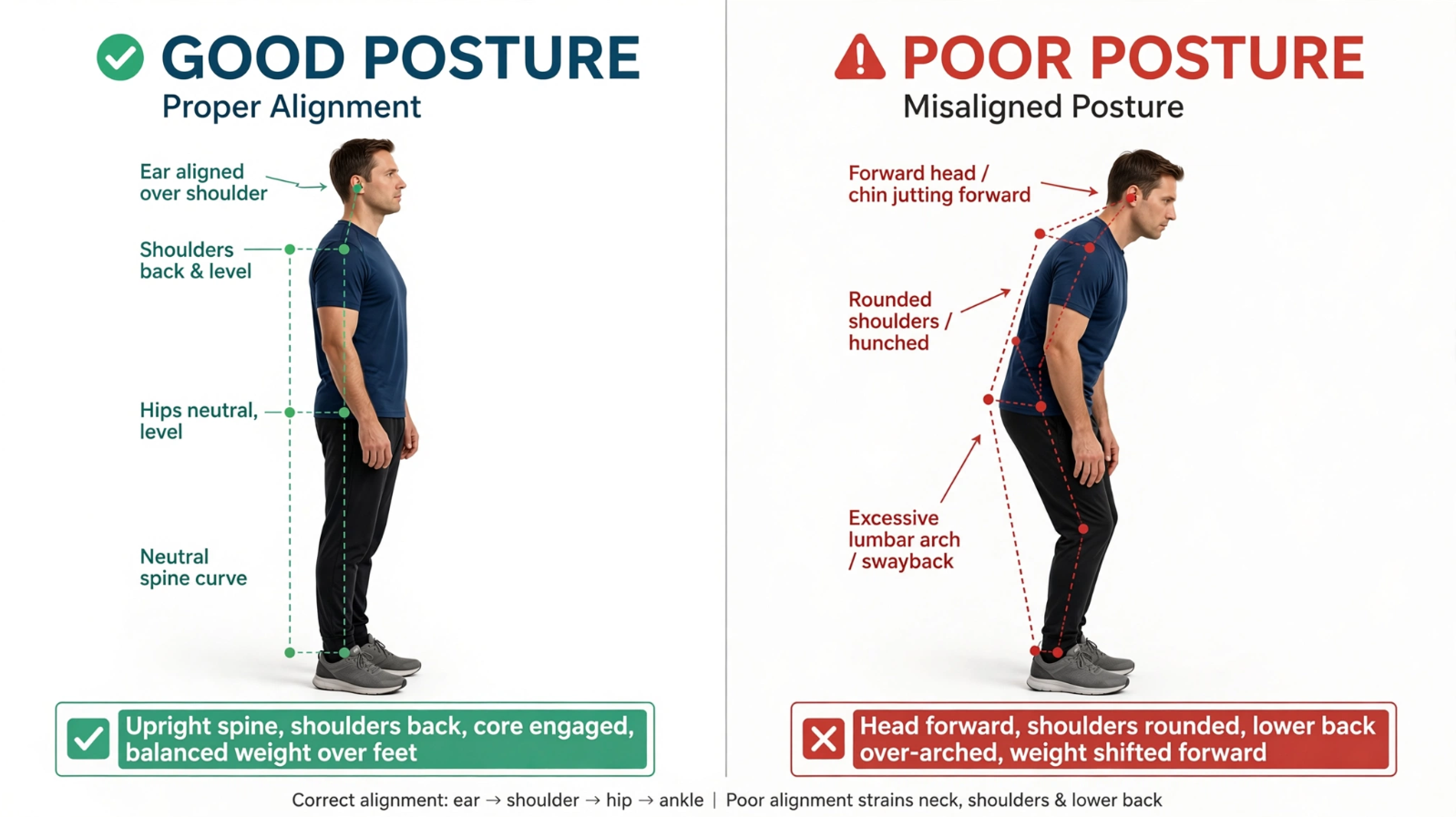
Good posture is the proper alignment of your body parts, supported by the right amount of muscle tension. It’s not about standing stiffly at attention—it’s about maintaining the natural curves of your spine in a balanced, supported position.
The Components of Good Posture
Standing Posture:
| Body Part | Proper Position |
|---|---|
| Head | Level, ears aligned with shoulders |
| Neck | Neutral, not forward or tilted |
| Shoulders | Back and down, not rounded forward |
| Chest | Open, not collapsed |
| Spine | Maintains natural “S” curve (not excessively arched or slouched) |
| Pelvis | Neutral (not tilted forward or backward excessively) |
| Hips | Level, not tilted to one side |
| Knees | Slightly bent, not locked |
| Feet | Hip-width apart, weight evenly distributed |
Sitting Posture:
| Body Part | Proper Position |
|---|---|
| Head | Level, ears aligned with shoulders |
| Back | Supported by chair, maintaining natural curve |
| Shoulders | Back and down |
| Hips | At or slightly above knee height |
| Knees | At 90 degrees, feet flat on floor |
| Screen | At eye level, not looking down |
The Natural Spinal Curves
Your spine has three natural curves:
| Curve | Location | Direction |
|---|---|---|
| Cervical Lordosis | Neck | Inward (concave) |
| Thoracic Kyphosis | Upper Back | Outward (convex) |
| Lumbar Lordosis | Lower Back | Inward (concave) |
Good posture maintains these curves in a balanced position. Poor posture exaggerates or flattens them, leading to pain and dysfunction.
Section 2: How Core Muscles Support Posture
The Core as a Postural Support System
Your core muscles surround your spine and pelvis like a corset. They provide the stability needed to maintain proper alignment against the forces of gravity and movement.
The Core Muscles and Their Postural Roles:
| Core Muscle | Postural Role |
|---|---|
| Transverse Abdominis | Deepest core muscle; provides 360-degree stability; supports the lumbar spine |
| Rectus Abdominis | Front of abdomen; flexes the spine; helps maintain pelvic position |
| Internal and External Obliques | Sides of abdomen; resist rotation; support lateral stability |
| Erector Spinae | Along the spine; maintains spinal extension; prevents slouching |
| Multifidus | Deep along the spine; provides segmental stability for each vertebra |
| Quadratus Lumborum | Deep in the lower back; stabilizes the pelvis and spine |
| Pelvic Floor | Base of the core; supports pelvic organs and intra-abdominal pressure |
| Diaphragm | Top of the core; controls breathing and intra-abdominal pressure |
How Weak Core Leads to Poor Posture
The Domino Effect:
| Step | What Happens | Result |
|---|---|---|
| 1 | Core muscles weaken | Reduced spinal support |
| 2 | Spine loses stability | Postural collapse |
| 3 | Gravity pulls body forward | Forward head, rounded shoulders |
| 4 | Chest muscles tighten | Pulls shoulders further forward |
| 5 | Upper back muscles weaken | Cannot pull shoulders back |
| 6 | Hip flexors tighten | Pelvis tilts forward, arching lower back |
| 7 | Glutes weaken | Cannot support pelvic position |
| 8 | Result | Forward head, rounded shoulders, excessive lumbar curve, pain |
The Posture-Core Cycle
| Direction | Effect |
|---|---|
| Weak Core → Poor Posture | Core cannot support spine; posture collapses |
| Poor Posture → Weak Core | Muscles work in compromised positions; cannot activate properly |
Breaking the Cycle: Strengthening your core allows you to improve your posture. Improving your posture allows your core to work more effectively. It’s a positive cycle you can create.
Section 3: Common Postural Deviations
Forward Head Posture (“Tech Neck”)
What It Looks Like: Your head is positioned forward of your shoulders. Your ears are not aligned with your shoulders.
What’s Happening:
- The head weighs about 10–12 pounds
- For every inch it moves forward, the load on your neck increases by about 10 pounds
- At 2 inches forward, your neck is supporting 30+ pounds of pressure
Causes:
- Prolonged screen use
- Looking down at smartphones
- Poor ergonomics at work
- Weak deep neck flexors
- Tight chest muscles
Consequences:
- Neck pain
- Headaches
- Jaw pain (TMJ)
- Shoulder tension
- Reduced breathing capacity
Rounded Shoulders
What It Looks Like: Your shoulders are rolled forward, your chest is collapsed, and your upper back is rounded.
What’s Happening:
- Chest muscles (pectorals) are tight and shortened
- Upper back muscles (rhomboids, trapezius) are weak and lengthened
- The imbalance pulls the shoulders forward
Causes:
- Prolonged sitting
- Computer work
- Driving
- Weak back muscles
- Tight chest muscles
Consequences:
- Shoulder pain
- Shoulder impingement
- Headaches
- Reduced breathing capacity
- Chest tightness
Excessive Lumbar Lordosis (Anterior Pelvic Tilt)
What It Looks Like: Your lower back has an excessive arch, your belly protrudes, and your butt sticks out.
What’s Happening:
- Hip flexors are tight and shortened
- Glutes and hamstrings are weak
- The imbalance pulls the pelvis forward, creating the arch
Causes:
- Prolonged sitting
- Weak glutes
- Tight hip flexors
- Weak core
Consequences:
- Lower back pain
- Hip pain
- Hamstring strain
- Reduced athletic performance
Flat Back (Posterior Pelvic Tilt)
What It Looks Like: Your lower back is flattened, your pelvis is tilted backward, and your hips are tucked under.
What’s Happening:
- Core muscles are weak
- Glutes are tight and shortened
- The imbalance pulls the pelvis backward
Causes:
- Weak core
- Tight hamstrings
- Poor posture habits
Consequences:
- Lower back pain
- Difficulty standing for long periods
- Reduced mobility
Section 4: Postural Assessment—Where Are You?
The Wall Test
How to Perform:
- Stand with your back against a wall, heels about 2–3 inches from the wall
- Your buttocks, upper back, and head should touch the wall
- Your lower back should have a small gap (1–2 inches)
Interpretation:
| Observation | What It Means |
|---|---|
| Head doesn’t touch wall | Forward head posture |
| Shoulders don’t touch wall | Rounded shoulders |
| Gap in lower back > 2 inches | Excessive lumbar lordosis (anterior pelvic tilt) |
| Gap in lower back < 1 inch | Flat back (posterior pelvic tilt) |
The Mirror Test
How to Perform:
- Stand in front of a full-length mirror
- Look at your profile (side view)
- Check alignment of ears, shoulders, hips, knees, and ankles
Ideal Alignment:
- Ears aligned with shoulders
- Shoulders aligned with hips
- Hips aligned with knees
- Knees aligned with ankles
What to Look For:
- Head forward of shoulders → Forward head posture
- Shoulders forward of hips → Rounded shoulders
- Hips forward of shoulders/knees → Anterior pelvic tilt
- Hips backward of shoulders/knees → Posterior pelvic tilt
The Self-Assessment Checklist
| Question | Yes/No |
|---|---|
| Do I have neck or shoulder pain? | ☐ |
| Do I have lower back pain? | ☐ |
| Do I look down at screens for 4+ hours per day? | ☐ |
| Do I sit for 6+ hours per day? | ☐ |
| Do I have frequent headaches? | ☐ |
| Do I feel tension in my upper back or neck? | ☐ |
| Do I have difficulty standing for long periods? | ☐ |
| Do I notice my head jutting forward? | ☐ |
| Do I notice my shoulders rounding forward? | ☐ |
| Do I have a visible arch in my lower back? | ☐ |
Scoring:
- 0–2 “Yes”: Good posture, minimal issues
- 3–5 “Yes”: Some postural issues, address them
- 6–10 “Yes”: Significant postural issues, take action
Section 5: Core Exercises for Better Posture
These exercises specifically target the core muscles that support good posture.
Exercise 1: Dead Bug (Core Stabilization)
Why It Helps Posture: Activates the deep core stabilizers that support the spine in proper alignment.
Form:
- Lie on your back, arms extended toward the ceiling
- Lift legs to tabletop position (knees at 90 degrees)
- Press lower back firmly into the floor
- Extend right arm and left leg toward the floor
- Return to start, repeat on opposite side
- Sets & Reps: 3 x 10–12 per side
Postural Focus: Keep lower back pressed into the floor. This activates the transverse abdominis, which pulls the pelvis into a neutral position.
Exercise 2: Bird Dog (Spinal Stabilization)
Why It Helps Posture: Trains the deep spinal stabilizers (multifidus) and core to maintain a neutral spine.
Form:
- Start on all fours, hands under shoulders, knees under hips
- Keep back flat and core engaged
- Extend right arm forward and left leg back
- Hold for 2–3 seconds, maintaining flat back and level hips
- Return to start, repeat on opposite side
- Sets & Reps: 3 x 10–12 per side
Postural Focus: Maintain a flat back. Don’t let your lower back arch or round. This teaches your core to stabilize your spine in a neutral position.
Exercise 3: Plank (Anti-Extension)
Why It Helps Posture: Trains the core to resist excessive arching of the lower back—a common postural issue.
Form:
- Forearms on the floor, elbows under shoulders
- Body straight from head to heels
- Squeeze glutes and engage core
- Hold, breathing steadily
- Sets & Duration: 3 x 45–60 seconds
Postural Focus: Maintain a straight line. Don’t let your hips sag or pike up. This teaches your core to maintain a neutral spine.
Exercise 4: Chin Tucks (Neck Posture)
Why It Helps Posture: Specifically targets forward head posture by strengthening deep neck flexors.
Form:
- Sit or stand with a neutral spine
- Pull your head straight back (imagine someone is pulling a string from the back of your head)
- Your chin should tuck in, and the back of your neck should lengthen
- Hold for 3–5 seconds
- Release and repeat
- Sets & Reps: 3 x 10–15
Postural Focus: Don’t tilt your head up or down. The movement should be straight back—like you’re making a double chin.
Exercise 5: Face Pulls (Upper Back Posture)
Why It Helps Posture: Strengthens the muscles that pull the shoulders back, counteracting rounded shoulders.
Form (with resistance band or cable):
- Set a band or cable at face height
- Grasp with both hands, thumbs pointing back
- Pull the band toward your face, squeezing your shoulder blades together
- Hold for 2 seconds
- Return to start with control
- Sets & Reps: 3 x 12–15
Postural Focus: Squeeze your shoulder blades together at the end of the movement. This strengthens the rhomboids and lower trapezius—key muscles for good posture.
Exercise 6: Glute Bridges (Pelvic Posture)
Why It Helps Posture: Strengthens the glutes, which support pelvic position and counter anterior pelvic tilt.
Form:
- Lie on your back, knees bent, feet flat on the floor
- Press through your heels to lift your hips toward the ceiling
- Squeeze your glutes at the top, hold for 2 seconds
- Lower with control
- Sets & Reps: 3 x 15–20
Postural Focus: Squeeze your glutes at the top. This pulls your pelvis into a neutral position and reduces excessive lumbar curve.
Exercise 7: Wall Angels (Shoulder Posture)
Why It Helps Posture: Improves shoulder mobility and retrains proper shoulder position.
Form:
- Stand with your back against a wall, feet 2–3 inches from the wall
- Press your head, upper back, and buttocks against the wall
- Place your arms against the wall in a “W” position (elbows at shoulder height)
- Slowly slide your arms up the wall into a “Y” position
- Return to “W” and repeat
- Sets & Reps: 3 x 10–12
Postural Focus: Keep your entire back against the wall. If your lower back arches, your core is not engaged.
Section 6: The Posture-Correcting Workout
Workout A: The Complete Posture Routine (20 Minutes)
Perform 3–4 times per week:
| Exercise | Sets | Reps/Duration | Rest |
|---|---|---|---|
| Dead Bugs | 3 | 10–12 per side | 45 sec |
| Bird Dogs | 3 | 10–12 per side | 45 sec |
| Plank | 3 | 45–60 sec | 45 sec |
| Chin Tucks | 3 | 10–15 | 30 sec |
| Face Pulls (band) | 3 | 12–15 | 45 sec |
| Glute Bridges | 3 | 15–20 | 45 sec |
Workout B: The Desk Worker’s Posture Break (10 Minutes)
Perform during work breaks:
| Exercise | Reps/Duration |
|---|---|
| Chin Tucks | 10 reps |
| Wall Angels | 10 reps |
| Seated Cat-Cow | 10 reps |
| Chest Stretch (doorway) | 30 seconds per side |
| Hip Flexor Stretch | 30 seconds per side |
| Glute Squeezes | 20 reps |
Workout C: The Quick Posture Finisher (5 Minutes)
Perform after your main workout:
| Exercise | Reps/Duration |
|---|---|
| Plank | 60 seconds |
| Side Plank (left) | 30 seconds |
| Side Plank (right) | 30 seconds |
| Chin Tucks | 10 reps |
| Glute Bridges | 15 reps |
Section 7: Stretches for Posture Support
Tight muscles pull your body out of alignment. These stretches help release tension in posturally significant muscles.
Stretch 1: Chest Stretch (Doorway)
Why It Helps: Opens tight chest muscles (pectorals) that pull shoulders forward.
How To:
- Stand in a doorway, one forearm on each side of the doorframe
- Lean forward until you feel a stretch in your chest
- Hold for 30 seconds
- Repeat: 2–3 times
Stretch 2: Upper Trapezius Stretch
Why It Helps: Releases tension in the neck and upper shoulders.
How To:
- Sit or stand with a neutral spine
- Tilt your head to one side, bringing your ear toward your shoulder
- Gently press down with your hand on your head for a deeper stretch
- Hold for 30 seconds
- Repeat on the opposite side
- Repeat: 2–3 times per side
Stretch 3: Hip Flexor Stretch
Why It Helps: Releases tight hip flexors that pull the pelvis forward (anterior pelvic tilt).
How To:
- Kneel on one knee, other foot forward
- Push your hips forward until you feel a stretch in the front of your hip
- Squeeze your glute on the back leg
- Hold for 30 seconds
- Repeat on the opposite side
- Repeat: 2–3 times per side
Stretch 4: Thoracic Extension (Foam Roller)
Why It Helps: Opens the upper back and counteracts rounded shoulders.
How To:
- Lie on your back with a foam roller under your upper back (not lower back)
- Support your head with your hands
- Gently arch over the foam roller
- Hold for 30 seconds
- Repeat: 2–3 times
Stretch 5: Seated Cat-Cow
Why It Helps: Improves spinal mobility and reduces tension.
How To:
- Sit in a chair with feet flat on the floor
- Place hands on your knees
- Round your back, dropping your head (Cat)
- Arch your back, lifting your chest (Cow)
- Move between positions slowly
- Repeat: 10 breaths
Section 8: Ergonomics for Better Posture
Workspace Setup
| Element | Optimal Position |
|---|---|
| Chair | Lumbar support; hips at or slightly above knee height; feet flat on floor |
| Monitor | Top of screen at or below eye level; arm’s length away |
| Keyboard | Hands at or below elbow height; wrists straight |
| Mouse | Within easy reach; wrist straight |
| Desk | Height allowing arms to rest comfortably |
| Document Holder | At eye level, beside monitor |
| Lighting | Adequate, no glare on screen |
The 20-20-20 Rule
Every 20 minutes:
- Look at something 20 feet away
- For at least 20 seconds
This reduces eye strain and encourages posture changes.
The 30-Minute Rule
Every 30 minutes:
- Stand up
- Move around (walk, stretch)
- Change position
This prevents prolonged static postures that weaken core muscles.
Phone Posture
| Do | Don’t |
|---|---|
| Hold phone at eye level | Look down at phone |
| Use voice commands | Hold phone between ear and shoulder |
| Take breaks every 20 minutes | Scroll for extended periods |
| Use larger screens when possible | Hunch over small screens |
Section 9: Common Posture Mistakes
Mistake 1: “Standing Up Straight” by Arched Back
The Problem: Overcorrecting by exaggerating the arch in your lower back.
The Fix: Engage your core to pull your pelvis into a neutral position. Your lower back should have a natural curve, not an exaggerated arch.
Mistake 2: Sucking In Your Stomach
The Problem: Pulling your belly button toward your spine, which reduces core stability.
The Fix: Brace your core (push out, not suck in). Imagine wearing a tight weightlifting belt.
Mistake 3: Locking Your Knees
The Problem: Hyperextending your knees, which locks your pelvis and reduces core engagement.
The Fix: Keep a slight bend in your knees. This allows your core to engage properly.
Mistake 4: Holding Your Breath
The Problem: Tensing up and holding your breath.
The Fix: Breathe steadily. Inhale and exhale while maintaining core engagement.
Mistake 5: Ignoring the Glutes
The Problem: Letting your glutes relax, allowing your pelvis to tilt forward.
The Fix: Squeeze your glutes gently to maintain pelvic position. Your glutes are key to good posture.
Mistake 6: Overcorrecting
The Problem: Trying to maintain perfect posture all at once, leading to tension and discomfort.
The Fix: Make small, gradual changes. Focus on one area at a time (e.g., chin tucks this week, shoulder position next week).
Section 10: FAQ—Your Top Posture Questions
Q: Can core strength really improve my posture?
A: Yes. Your core muscles support your spine in proper alignment. Strong core muscles keep your spine stable, allowing you to maintain good posture with less effort. Weak core muscles allow your posture to collapse.
Q: How long does it take to see posture improvements?
A: Many people notice reduced tension and improved awareness within 2–4 weeks. Significant postural changes typically take 8–12 weeks of consistent training. Be patient—you’ve been developing poor posture for years; it takes time to correct.
Q: Is good posture natural, or do I have to work for it?
A: Both. Children naturally have good posture. But years of sitting, screen use, and sedentary habits create poor posture. You need to retrain your body to return to its natural alignment. With consistent effort, good posture becomes natural again.
Q: Can I fix my posture just by thinking about it?
A: Not entirely. While awareness is the first step, you need to strengthen the core muscles that support good posture and stretch the muscles that pull you out of alignment. You can’t think your way out of weak muscles.
Q: Should I use a posture corrector brace?
A: Posture braces can be helpful for awareness and reminders, but they’re not a long-term solution. They can make your muscles weaker if you rely on them too much. Use them as a reminder, but focus on building the core strength that supports posture naturally.
Q: Will fixing my posture make me taller?
A: It won’t increase your bone length, but it will make you look taller. Poor posture can reduce your visible height by 1–2 inches. Correcting posture restores your full height.
Q: Can I fix my posture without exercise?
A: Exercise is the most effective way to improve posture. While ergonomic changes (better workspace setup) can help, they’re not enough on their own. You need to strengthen the muscles that support your spine.
Q: What’s the best sleeping position for posture?
A: Back sleeping (with a pillow under your knees) or side sleeping (with a pillow between your knees). Avoid stomach sleeping, which strains your neck and lower back. Use a supportive pillow that maintains neck alignment.
The VigorForty Take
Your posture is a window into your health. It reveals how strong your core is, how balanced your muscles are, and how well you’re managing the demands of daily life.
The connection between core and posture is direct:
- Strong core + mobile spine = good posture
- Weak core + tight muscles = poor posture
The solution is simple:
- Strengthen your core (dead bugs, bird dogs, planks, pallof presses)
- Stretch tight muscles (chest, hips, shoulders)
- Practice good ergonomics (workspace setup, frequent breaks)
- Be aware (check your posture regularly)
- Be consistent (daily practice, not just occasional effort)
The benefits are profound:
- Reduced neck, shoulder, and back pain
- Better breathing and energy
- Improved exercise performance
- More confidence and presence
- Better health and function
Your core is the foundation of your posture. Build it strong.
This article was reviewed by the Vigor Forty Editorial Review Board on July 19, 2026.
🔗 Related Articles
- What is Core Stability and Why Does It Matter for Every Lift?
- Core Stability for Lifters: How a Strong Core Protects Your Lower Back
- Beyond Crunches: The Best Exercises for True Core Stability
- 5 Foundational Movement Patterns for a Stronger Body
Affiliate Disclosure: Some links in this article may be affiliate links. If you make a purchase through these links, Vigor Forty may earn a small commission at no extra cost to you. We only recommend products we trust.