
You’ve cut off the late-night snacks, and you’re trying your best to put the phone away before bed. Yet, you still find yourself tossing and turning, staring at the alarm clock as it ticks closer to morning.
When we think about “sleep hygiene,” we often think of habits. But what about your physical environment?
Your bedroom should not be an extension of your living room, an auxiliary home office, or a media center. To your brain, your bedroom needs to mean one thing and one thing only: deep, uninterrupted rest. If your room is too bright, too warm, or cluttered with reminders of your daily stressors, your biology will fight sleep—no matter how tired you are.
Read Related Articles
- The 3-2-1 Rule: How to Optimize Your Circadian Rhythm for Deep, Restorative Sleep
- Beyond Sleep Hygiene: Why Your Bedroom Is Keeping You Tired (And How to Fix It)
- Calm the System, Sleep Follows: Breaking the Cycle of High-Stress Biohacking
- Recharging the Cellular Battery: The Deep Science of Mitochondrial Health and Mid-Life Energy
- Beyond Calorie Counting: Mastering Metabolic Flexibility to Erase Mid-Day Crashes and Stubborn Fat
- Protecting the Master Processor: Reversing Brain Fog and Building Lifelong Cognitive Reserve
- Reclaiming the Balance: Healing the “Cortisol Steal” and Building Elite Stress Resilience
Here is how to audit your environment, eliminate modern sleep disrupters, and build a bulletproof sleep sanctuary.
1. The Sleep Sanctuary Audit: Dark, Quiet, and Cool
Your body relies on environmental cues to signal that it’s safe to drop its guard and enter deep sleep phases. If your room doesn’t mimic the natural conditions of a cave after sunset, your sleep architecture will suffer.
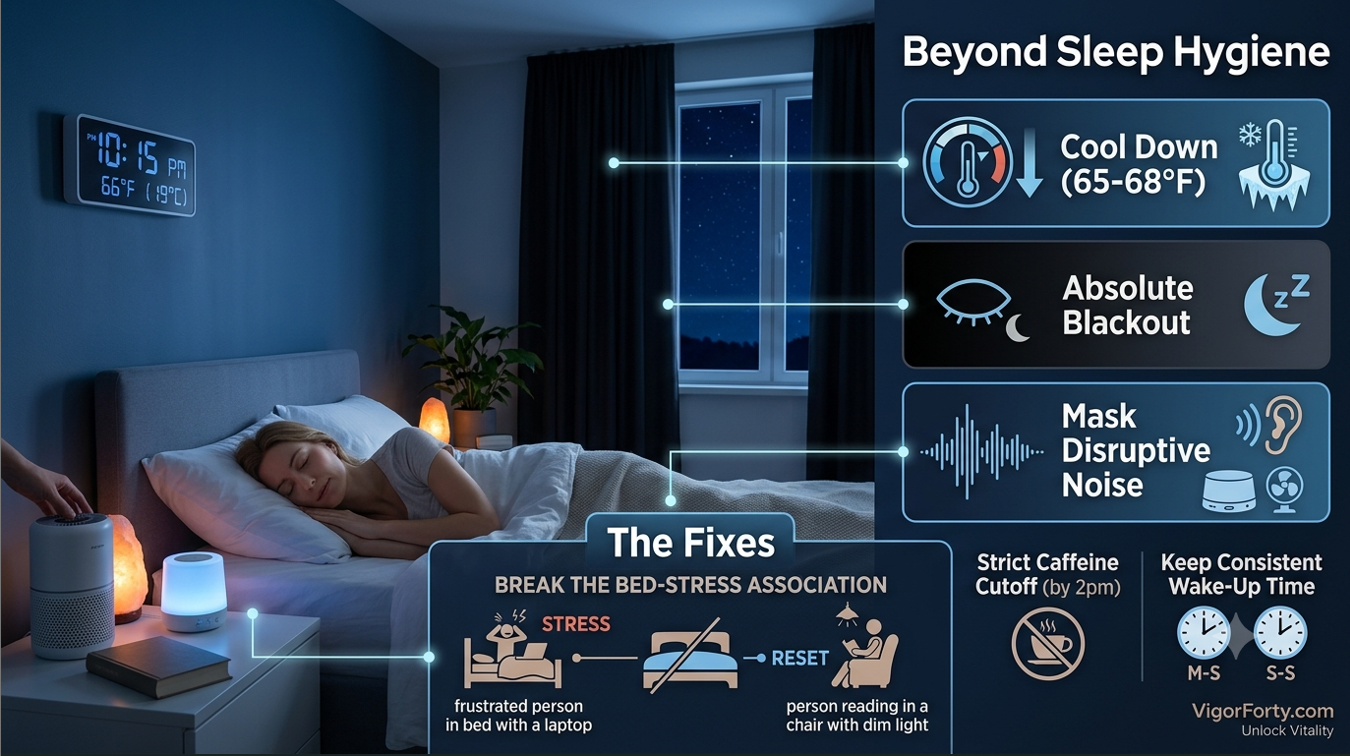
The Temperature Sweet Spot: 65°F to 68°F
Many people keep their homes too warm at night, unaware that a high ambient temperature directly interferes with REM and deep sleep. To initiate sleep, your core body temperature must drop by about $2^\circ\text{F}$ (or $\sim 1^\circ\text{C}$).
- The Fix: Lower your thermostat to somewhere between 65°F and 68°F. If that feels chilly, use a breathable, layered blanket system rather than cranking up the central heat.
Absolute Blackout Conditions
Even the tiniest amount of ambient light—the glow from a streetlamp through the blinds, a flashing smoke detector LED, or a charging phone screen—can penetrate your eyelids and alert your brain’s master clock. This subtle exposure suppresses melatonin production throughout the night.
- The Fix: Invest in high-quality blackout curtains. Cover or tape over any electronic LED lights, and keep your phone face down (or better yet, in another room).
Managing the Acoustic Environment
Sudden traffic sounds, a partner snoring, or a house settling can easily jar you out of deep sleep, even if you don’t fully wake up.
- The Fix: Introduce a steady, ambient sound to drown out sudden noise spikes. A dedicated white noise machine, a mechanical fan, or a high-quality air purifier works wonders for masking disruptive city noises.
2. The Stimulus Control Rule: Break the Bed-Stress Association
One of the biggest mistakes people make—especially with the rise of remote work—is using their bed for activities other than sleep. When you reply to emails, watch intense true-crime documentaries, or argue on social media while under the covers, your brain builds a subconscious association: The bed is a place for high mental arousal and stress.
To optimize your sleep, you must strictly enforce Stimulus Control:
- The Rule: The bed is reserved exclusively for sleep and intimacy.
- The 20-Minute Reset: If you are lying awake, frustrated, and unable to sleep for more than 20 minutes, get out of bed. Go to a different room, sit in a comfortable chair under dim light, and do something intentionally boring (like reading a dry book or manual). Do not look at your phone. Only return to bed when your eyelids are heavy.
By doing this, you break the cycle of associating your mattress with frustration and re-train your brain to realize that hitting the pillow means lights out.
3. Defeating the Two Silent Sleep Killers
Sometimes the environment is perfect, but hidden daytime habits ruin your nights. In the US, two major cultural habits quietly sabotage our sleep biology:
The Afternoon Caffeine Trap
Caffeine has a half-life of roughly 6 hours and a quarter-life of up to 12 hours. That means if you have a large iced coffee or an energy drink at 3:00 PM, a quarter of that caffeine is still actively blocking sleep receptors in your brain at 3:00 AM. You might still fall asleep, but you won’t get the deep, restorative stages your body requires.
- The Fix: Implement a strict caffeine cutoff time. Stop consuming coffee, soda, or energy drinks at least 8 to 10 hours before you intend to sleep (usually around 12:00 PM to 2:00 PM for most schedules).
The “Catch-Up” Sleep Myth
It’s incredibly common to skimp on sleep during a busy workweek and try to “make up for it” by sleeping in until 10:00 AM on Saturday and Sunday. Unfortunately, your circadian rhythm doesn’t have a bank account. Drastically shifting your wake-up time on weekends causes a phenomenon known as social jetlag. It completely resets your internal clock, ensuring that you’ll be wide awake and frustrated come Sunday night.
- The Fix: Keep your wake-up time within a 60-minute window every single day of the week. Consistency is the ultimate anchor for vibrant daytime energy.
Take the VigorForty Sanctuary Challenge
Take a look around your bedroom today with fresh eyes. What is one small change you can make to transform it into a true sanctuary tonight? Whether it’s dropping the thermostat a couple of degrees, moving your phone charger across the room, or cutting off coffee after lunch, small shifts yield massive returns in energy and longevity.
How have you set up your bedroom for better rest? Have you tried a caffeine cutoff? Share your strategies in the comments below, and subscribe to the VigorForty newsletter for more direct, actionable health strategies.