Author Box
Author: Vigor Forty Editorial Team
Medically Reviewed By: Editorial Review Board
Last Updated: August 23, 2026
Medical Disclaimer
Disclaimer: This article is for informational purposes only and is not a substitute for professional medical advice, diagnosis, or treatment. Always seek the advice of your physician or other qualified health provider with any questions you may have regarding a medical condition. Consult your physician before beginning a new exercise, diet, or supplement program, especially if you have an underlying health condition or are immunocompromised. Read our full Medical Disclaimer at vigorforty.com/disclaimer.
Period Hygiene Management for School-Going Girls: A Complete Guide
Introduction
The school bell rings. Your daughter shifts in her seat, suddenly aware that something feels different. She raises her hand to ask for the bathroom pass, hoping no one notices the small pouch she slips into her pocket. For millions of school-going girls, managing a period outside the safety of home is a quiet challenge—one that requires preparation, confidence, and practical knowledge.
As mothers, we remember what it was like. The anxiety of a potential leak, the awkwardness of asking to use the restroom, the fear of being teased. Many of us navigated those years with little guidance and a lot of embarrassment. But we have the power to change that story for our daughters.
This guide offers a comprehensive, practical approach to period hygiene management for school-going girls. It covers product choices, school-day strategies, hygiene practices, social and emotional concerns, and when to seek medical advice. Because every girl deserves to attend school feeling clean, confident, and in control of her body.
📌 Key Takeaways
- Preparation Is Power: A well-stocked period kit—kept in her backpack or locker—reduces anxiety and prevents emergencies.
- Know the Options: Pads, tampons, period underwear, and menstrual cups all have pros and cons. Let your daughter choose what feels right.
- Changing Frequency Matters: Most girls need to change products every 3–4 hours to stay fresh and reduce infection risk.
- Hygiene Is Simple: Warm water and mild soap are enough for the vulvar area. Avoid douches, scented sprays, and harsh cleansers.
- School Communication Helps: Talking to a trusted teacher or school nurse can make bathroom access easier and reduce stress.
- Confidence Is Contagious: When you treat periods as normal, your daughter will too.
Understanding Period Hygiene: Why It Matters
Good period hygiene is about more than just staying clean. It prevents skin irritation, reduces the risk of infection, and—perhaps most importantly—protects a girl’s confidence and dignity during a vulnerable time.
When menstrual blood leaves the body, it is usually sterile. However, once it reaches the skin’s surface and mixes with the natural bacteria that live there, it can begin to break down and develop odor. Prolonged contact with a wet or saturated pad or tampon can also irritate the delicate skin of the vulva and perineum [1].
What good hygiene prevents:
- Skin chafing and rashes
- Urinary tract irritation
- Unpleasant odor
- Rare but serious infections like toxic shock syndrome (TSS)
- Staining of clothing
- Emotional distress and embarrassment
What good hygiene does NOT require:
- Harsh soaps or douches
- Scented feminine sprays or wipes
- Excessive washing or scrubbing
- Shame or secrecy
Menstrual Product Options: What Works Best for School
Choosing the right product is a personal decision. There is no single “right” choice. What matters is that your daughter feels comfortable, confident, and able to manage her flow throughout the school day.
| Product | How It Works | Pros | Cons | Best For |
|---|---|---|---|---|
| Disposable Pads | Stick to underwear; absorb flow | Easy to use; no insertion; widely available | Can feel bulky; may shift; can cause chafing | Beginners; light to heavy flow |
| Tampons | Inserted into vagina; absorb flow internally | Invisible under clothing; good for sports/swimming | Requires insertion comfort; small TSS risk if misused | Active girls; swimmers; older teens |
| Period Underwear | Reusable underwear with absorbent layers | Eco-friendly; feels like normal underwear; no insertion | Need washing; backup needed for heavy flow | Light flow; backup with tampon/pad; overnight |
| Menstrual Cups | Flexible cup inserted into vagina; collects flow | Reusable for years; 12-hour wear time; eco-friendly | Steep learning curve; requires comfort with insertion | Older teens; experienced users |
| Reusable Cloth Pads | Washable fabric pads snapped into underwear | Eco-friendly; soft; no chemicals | Need washing and storage; bulkier than disposables | Light flow; backup; eco-conscious girls |
Recommendation for beginners: Most girls start with disposable pads. They are straightforward, require no insertion, and are easy to change in a school restroom. Tampons can be introduced when she feels ready, often within the first year of menstruation. Period underwear is an excellent backup or light-day option.
Building a School Period Kit
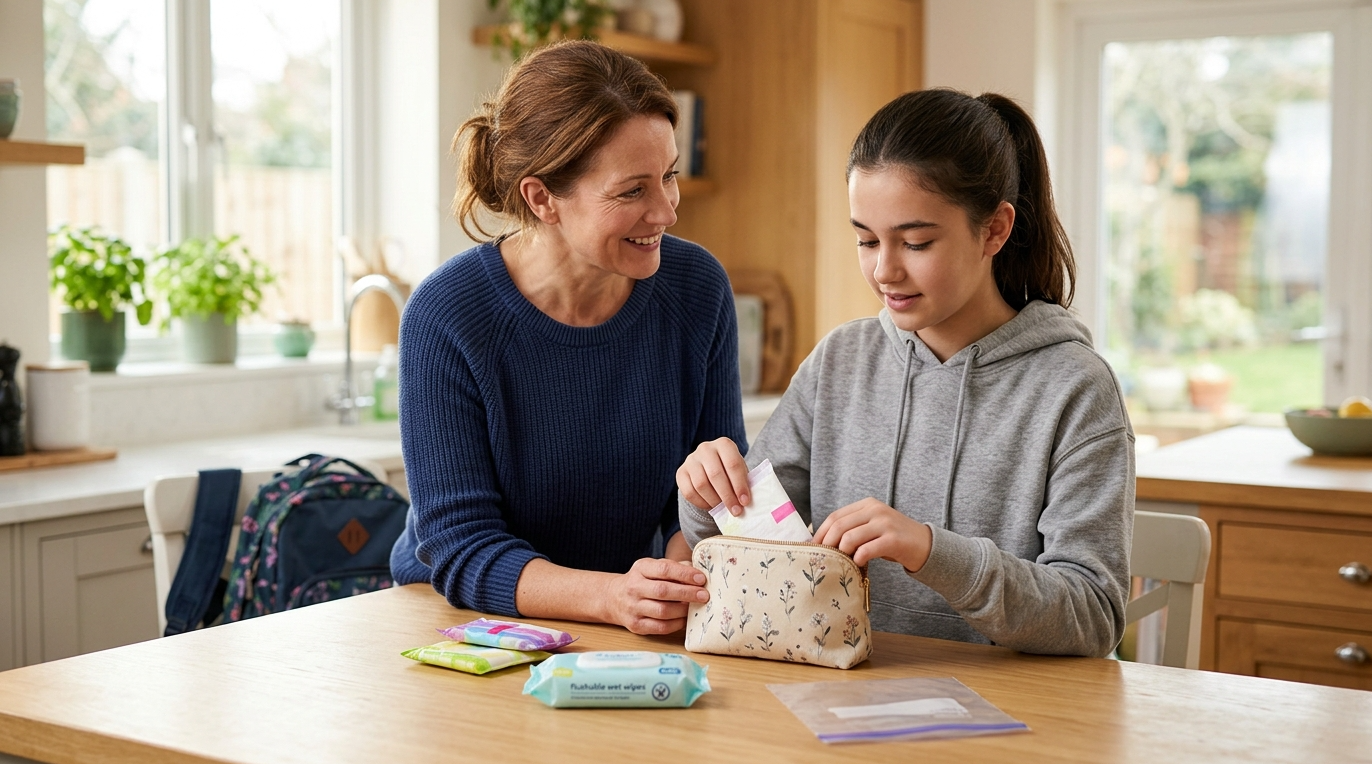
A well-stocked period kit is the single most effective tool for reducing school-day anxiety. Help your daughter assemble a small, discreet pouch that stays in her backpack or locker at all times.
What to include:
- 2–3 pads and/or tampons: Choose slender, teen-sized options to fit in a small pouch.
- 1 pair of clean underwear: Folded flat in a small ziplock bag.
- Unscented, pH-balanced wet wipes: For freshening up if needed. Avoid scented wipes, which can irritate sensitive skin.
- A small ziplock bag: For wrapping used products if no disposal bin is available.
- Pain relief (if allowed): Check school policy. If medication is permitted, include age-appropriate ibuprofen or naproxen with clear dosing instructions. If not, keep it at home and dose before school.
- Hand sanitizer: For use before and after changing products if soap and water are unavailable.
- A written note of encouragement: A small card with a reassuring message—”You’ve got this. Love, Mom”—can make a big difference on a hard day.
Tip: Keep an identical kit in her locker as a backup. That way, even if she forgets her backpack pouch, she has supplies.
The School Day: Practical Strategies
Managing a period during a 7-hour school day requires planning. Here are practical strategies to share with your daughter.
1. Plan Bathroom Breaks
- Most girls need to change a pad or tampon every 3–4 hours, even if flow is light.
- If she has a heavy flow day, she may need to change every 2–3 hours.
- Encourage her to use bathroom breaks between classes, during lunch, or at designated times.
- If bathroom access is restricted by school policy, talk to the school nurse or a trusted teacher to arrange a discreet signal or pass.
2. Wear the Right Clothing
- Dark-colored bottoms can hide unexpected leaks.
- Avoid white or light-colored pants on heavy flow days.
- Layering with a long cardigan or hoodie tied around the waist can provide emergency coverage.
3. Use Double Protection on Heavy Days
- A tampon plus a thin pad or period underwear provides backup protection.
- This reduces anxiety about leaks during long classes or tests.
4. Handle Stains Calmly
- If a leak happens, tie a sweater or jacket around her waist and go to the nurse or bathroom.
- Cold water removes blood stains better than hot water. If she has a change of clothes, she can change.
- Let her know leaks are normal and happen to almost everyone at some point. It is not a disaster.
5. Communicate with the School
- If your daughter is anxious, arrange a meeting with the school nurse or a trusted female teacher.
- A simple heads-up—”My daughter just started her period and may need bathroom access more frequently”—can make a huge difference.
- Some schools have discreet bathroom pass systems for girls who menstruate.
Hygiene Practices: Keeping Clean and Comfortable
Proper hygiene prevents odor, irritation, and infection. The good news? It is simple.
Daily hygiene during periods:
- Change products regularly: Every 3–4 hours for pads and tampons; every 8–12 hours for menstrual cups.
- Wash hands before and after changing products.
- Clean the vulvar area once daily with warm water. Mild, unscented soap can be used if desired, but plain water is sufficient.
- Wipe from front to back after using the toilet to prevent bacteria from the anus entering the vagina or urethra.
- Avoid douching: The vagina is self-cleaning. Douching disrupts the natural bacterial balance and increases infection risk [2].
- Avoid scented products: Scented pads, tampons, wipes, and sprays can irritate the vulva and cause contact dermatitis.
- Change out of sweaty or wet clothing promptly after sports or swimming.
Bathing during periods:
- Girls can absolutely shower or bathe during their period. Warm water can even ease cramps.
- There is no medical reason to avoid washing during menstruation. In fact, it is encouraged.
Diagnosis and Treatment: Recognizing Problems
Most period hygiene issues are minor and easily managed. However, certain symptoms warrant medical attention.
Common minor issues and solutions:
| Issue | Symptoms | Management |
|---|---|---|
| Skin irritation/rashes | Redness, itching, burning on vulva or inner thighs | Switch to unscented products; change more frequently; use a barrier cream if recommended by doctor |
| Mild odor | Noticeable smell between changes | Change products more often; wear breathable cotton underwear; avoid scented products |
| Chafing from pads | Raw, sore skin where pad rubs | Try a different brand; use soft cotton pads; apply petroleum jelly to irritated area |
Symptoms that require a doctor:
- Persistent itching or burning that does not improve with product changes
- Unusual vaginal discharge with a strong odor, green/gray color, or cottage-cheese texture (possible infection)
- Pain or burning during urination (possible urinary tract infection)
- Fever, rash, vomiting, or dizziness while using tampons (possible toxic shock syndrome—seek emergency care immediately)
- Sores, blisters, or lesions on the vulva
- Severe pain that interferes with daily activities
Prevention: Building Healthy Habits
Prevention is about more than just products. It is about building a foundation of body literacy and self-care.
- Track the cycle: Knowing when her period is due allows her to pack supplies in advance.
- Keep backup supplies: In her backpack, locker, and maybe even the car.
- Wear breathable underwear: Cotton is best. Avoid synthetic fabrics that trap moisture.
- Stay hydrated: Drinking water helps overall health and may reduce bloating.
- Eat iron-rich foods: Menstruation depletes iron. Include spinach, lentils, fortified cereals, and lean meats.
- Get enough sleep: Fatigue can worsen cramps and mood symptoms.
- Exercise regularly: Moderate physical activity improves circulation and may reduce cramps.
When to See a Doctor
Seek medical advice if your daughter:
- Has symptoms of toxic shock syndrome (TSS): Sudden high fever, vomiting, diarrhea, rash resembling sunburn, dizziness, or confusion while using tampons. This is a medical emergency.
- Has signs of a urinary tract infection: Burning with urination, frequent urge to urinate, cloudy or strong-smelling urine.
- Has signs of a vaginal infection: Unusual discharge, itching, burning, or odor.
- Has severe cramps that do not respond to over-the-counter medication or heat.
- Has extremely heavy bleeding: Soaking through a pad or tampon every 1–2 hours for several hours.
- Misses school regularly because of period symptoms.
- Develops a rash or skin irritation that does not improve with product changes.
The VigorForty Take
At VigorForty, we believe that period hygiene is not just about pads and tampons—it is about dignity. Every girl deserves to attend school without fear of leaks, odor, or embarrassment. And every mother has the power to give her that gift.
Our holistic, practical recommendations:
1. Normalize the Period Kit
Do not hide the kit like contraband. Keep it on the bathroom counter next to the hairbrush. Say, “This is your period kit. It lives in your backpack now. Let’s check it every month.” When it becomes routine, it loses its power to embarrass.
2. Practice Makes Confident
Before her first period at school, do a “dry run” at home. Let her practice opening a pad, positioning it in her underwear, and wrapping it for disposal. This removes the fear of fumbling in a public restroom.
3. Talk About the Messy Parts
Blood on underwear? Leaks on the bedsheet? These are not failures. Teach her how to rinse blood stains in cold water. Keep a stain remover in the laundry room. Say, “This happens to everyone. Here’s how we handle it.” Matter-of-fact, not shame.
4. Connect It to Your Own Story
Share a memory—maybe the time you started your period on a field trip, or the leak you had during a class presentation. Laugh about it together. This tells her that periods are survivable, even funny in hindsight.
5. Advocate for Systemic Change
Does her school provide free menstrual products in restrooms? Are bathroom breaks accessible? Consider raising these questions with the PTA or school administration. Period equity is a public health issue, not a luxury.
6. Teach Body Literacy for Life
Period hygiene is the entry point to a broader conversation about vaginal health, reproductive rights, and self-advocacy. Teach her the correct names for her anatomy. Teach her that she has the right to ask questions, to say no, and to seek care when something feels wrong.
Period management at school is a skill. Like any skill, it improves with practice, patience, and a little bit of preparation. You are not just handing her a pad—you are handing her the confidence to walk through the school day with her head held high.
FAQ Section
Q1: How many pads should a school-going girl use per day?
A: This depends on her flow. On average, most girls change pads every 3–4 hours, which means 3–5 pads during a typical school day. On lighter days, fewer may be needed; on heavy days, more. Encourage her to change whenever the pad feels wet or after 4 hours, whichever comes first.
Q2: Is it safe for a 12-year-old to use tampons?
A: Yes. There is no minimum age for tampon use. If a girl feels comfortable inserting one and understands the importance of changing it every 4–8 hours, tampons are safe. Some girls prefer to start with pads and transition to tampons later. The choice is personal.
Q3: What should my daughter do if she leaks at school?
A: First, reassure her that leaks happen to almost everyone. She should tie a sweater or jacket around her waist, go to the bathroom or nurse’s office, and change her product. If she has a spare pair of underwear in her period kit, she can change. Cold water removes blood stains. She should not panic—it is a solvable problem.
Q4: Can my daughter swim during her period?
A: Yes. Menstruation does not prevent swimming. Tampons and menstrual cups can be worn while swimming; pads cannot because they absorb water and become ineffective. If she prefers not to use internal products, she can choose period swimwear or sit out that day. There is no medical risk to swimming during a period.
Q5: How often should period underwear be changed during the school day?
A: Period underwear can be worn for 6–12 hours depending on flow and the absorbency of the specific product. For school use, one pair may last the entire day if flow is light to moderate. For heavy flow, it is best used as backup with a pad or tampon. Always follow the manufacturer’s guidelines.
Q6: Is it normal for periods to smell?
A: Menstrual blood itself has a mild, metallic smell that is usually not noticeable to others. If odor becomes strong or unpleasant, it is often because blood has been in contact with air and bacteria for too long. Changing products every 3–4 hours and washing the vulvar area daily with warm water resolves most odor.
Q7: What should I do if my daughter is too embarrassed to carry a period kit to school?
A: Empathy first. Say, “I understand it feels awkward. Would it help if we found a pouch that looks like a pencil case?” Discreet pouches exist that do not look like period supplies. Also consider keeping a second kit in her locker so she does not have to carry one in her backpack. Over time, the embarrassment usually fades.
Conclusion
Managing a period at school is a milestone—one that every girl navigates in her own way. It can be daunting, but it does not have to be overwhelming. With the right products, a well-stocked kit, and a mother’s calm guidance, a school day with a period becomes just another day.
As women over 40, we have decades of period experience behind us. We know the rhythms, the surprises, and the small hacks that make it easier. Now is the time to pass that wisdom on.
Teach her to be prepared, to stay clean, and to hold her head high. Teach her that her period is not a weakness to be hidden but a sign of health to be managed with confidence. She is not just learning to manage her period—she is learning to manage her life.
References
- American College of Obstetricians and Gynecologists. (2023). Your first period. https://www.acog.org/womens-health/faqs/your-first-period
- Mayo Clinic. (2023). Menstrual hygiene practices: What’s normal? https://www.mayoclinic.org/healthy-lifestyle/womens-health/in-depth/menstrual-hygiene/art-20046480
- Centers for Disease Control and Prevention. (2023). Menstrual hygiene. https://www.cdc.gov/hygiene/personal-hygiene/menstrual.html
- Cleveland Clinic. (2023). Toxic shock syndrome. https://my.clevelandclinic.org/health/diseases/15238-toxic-shock-syndrome