

Author: Vigor Forty Editorial Team
Medically Reviewed By: Editorial Review Board
Disclaimer: This article is for informational purposes only and is not a substitute for professional medical advice. Read our full Medical Disclaimer.
📌 Key Takeaways
- The Sarcopenia Shift: After age 30, adults lose up to 3% to 8% of muscle mass per decade. This rate accelerates drastically after 40 if protein intake is insufficient.
- The GLP-1 Factor: With millions of Americans now utilizing weight-loss medications (like semaglutide), prioritizing protein is essential to ensure weight loss comes from fat, not critical lean muscle.
- Distribution Matters: The human body cannot store excess protein. To trigger muscle synthesis, protein must be spaced evenly throughout the day, not crammed into a single large dinner.
- Clinical Benchmark: Leading medical boards recommend an intake of $1.2\text{ to }2.0\text{ grams of protein per kilogram of body weight}$ daily for active adults looking to optimize body composition.
Introduction: The Changing Landscape of American Weight Loss
For decades, the standard American approach to weight management was simple: eat less, move more. However, the modern clinical landscape has completely shifted. With the rapid rise of advanced GLP-1 receptor agonists (weight-loss medications) alongside a growing national awareness of healthy aging, the conversation has changed. We are no longer just fighting fat; we are actively fighting to save muscle.
When individuals lose weight rapidly—whether through aggressive calorie restriction or medical assistance—up to 25% to 40% of that lost weight can come directly from lean muscle mass. This loss lowers your basal metabolic rate, weakens joint stability, and compromises long-term physical autonomy. To protect your structural health, you must master daily protein requirements and learn how to feed your body to preserve muscle mass.
Section 1: The Math Behind Your Daily Protein Requirements
The Recommended Dietary Allowance (RDA) for protein in the United States sits at a modest $0.8\text{ grams per kilogram of body weight}$. However, modern sports medicine and clinical research indicate that this number is merely the bare minimum required to prevent outright deficiency—it is not optimized for longevity, vitality, or muscle retention.
To calculate your ideal daily intake for lean mass maintenance, use this targeted clinical formula:
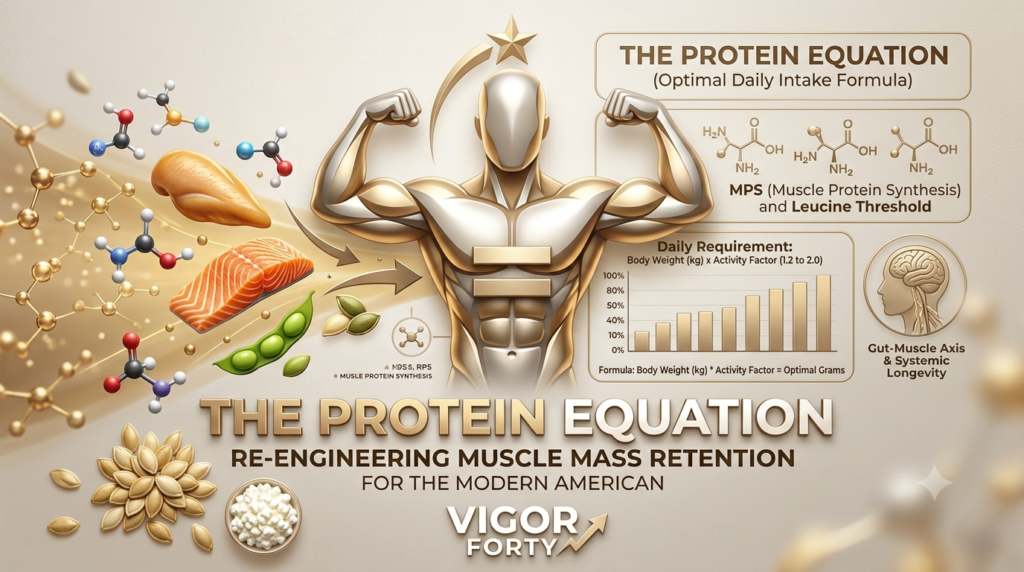
Optimal Daily Protein (Grams) = Body Weight in kg × Activity Factor (1.2 to 2.0)
- Sedentary or Caloric Maintenance: Multiply your weight in kilograms by 1.2.
- Active or Moderate Exercise: Multiply your weight in kilograms by 1.6.
- Caloric Deficit, Weight-Loss Meds, or Heavy Lifting: Multiply your weight in kilograms by 2.0.
(To convert your weight from pounds to kilograms, simply divide your weight in lbs by 2.2).
The Anabolic Window and Muscle Protein Synthesis (MPS)
Your body undergoes a continuous cycle of breaking down muscle tissue and rebuilding it. To trigger rebuilding (known as Muscle Protein Synthesis), a single meal must contain a threshold of roughly 2.5 to 3 grams of the essential amino acid Leucine. Shifting away from a typical American eating pattern—where breakfast is entirely carbohydrates and dinner is packed with a massive portion of steak—and spreading your protein intake evenly ensures your body stays in a net positive muscle-building state all day long.
Section 2: Building the Perfect Protein Matrix (The High-Yield Snack & Meal Guide)
Meeting an elevated protein goal can be difficult within a busy American schedule, often leading people to rely heavily on highly processed protein bars packed with sugar alcohols.
The strategy below maps out how to select clean, whole food, high-protein snacks and meals that satisfy your daily targets cleanly:
| Target Category | Whole Food Source (Per 100g serving) | Protein Yield | Added Longevity Benefit |
| Lean Poultry | Organic Chicken or Turkey Breast | ~31 grams | Exceptionally low in saturated fat; rich in niacin and B6. |
| Cold-Water Fish | Wild-Caught Sockeye Salmon | ~25 grams | Loaded with Omega-3 fatty acids (EPA/DHA) which lower systemic joint inflammation. |
| Plant-Based Core | Tempeh or Organic Edamame | ~18-20 grams | High in dietary fiber, promoting a healthy gut microbiome while delivering complete amino acids. |
| Dairy / Casein | Low-Fat Cottage Cheese | ~11 grams | High in slow-digesting casein protein, making it an excellent evening snack to prevent overnight muscle breakdown. |
| On-the-Go Snack | Dry-Roasted Pumpkin Seeds (Pepitas) | ~30 grams (per cup) | Packed with zinc, magnesium, and plant sterols for hormonal support. |
Section 3: The Medical Block (Clinical Consensus)
Optimizing protein intake to preserve lean mass and metabolic health is heavily supported by leading medical networks across the United States.
The American Heart Association (AHA)
While the AHA emphasizes watching your intake of saturated fats from red meat, their guidelines strongly support diverse, lean protein strategies. The AHA recommends sourcing proteins primarily from plants (such as legumes, nuts, and seeds), alongside regular servings of fish, seafood, and low-fat dairy. This approach helps maintain vascular health while ensuring your muscles receive the amino acids required for repair.
The American College of Sports Medicine (ACSM)
The ACSM explicitly states that to increase or maintain muscle mass, active individuals require substantially more protein than the base federal guidelines suggest. They advise that protein should be consumed regularly throughout the day—roughly every 3 to 4 hours—and combined with progressive resistance training to maximize metabolic health, optimize bone density, and ensure long-term physical function as you age.