Author Box
Author: Vigor Forty Editorial Team
Medically Reviewed By: Editorial Review Board
Last Updated: August 23, 2026
Medical Disclaimer
Disclaimer: This article is for informational purposes only and is not a substitute for professional medical advice, diagnosis, or treatment. Always seek the advice of your physician or other qualified health provider with any questions you may have regarding a medical condition. Consult your physician before beginning a new exercise, diet, or supplement program, especially if you have an underlying health condition or are immunocompromised. Read our full Medical Disclaimer at vigorforty.com/disclaimer.
First Period (Menarche): What to Expect, Average Age, and How to Prepare Your Daughter
Introduction
There is a moment in every mother’s life when she realizes her little girl is no longer so little. It may be when you notice the first breast buds, the first whisper of body odor, or the sudden growth spurt that makes her jeans too short. But perhaps no milestone carries as much emotional weight as the first period—menarche.
For many women over 40, this moment stirs a deep well of memory. We recall our own first period—where we were, who we told, how we felt. Some of us were prepared with calm reassurance. Many of us were not. We fumbled through it alone, confused and embarrassed. Now, as mothers, we have the chance to do it differently.
This guide is designed to help you understand what menarche is, when it typically happens, what your daughter can expect, and how to prepare her—practically and emotionally—for this profound transition into womanhood.
📌 Key Takeaways
- Definition: Menarche is the medical term for a girl’s first menstrual period. It marks the culmination of puberty’s physical changes.
- Average Age: In the United States, the average age of menarche is about 12.5 years, but anywhere from 10 to 15 is considered normal.
- Sequence of Puberty: The first period usually arrives 2 to 3 years after breast buds appear, and after the peak growth spurt.
- Irregularity Is Normal: For the first 1 to 2 years, cycles are often irregular, light, heavy, or skipped. This is usually not a concern.
- Preparation Matters: Girls who understand what to expect feel more confident and less afraid. Open, honest conversation is key.
- When to See a Doctor: No period by age 15, or no period within 3 years of breast development, warrants medical evaluation.
What Is Menarche?
Menarche (pronounced meh-NAR-kee) is the medical term for a girl’s first menstrual period. It comes from the Greek words men (month) and arkhe (beginning). It is not an isolated event but the final milestone in a long sequence of pubertal changes.
To understand menarche, we need to understand the menstrual cycle itself. Each month, the ovaries release an egg in a process called ovulation. The lining of the uterus (endometrium) thickens with blood and tissue in preparation for a possible pregnancy. If pregnancy does not occur, this lining sheds, exiting the body through the vagina as menstrual flow [1].
Menarche occurs when the hormonal communication between the brain and ovaries has matured enough to produce this first complete cycle. However, for many girls, the first periods are anovulatory—meaning the ovaries have not yet released an egg. The bleeding happens due to hormonal fluctuations alone, which is why early cycles can be unpredictable [2].
Average Age and Normal Range
The timing of menarche has shifted over the past century. In the United States, the average age of first period is now approximately 12.5 years, down from around 14 in the early 1900s [3]. However, “average” means that many girls start earlier or later and are still perfectly healthy.
What is considered normal?
- Typical range: 10 to 15 years old.
- Early menarche: Before age 10, especially if accompanied by breast development before age 8.
- Delayed menarche: No period by age 15, or no period within 3 years of breast development.
Factors that influence timing:
- Genetics: A mother’s age at menarche is one of the strongest predictors of her daughter’s age [3].
- Body weight and nutrition: Higher body mass index (BMI) is associated with earlier menarche. Low body weight or intense athletic training can delay it.
- Race and ethnicity: Studies show Black and Hispanic girls in the U.S. tend to start slightly earlier than White and Asian girls [3].
- Environmental factors: Exposure to certain endocrine-disrupting chemicals may be linked to earlier puberty, though research is ongoing.
- Psychosocial stress: High stress in childhood has been associated with earlier menarche in some studies.
Key relationship to breast development: Menarche typically occurs 2 to 3 years after breast budding (thelarche). If a girl develops breast buds at age 9, her first period may arrive around 11 to 12. If breast buds appear at 12, the period may come at 14 or 15. The interval is more important than the age alone [4].
Hormonal Causes: What Triggers the First Period
Menarche is the result of the Hypothalamic-Pituitary-Ovarian (HPO) Axis maturing over several years.
- The hypothalamus releases gonadotropin-releasing hormone (GnRH).
- GnRH tells the pituitary gland to release follicle-stimulating hormone (FSH) and luteinizing hormone (LH).
- FSH and LH stimulate the ovaries to produce estrogen and progesterone.
- Estrogen builds the uterine lining. When estrogen levels drop and progesterone is insufficient, the lining sheds—creating the first period.
In the early months after menarche, this system is still learning to coordinate. It is common for cycles to be anovulatory and irregular as the HPO axis matures fully [2].
Symptoms Before the First Period
In the months leading up to menarche, girls may experience signs that their first period is approaching. These are caused by rising and fluctuating hormones.
Common premenstrual signs in the 3–6 months before menarche:
- Vaginal discharge: A clear or whitish, odorless discharge is often the first sign that estrogen is active. This can begin 6 to 12 months before the first period.
- Mild cramping: Some girls feel dull aches in the lower abdomen or lower back.
- Bloating: A feeling of fullness or puffiness in the abdomen.
- Breast tenderness: Hormonal shifts can cause soreness or sensitivity.
- Mood changes: Irritability, tearfulness, or anxiety may increase.
- Acne flare-ups: Breakouts may worsen just before bleeding begins.
- Food cravings: A sudden desire for salty, sweet, or carbohydrate-rich foods.
Not all girls experience these symptoms. Some are completely unaware until they notice blood. Both experiences are normal.
What to Expect: Flow, Duration, and Appearance
The first period is often light and may not look like what girls expect. It can be reassuring to prepare your daughter for the range of normal.
| Characteristic | Typical First Period | Notes |
|---|---|---|
| Color | Brownish, dark red, or bright red | Brownish blood is older blood; both are normal. |
| Flow | Light spotting to moderate flow | Many girls start with spotting for 1–2 days before heavier flow. |
| Duration | 2 to 7 days | Shorter or longer is still normal for the first year. |
| Amount | Usually less than 6 pads/tampons per day | Heavy soaking (>1 pad per 1–2 hours) is a red flag. |
| Clots | Small, occasional clots are normal | Large clots (bigger than a quarter) may indicate heavy bleeding. |
| Irregularity | Cycles may be 21–45 days apart | Irregular for the first 1–2 years is expected. |
Important: It is normal for the first period to be followed by several months of no bleeding. The body is still figuring out its rhythm.
How to Prepare Your Daughter
Preparation is the single most important thing you can do to ensure a positive menarche experience. It involves practical supplies, clear education, and emotional reassurance.
1. Start the Conversation Early
Do not wait until the first period arrives to talk about it. Begin discussing menstruation around age 8 or 9, using simple, age-appropriate language. Answer questions honestly. Use correct anatomical terms. If you feel awkward, say, “I’m not sure how to explain this, but I want to do it right. Let’s figure it out together.”
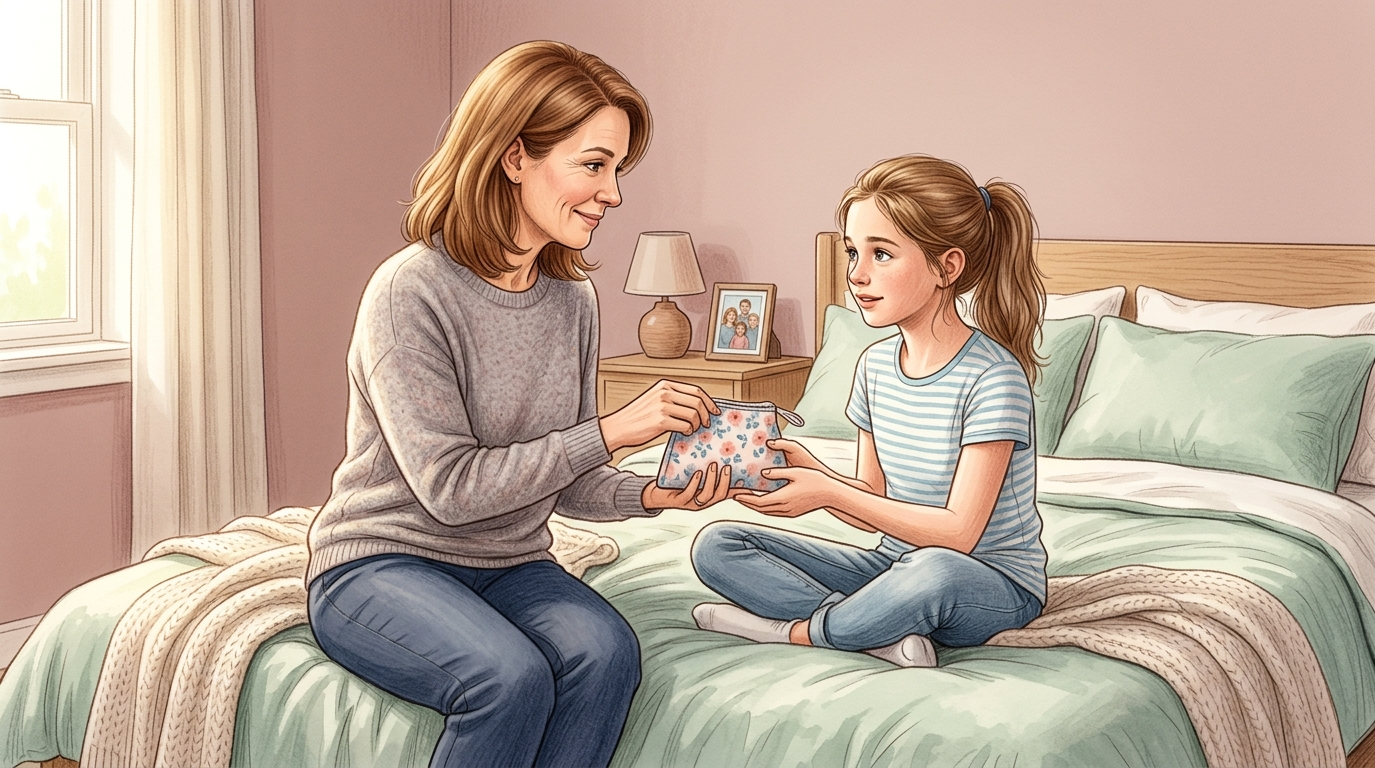
2. Create a Period Kit
Help your daughter assemble a small pouch she can keep in her backpack or locker. Include:
- 2–3 sanitary pads (slender or teen-sized)
- A clean pair of underwear
- A few wet wipes (unscented, pH-balanced)
- A small ziplock bag for used items if no bin is available
- A written reminder of what to do if she is at school
Let her choose the pouch and help pack it. This gives her a sense of control.
3. Explain Hygiene Products
Teach her the differences between options:
- Pads: Easiest for beginners. Stick to underwear, absorb flow, change every 3–4 hours or when saturated.
- Tampons: Safe for teens, but require comfort with insertion. Some girls prefer pads first. There is no medical reason to avoid tampons.
- Menstrual cups: Generally not recommended for beginners due to learning curve.
- Period underwear: Reusable, absorbent underwear. Good for backup or light days.
Allow her to choose what feels right. Do not push tampons if she is not ready.
4. Discuss Hygiene and Safety
- Change pads/tampons every 3–4 hours to prevent odor and reduce risk of toxic shock syndrome (TSS), a rare but serious bacterial infection associated with tampon use [5].
- Wash hands before and after changing products.
- Keep the vulvar area clean with warm water; no need for douches or scented sprays.
5. Normalize the Emotional Side
Tell her it is okay to feel confused, curious, or even upset. Share a brief, reassuring story of your own first period. Avoid framing it as a “burden” or “curse.” Instead say: “This is a sign your body is healthy and growing up. It might feel weird at first, but it gets easier.”
Diagnosis: When Timing Is a Concern
If a girl’s period is early or late, a pediatrician or adolescent gynecologist may evaluate for underlying causes.
What the doctor will do:
- Medical History: Ask about breast development, pubic hair, growth patterns, family history, and any medications.
- Physical Exam: Assess Tanner stages and overall health.
- Bone Age X-Ray: Helps determine if skeletal maturity matches chronological age.
- Blood Tests: May check levels of FSH, LH, estradiol, thyroid hormones, and prolactin.
- Pelvic Ultrasound: Rarely needed in young girls unless there is pain or suspected anatomical issue.
Possible causes of early menarche (before age 10):
- Central precocious puberty (brain starts puberty early)
- Obesity
- Ovarian cysts or tumors (rare)
- Hypothyroidism (rare)
Possible causes of delayed menarche (after age 15):
- Constitutional delay (family pattern of late puberty)
- Low body weight or eating disorders
- Excessive exercise
- Polycystic ovary syndrome (PCOS)
- Genetic conditions (e.g., Turner syndrome)
- Pituitary or thyroid disorders
Treatment and Management
For most girls, menarche requires no medical treatment—only management and support. However, if there is an underlying hormonal disorder, a specialist may recommend specific therapies.
Managing Period Symptoms
Cramps (dysmenorrhea):
- Heat therapy: A warm heating pad or hot water bottle on the lower abdomen.
- Gentle exercise: Walking, stretching, or yoga can reduce pain.
- Over-the-counter pain relief: Ibuprofen or naproxen are commonly used, but always consult a doctor or pharmacist for appropriate dosing for your daughter’s age and weight. Never give aspirin to children or teens due to risk of Reye’s syndrome.
Heavy bleeding:
- If she soaks through a pad or tampon every 1–2 hours, or passes large clots, see a doctor. This may indicate a bleeding disorder or hormonal imbalance.
Irregular cycles:
- Track cycles on a calendar or app. Irregularity is normal for the first 2 years. If cycles remain very irregular (less than 21 days or more than 45 days apart) after 2 years, seek evaluation.
Mood symptoms:
- Encourage sleep, physical activity, and talking about feelings. If mood swings are severe, interfere with daily life, or include depression or anxiety, seek professional support.
Medical Treatments for Underlying Causes
- Hormonal birth control: May be prescribed to regulate heavy or painful periods in teens, but this is a medical decision made with a doctor and family.
- GnRH agonists: Used only for precocious puberty to pause development.
- Thyroid medication or other targeted therapy: If an underlying endocrine disorder is found.
Always follow the guidance of a pediatrician or pediatric endocrinologist. Never give your daughter medication prescribed for someone else.
Prevention and Healthy Habits
You cannot prevent menarche—it is a healthy, expected milestone. However, you can support a regular, comfortable menstrual cycle through lifestyle.
- Balanced nutrition: Ensure adequate iron, calcium, vitamin D, and overall calories. Iron deficiency is common in menstruating girls.
- Healthy weight: Both underweight and overweight can disrupt cycles. Aim for a steady, healthy weight through balanced eating and activity.
- Regular physical activity: Moderate exercise supports hormonal balance and reduces cramps. Avoid excessive, compulsive training.
- Adequate sleep: Girls aged 10–15 need 8 to 10 hours per night. Sleep deprivation affects hormones.
- Stress management: Teach relaxation techniques, journaling, or mindfulness. High stress can delay or disrupt cycles.
- Open communication: Keep the conversation going. A girl who feels she can ask questions is less likely to hide problems.
When to See a Doctor
Seek medical advice if your daughter:
- Has not had a period by age 15.
- Has not had a period within 3 years of breast development.
- Has severe pain that does not improve with heat or over-the-counter medication.
- Soaks through a pad or tampon every 1–2 hours for several hours.
- Passes large blood clots (bigger than a quarter).
- Has periods that last longer than 7 days.
- Has bleeding between periods after cycles have been established.
- Experiences fainting, dizziness, or severe weakness during periods.
- Develops a sudden high fever or rash while using tampons (possible toxic shock syndrome).
The VigorForty Take
At VigorForty, we believe that how a mother handles menarche echoes through a daughter’s life. It can shape her relationship with her body, her fertility, and her sense of self-worth. We also know that for women over 40, this moment arrives at a poignant intersection—just as our own reproductive years are winding down.
Our holistic, practical recommendations:
1. Reframe Menarche as a Celebration, Not a Burden
Many of us were taught that periods are “the curse,” something to dread. Instead, tell your daughter: “This is a sign your body is working. It means you are healthy and growing.” Consider marking the occasion quietly—a special dinner, a journal, a small gift. Not to make it heavy, but to signal that this is worthy of honor.
2. Share Your Own Story—Honestly and Hopefully
Tell her about your first period. If it was confusing or embarrassing, say so. Then add: “I wish someone had told me what I’m telling you now.” This builds trust and positions you as an ally, not an authority figure delivering a lecture.
3. Connect It to Your Own Transition
If you are in perimenopause, your cycles may be irregular, heavier, or disappearing. That is a powerful teaching moment. Say, “My body is changing too, just in the opposite direction. We’re both on this journey.” This normalizes the fact that female bodies are dynamic, not static.
4. Teach Body Literacy, Not Shame
Use correct anatomical terms from the start. A girl who can say “vulva” and “uterus” without embarrassment is better equipped to advocate for her own health. If you struggle with these words, practice. Your comfort becomes her comfort.
5. Build a Support Network
Encourage her to talk to trusted aunts, older cousins, or family friends. Sometimes a girl feels more comfortable asking questions of someone who is not her mother. That is not a rejection of you; it is a sign of healthy community.
6. Prioritize Your Own Gynecological Health
As women over 40, we need regular Pap smears, mammograms, and bone density checks. Let your daughter see you scheduling these appointments without fear or embarrassment. You are modeling what lifelong reproductive health looks like.
Menarche is not an ending. It is a beginning—for her, and for the next chapter of your relationship.
FAQ Section
Q1: What is the average age for a girl’s first period in the US?
A: The average age is about 12.5 years, but anywhere from 10 to 15 is considered normal. The timing is influenced by genetics, body weight, nutrition, and ethnicity.
Q2: How can I tell if my daughter’s first period is coming soon?
A: Look for signs like a clear or whitish vaginal discharge (often 6–12 months before), mild cramping, bloating, breast tenderness, mood changes, or acne flare-ups. Some girls have no warning signs at all.
Q3: Should my daughter use pads or tampons for her first period?
A: There is no medical reason to choose one over the other. Many girls find pads easier and less intimidating initially. Tampons are safe if she feels comfortable inserting them. Let her choose what feels right and teach proper use and changing frequency.
Q4: Is it normal for periods to be irregular for the first year?
A: Yes. For the first 1 to 2 years after menarche, cycles are often irregular, anovulatory, and unpredictable. Cycles may be 21 to 45 days apart, and skipping months is common. If irregularity persists beyond 2 years, see a doctor.
Q5: What is toxic shock syndrome (TSS), and how can it be prevented?
A: TSS is a rare but serious bacterial infection associated with tampon use. To reduce risk, use the lowest absorbency tampon needed, change it every 4–8 hours, avoid sleeping in tampons, and alternate with pads. If your daughter develops sudden fever, vomiting, rash, or dizziness while using a tampon, seek emergency care immediately.
Q6: Can my daughter swim during her period?
A: Yes. Menstruation does not prevent swimming. A tampon or menstrual cup can be worn while swimming; pads cannot. If she prefers not to use internal products, she can sit out or wear period swimwear designed for that purpose.
Q7: When should I be concerned about my daughter’s period pain?
A: Mild to moderate cramping that responds to heat or over-the-counter medication is normal. Severe pain that makes her miss school, double over, or does not improve with medication may indicate a condition like endometriosis or a pelvic issue. See a doctor if pain is debilitating.
Conclusion
Menarche is a threshold—one that every woman crosses in her own time and her own way. For mothers, it is a moment of pride, nostalgia, and sometimes a little grief for the childhood that is passing. For daughters, it is a step into a new identity, one that can feel both exciting and overwhelming.
The best gift you can give your daughter is preparation without fear, information without shame, and love without condition. Tell her what to expect. Show her how to manage it. Reassure her that her body is doing exactly what it should.
And as you guide her through her first period, remember that you are also writing the story she will one day tell her own daughter. Make it a story of strength, honesty, and grace.
References
- American College of Obstetricians and Gynecologists. (2023). Your first period. https://www.acog.org/womens-health/faqs/your-first-period
- National Institute of Child Health and Human Development. (2021). Menstruation and the menstrual cycle. https://www.nichd.nih.gov/health/topics/menstruation
- Biro, F. M., Greenspan, L. C., Galvez, M. P., Pinney, S. M., Teitelbaum, S., Windham, G. C., … Wolff, M. S. (2013). Onset of breast development in a longitudinal cohort. Pediatrics, 132(6), 1019–1027. https://doi.org/10.1542/peds.2012-3773
- Mayo Clinic. (2023). Puberty: What’s normal and what’s not. https://www.mayoclinic.org/healthy-lifestyle/childrens-health/in-depth/puberty/art-20045152
- Cleveland Clinic. (2023). Toxic shock syndrome. https://my.clevelandclinic.org/health/diseases/15238-toxic-shock-syndrome