Author Box
Author: Vigor Forty Editorial Team
Medically Reviewed By: Editorial Review Board
Last Updated: August 23, 2026
Medical Disclaimer
Disclaimer: This article is for informational purposes only and is not a substitute for professional medical advice, diagnosis, or treatment. Always seek the advice of your physician or other qualified health provider with any questions you may have regarding a medical condition. Consult your physician before beginning a new exercise, diet, or supplement program, especially if you have an underlying health condition or are immunocompromised. Read our full Medical Disclaimer at vigorforty.com/disclaimer.
When Does a Woman’s Body Stop Growing? Physical Maturity Before 20
Introduction
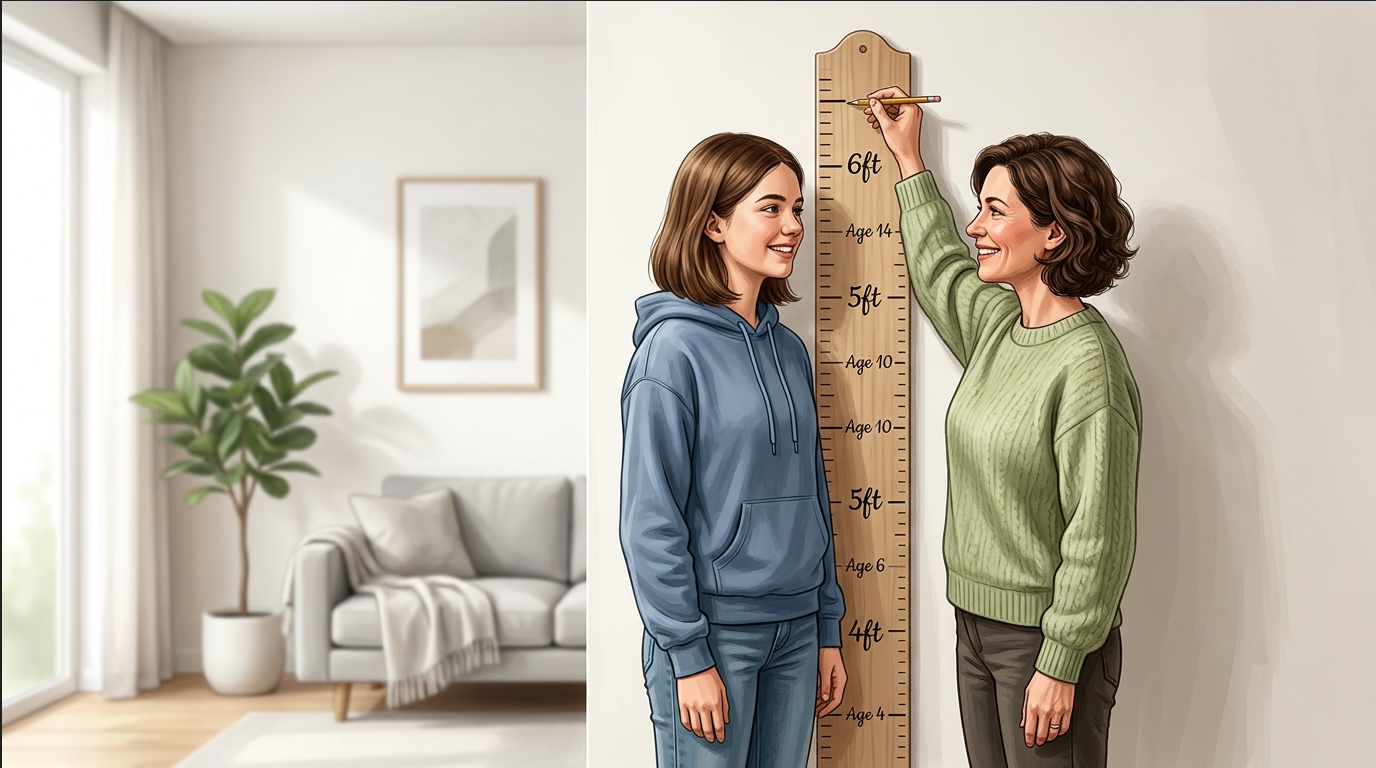
The growth chart on the kitchen wall tells a story. The pencil marks climb steadily through childhood, spike dramatically during the preteen years, and then—almost imperceptibly—stop. One day, the measurements level off. The child is gone, and a young woman stands in her place.
For mothers over 40, this moment is layered with meaning. We have watched our daughters stretch, fill out, and reshape. We have measured, worried, and marveled. And now, as their growth plates close and their bodies reach their final adult form, we find ourselves at a different threshold—navigating the physical changes of perimenopause and menopause. The symmetry is striking: as our daughters complete their physical maturation, we are entering a new phase of our own.
Understanding when and why a woman’s body stops growing is more than a matter of curiosity. It is essential knowledge for mothers who want to support their daughters’ final years of growth—and for women who want to protect the bodies they have now.
📌 Key Takeaways
- Height Growth Stops First: Most girls reach their final adult height by age 14 to 16, about 2 to 2.5 years after their first period.
- Growth Plates Close: The long bones stop lengthening when estrogen signals the growth plates to fuse. After closure, no further height gain is possible.
- Bone Density Peaks Later: While height stops, bone mass continues to build until around age 18 to 25, when peak bone mass is achieved.
- Other Changes Continue: Breast development, hip widening, and fat redistribution may continue into the late teens and early 20s.
- The Brain Is Still Growing: The prefrontal cortex—responsible for judgment and impulse control—is not fully mature until around age 25.
- Bone Health Is a Lifelong Project: The bone mass built before 20 determines osteoporosis risk decades later.
Understanding Growth Plates: The Biology of Stopping
To understand when growth stops, we must understand how bones grow. Long bones—like the femur in the thigh and the humerus in the arm—do not grow uniformly. They grow from specialized areas near their ends called growth plates, or epiphyseal plates.
These plates are made of cartilage. During childhood and puberty, new cartilage cells form, mature, and are replaced by bone. This process lengthens the bone. As long as the growth plate remains open, height increases [1].
At puberty, rising estrogen levels in girls do two things:
- Accelerate growth: Moderate estrogen levels boost growth hormone and IGF-1, causing the rapid growth spurt of early puberty.
- Close the plates: High estrogen levels, sustained over time, eventually signal the growth plates to stop producing new cartilage. The plates thin, calcify, and finally fuse. Once fused, no further bone lengthening is possible [2].
This is why girls who start puberty early may have a shorter adult height if untreated. Their growth plates close earlier, shortening the window for growth.
Timeline of Female Physical Maturation
The female body does not stop growing all at once. Different systems mature at different rates.
| Body System | When Growth/Development Stops | Notes |
|---|---|---|
| Height (long bone growth) | 14–16 years, usually 2–2.5 years after first period | Growth plates close; no further height gain |
| Breast development | 16–18 years | Full adult contour typically achieved |
| Hip and pelvic widening | 16–18 years | Pelvic bones stop widening when growth plates fuse |
| Bone density (peak bone mass) | 18–25 years | Bone continues to mineralize after height stops |
| Muscle mass | Late teens to early 20s | Strength can increase with training |
| Brain (prefrontal cortex) | Around age 25 | Judgment, planning, and impulse control mature last |
Adapted from NIH and Mayo Clinic puberty guidelines [1][2].
Key insight: Height stops first, but the body continues to mature in other ways for years afterward. A 16-year-old girl may have reached her adult height, but her bones are still densifying, her breasts may still be developing, and her brain is far from finished.
The Role of Estrogen in Stopping Growth
Estrogen is the master regulator of female growth cessation. It is produced by the ovaries in increasing amounts during puberty. Its effects on growth are dose-dependent:
- Early puberty (low-moderate estrogen): Stimulates growth hormone secretion, driving the growth spurt.
- Mid-puberty (moderate estrogen): Continues to support growth while gradually increasing the rate of growth plate maturation.
- Late puberty (high estrogen): Accelerates growth plate closure. The plates fuse, and height growth ends [2].
Important nuance: The total amount of growth a girl achieves depends on the duration of her growth window, not just the speed. A girl who starts puberty at 9 may have a faster growth rate but a shorter overall growth period than a girl who starts at 12. This is why early puberty can lead to shorter adult height if untreated.
Factors That Influence When Growth Stops
Several variables affect the timing of physical maturity.
1. Genetics
The strongest predictor of a girl’s adult height and growth timeline is her genetic inheritance. The mid-parental height formula provides an estimate:
- (Father’s height + Mother’s height) ÷ 2) – 2.5 inches (6.5 cm) for a girl.
- This is an estimate, not a guarantee. About 60–80% of height variation is genetic [3].
2. Age at First Period
Menarche is a critical milestone. Most girls stop growing 2 to 2.5 years after their first period. A girl who starts menstruating at 11 will likely stop growing by 13.5 to 14. A girl who starts at 14 may continue growing until 16 or 17.
3. Nutrition
Adequate nutrition is essential for reaching genetic height potential. Malnutrition, eating disorders, or extreme caloric restriction during puberty can delay growth and reduce final adult height. Conversely, excess body fat is associated with earlier puberty and earlier growth plate closure [3].
4. Chronic Illness
Chronic conditions—such as inflammatory bowel disease, kidney disease, or untreated thyroid disorders—can delay growth and extend the growth window. Conversely, treating the illness can allow catch-up growth.
5. Physical Activity
Moderate physical activity supports healthy growth. However, extreme training—especially in sports like gymnastics, ballet, or distance running—can delay puberty and extend the growth period. This is not always harmful, but it requires monitoring to ensure the girl remains healthy.
6. Environmental Factors
Exposure to endocrine-disrupting chemicals—like certain phthalates and BPA—has been linked to altered pubertal timing. Research is ongoing, but reducing plastic exposure is a reasonable precaution [3].
Symptoms: How to Recognize Growth Is Slowing
There are several signs that a girl’s growth is winding down. None are definitive alone, but together they paint a clear picture.
Signs that height growth is nearing completion:
- Growth chart plateau: Height percentiles remain stable over 6–12 months with no further increase.
- Menstrual regularity: Periods have been regular for 1–2 years, indicating hormonal maturity.
- Breast and pubic hair at Tanner Stage 5: Full adult development.
- Shoe size stability: Foot growth often slows before height growth.
- Decreased appetite: The caloric demands of the growth spurt diminish.
- Bone age X-ray: If performed, shows nearly fused growth plates.
What does NOT stop at the same time:
- Weight and body composition: Fat distribution and muscle mass may continue to change into the early 20s.
- Bone density: Bone mineralization continues long after height stops.
- Emotional and cognitive development: The brain continues to mature well into the mid-20s.
Diagnosis: Assessing Growth Maturity
If there is concern about a girl’s growth—either too little remaining or too much—a pediatrician can assess skeletal maturity.
What the doctor will do:
- Growth Chart Review: Plotting height and weight over time is the simplest and most informative tool. A plateau indicates growth is complete or near complete.
- Physical Exam: Assess Tanner stages for breast and pubic hair development.
- Bone Age X-Ray: An X-ray of the left hand and wrist. The doctor compares the appearance of the growth plates to standards for chronological age. If the plates are fused, no further height growth is possible. If they remain open, more growth is expected.
- Blood Tests: Only if a hormonal problem is suspected. Tests may check thyroid function, growth hormone, or estrogen levels.
When is a bone age X-ray useful?
- To evaluate early puberty (before age 8).
- To evaluate delayed puberty (no breast development by 13).
- To predict remaining growth potential in a girl who is significantly shorter or taller than expected.
- To assess growth in a girl with a chronic illness or nutritional concern.
Treatment and Management: Maximizing Remaining Growth
For most girls, no medical treatment is needed to stop growth at the “right” time—it happens naturally. However, there are situations where intervention is appropriate.
Supporting Healthy Growth Completion
- Nutrition: Ensure adequate calories, protein, calcium, and vitamin D. The body cannot build bone or tissue without fuel.
- Sleep: Growth hormone is released primarily during deep sleep. Teens need 8–10 hours per night.
- Physical activity: Weight-bearing exercise builds bone density and supports muscle development.
- Avoid smoking and alcohol: Both can impair bone development and overall health.
- Manage stress: Chronic stress can disrupt hormones and delay maturation.
Medical Interventions
For early puberty (before age 8):
- GnRH agonists: These medications pause puberty by suppressing the brain’s signal to the ovaries. This keeps growth plates open longer, potentially increasing adult height. They are managed by pediatric endocrinologists.
For delayed puberty (no breast development by 13):
- Hormone therapy: If the delay is due to an underlying condition like ovarian failure or hypogonadism, estrogen therapy may be initiated to induce puberty and allow growth to proceed.
For constitutional delay (family pattern of late growth):
- Usually, no treatment is needed. The girl will grow later than peers but reach a normal adult height. Reassurance and monitoring are sufficient.
Any medical treatment must be individualized and supervised by a specialist. Never self-prescribe or use another person’s medication.
Prevention: Building Peak Bone Mass Before 20
The most important “prevention” strategy is not about stopping growth, but about maximizing the quality of the skeleton that is being built. Nearly 90% of peak bone mass is achieved by age 18 in girls [4]. Peak bone mass is the maximum bone density a person will ever have. The higher the peak, the lower the risk of osteoporosis later in life.
Key strategies for optimizing peak bone mass:
- Calcium: 1,300 mg per day for girls aged 9–18. Sources: milk, yogurt, cheese, fortified plant milks, tofu, leafy greens.
- Vitamin D: 600 IU per day minimum; some experts recommend more for teens. Sun exposure, fatty fish, egg yolks, and fortified foods. Supplements may be recommended by a doctor.
- Weight-bearing exercise: Running, jumping, dancing, tennis, and strength training all stimulate bone formation.
- Adequate protein: Supports bone matrix and muscle mass.
- Avoid excessive caffeine and soda: High intake may interfere with calcium absorption.
- Maintain a healthy weight: Both underweight and obesity can harm bone health. Underweight girls may have delayed bone maturation; overweight girls may have earlier growth plate closure.
When to See a Doctor
Seek medical evaluation if your daughter:
- Has no breast development by age 13 or no period by age 15.
- Shows signs of early puberty (breast development before 8, period before 10).
- Has stopped growing but her growth plates should still be open (e.g., growth stalled at age 10 with no pubertal development).
- Is growing extremely slowly or not at all for more than a year during expected growth years.
- Is significantly shorter or taller than expected based on family history.
- Has a chronic illness that may affect growth.
- Has signs of an eating disorder (weight loss, food restriction, excessive exercise, distorted body image).
- Has symptoms of a thyroid problem (unexplained weight changes, fatigue, constipation, neck swelling).
The VigorForty Take
At VigorForty, we see the end of a daughter’s growth not as an ending, but as a transition—for both of you. Her body has reached its adult form, or nearly so. Yours is entering a new phase of change. The convergence is powerful.
Our holistic, practical recommendations:
1. Celebrate the Milestone Quietly
Do not make a big production of “you’ve stopped growing.” Instead, acknowledge it naturally: “It looks like you’ve reached your adult height. How do you feel about that?” This opens a conversation without making her self-conscious.
2. Shift the Focus from Height to Health
Once height growth ends, the conversation should pivot to bone density, strength, and overall health. Say, “Your bones are still getting stronger, even though you’re not getting taller. Let’s keep feeding them well.” This teaches her that her body’s work is not done.
3. Connect It to Your Own Bone Health
If you are over 40, your estrogen is declining, and your bones are beginning to thin. Say, “I’m at the stage where I need to protect my bones too. Let’s make calcium and exercise a family priority.” This turns a potential source of worry into a shared project.
4. Honor the Emotional Weight
The end of growth can be bittersweet. Your daughter may feel relief, or she may grieve the childhood body she is leaving behind. Let her feel it. Do not rush to fix it. Simply listen.
5. Teach Her That Bodies Change—At Every Age
The most powerful lesson you can impart is that physical change is constant. She is finishing one chapter; you are starting another. Both are natural. Both are survivable. Both can be embraced.
6. Look Ahead Together
Talk about what comes next—not just for her body, but for her life. Her physical maturity is one part of her development. Her education, her passions, her character—these are still growing, and they will for decades to come.
The body she has at 20 is not the body she will have at 40 or 60. But the habits she builds now—strong bones, healthy eating, regular exercise, and self-respect—will shape that future body more than she can imagine. You are not just witnessing the end of her growth. You are watching the beginning of her adult health.
FAQ Section
Q1: At what age do most girls stop growing in height?
A: Most girls stop growing in height about 2 to 2.5 years after their first period. This typically means ages 14 to 16 for most girls. By age 15, most girls have reached 95–98% of their adult height.
Q2: Can a girl grow taller after her first period?
A: Yes, but not much. Most girls grow only 1 to 2 inches total after their first period. The major growth spurt occurs before menstruation begins. If significant growth continues long after menarche, it is unusual but not necessarily abnormal.
Q3: When does bone density stop increasing in women?
A: Peak bone mass is typically achieved by the early to mid-20s, around ages 18 to 25. After that, bone density plateaus and then gradually declines with age, accelerating after menopause. This is why building strong bones in adolescence is critical.
Q4: Does the brain stop growing at the same time as the body?
A: No. The brain’s physical size may be adult-like by adolescence, but functional maturation—especially in the prefrontal cortex, which governs judgment, planning, and impulse control—continues until around age 25. This explains some of the impulsive decisions teenagers make.
Q5: Can nutrition affect final adult height?
A: Yes. Severe malnutrition or eating disorders during puberty can stunt growth and reduce adult height. Conversely, adequate calories, protein, calcium, and vitamin D support reaching genetic height potential. However, overnutrition (obesity) may lead to earlier puberty and earlier growth cessation.
Q6: Is it possible to predict my daughter’s adult height?
A: A rough estimate is the mid-parental formula: (father’s height + mother’s height) divided by 2, then subtract 2.5 inches for a girl. For a more precise prediction, a bone age X-ray can show how much growth potential remains in the growth plates.
Q7: What are the signs that my daughter has stopped growing?
A: Signs include stable height on a growth chart for 6–12 months, regular menstrual cycles for 1–2 years, Tanner Stage 5 breast and pubic hair development, and stable shoe size. A bone age X-ray showing fused growth plates is definitive.
Conclusion
The moment a daughter stops growing is not just a measurement on a wall. It is the quiet close of a chapter—the end of childhood’s upward climb and the beginning of the body she will carry through adulthood.
For mothers over 40, this milestone arrives at a profound intersection. Our daughters are reaching their physical peak just as we are navigating the changes of midlife. Their bones are at their densest; ours are beginning to thin. Their height is set; our posture may be shifting. It is a reminder that the female body is always in motion, always adapting.
The most important thing you can do now is teach her that the body is not a finished product but a lifelong project. The skeleton she builds before 20 will serve her for the next 60 years. The habits she forms—good nutrition, regular movement, adequate sleep—will determine how well that skeleton ages.
And as you guide her, do not forget to apply the same wisdom to yourself. Your body is not finished either. It is simply entering its next season. Honor it. Care for it. And watch with pride as the woman you raised steps fully into her own.
References
- National Institute of Child Health and Human Development. (2021). Puberty. https://www.nichd.nih.gov/health/topics/puberty
- Mayo Clinic. (2023). Puberty: What’s normal and what’s not. https://www.mayoclinic.org/healthy-lifestyle/childrens-health/in-depth/puberty/art-20045152
- Cleveland Clinic. (2023). Puberty. https://my.clevelandclinic.org/health/articles/22193-puberty
- National Osteoporosis Foundation. (2023). Building strong bones in youth. https://www.bonehealthandosteoporosis.org/preventing-fractures/nutrition-for-bone-health/